KEMETIC SCIENCE

KEMETIC SCIENCE
Positive Progress Through The Benevolent Use Of Knowledge
Showing posts with label Kemetic Children Of The Sun* Kissed From The Dawn Of Time. Show all posts

Wednesday, October 19, 2011

In The Fields of the Blessed

Do the Reeds of Papyrus on the Banks of the Nile Hold the Secrets of Hidden Dimensions?


BY WILLIAM HENRY


“The doors of the sky are opened, the doors of the firmament are thrown open at dawn for Horus of the Gods. He goes up to the Field of Reeds, he bathes in the Field of Reeds.”—Utterance 325, Pyramid Text.


In numerous ancient traditions there is a description of a hidden and blessed place linked by a chain of symbols, a repetition of place names (the Reed Place), and references to this place as a door to a parallel dimension. As I docu­ment in my book, Starwalkers and the Dimension of the Blessed, whether we look to the Mayans, the Egyptians, the early Christians, or the Holy Grail legends, we find a recollection of an essential teaching about this ‘blessed’ place.


For instance, in the ancient Egyptian records of Amenta, the “Hidden Place,” we learn of two mounts. Atop the higher mount we find the gate to the Field of Reeds, also known as the Aarru Fields of Heaven. Aarru means “blessed”. The ancient Egyptian’s direct experiences of this blessed realm are recorded in texts and in scenes on tem­ple walls.


Ancient traditions the world over are also loaded with stories about beatified beings that travel between our world and the blessed realm. Sages, shamans and bodhisattvas who used spiritual technology—dreams, visions, hallucino­gens, remote viewing—to expand consciousness to explore this realm left us these descriptions. They who learned about it also spent much of their lives preparing spiritually to enter it.


In Lost Secrets of the Sacred Ark, Laurence Gardner makes a valuable contribution to the understanding of this “Field” (plane, zone) by declaring that Aaru is also called the Dimension of the Blessed. Science fiction TV shows and movies often mention the concept of dimension. In the common mind this word connotes parallel universes, alter­nate universes and planes of existence. Was the ancient mind also tuned to the concept that one could travel to paral­lel/alternate universes/planes/fields? As many stories say (and physics theorizes), these universes are closer to us than we realize.


Hesiod called this dimension the Isle of the Blessed and the Elysium. Those mortals who were fortunate enough went to dwell on the Blessed Isle for eternity. Elysium was an “Apple-land,” like Avalon or Eden.


In the Aeneid, Virgil referred to it by additional names, including “Land of Joy,” “the Fortunate Wood” and the “Home of the Blessed.” It is claimed to have been located on the White Island, which was called Leuke or Leuce, a word that is very close to Luc, which means light. In the apocryphal Book of Enoch, Enoch, the prophet who walked the stars with God, speaks of proceeding to ‘the middle of the earth,’ where he beheld a ‘blessed land,’ ‘happy and fer­tile.’ An angel shows him ‘the first and last secrets in heaven above, and in the depths of the earth: In the extremities of heaven, and in the foundations of it, and in the receptacle of the winds.’ Jesus also descended to what some believe to be the ‘inner earth’ between his crucifixion and resurrection.


The Field of the Blessed resonates to the Christian ideal of the Kingdom of Heaven. They share the same message. Jesus urged us to “go within” to seek it. … and to not stop seeking until we find the truth. Only then will we be free.


Those with a blessed heart, Jesus said, will see this kingdom. In addition, in the Pistis Sophia he is more direct, saying: “Cease not to seek day and night and remit not yourselves until ye find the purifying mysteries which will purify you and make you into a refined light, so that you will go on height and inherit the light of my kingdom.” It appears that the wisdom taught to Enoch in the ‘inner earth’ may have had something to do with transforming him­self into a being of light preparatory to entering the dimension of the blessed.


The Afterlife Journey


Among the primary source materials for the Greek and Roman tales about the Field of the Blessed, and I believe Jesus’ statements, is the Book of the Amduat (or Tuat). This Egyptian text began appearing c. 1500 B.C. It describes the after-life journey of the initiated pharaoh to the Field of the Blessed (Aarru), the netherworld kingdom ruled by Osiris, where all the wishes of the deceased would be fulfilled.


The Egyptian Pyramid Texts, which provide instruction about the afterlife, are also loaded with references to the Field of the Blessed. Another Egyptian source is the Edfu Texts written in stone on the walls of the Temple of Horus, the Sun-god, at Edfu, Egypt, which was constructed around 250 B.C., but whose sources are much older. The walls of this temple feature the story of the arrival of sages from the stars who created a civilization beside a Field of Reeds.


In Egypt, the papyrus reeds grow abundantly along the banks of the Nile. Intriguingly, Byblos is the Greek word for papyrus. Bible comes from byblos. Our English word “paper” is derived from the word “papyrus,” an Egyptian word that originally meant “that which belongs to the house” (the bureaucracy of ancient Egypt). The Egyptians used the reed and triangular shape (when viewed in cross section) as a metaphor for many aspects of life. The pyramids at Giza, sometimes referred to as the Bible in Stone, are magnificent examples of this metaphor.


In Egyptian hieroglyphs, a rolled papyrus made from the papyrus reed is the symbol for knowledge. A roll of papy­rus symbolized the unfolding of life itself. Correspondingly, writing utensils were originally made of reeds. Thoth, the Egyptian god of divine magic and alchemy, is shown writing with a reed pen. Hence, the reed simply and elegantly symbolizes also wisdom. Perhaps this is why reading is fundamental to acquiring wisdom.


The metaphor of the reed continues in the afterlife Field or Place of Reeds where it signifies the unfolding of life in a finer realm, along the heavenly Nile, the Milky Way. Interestingly, the Hopi, ancient inhabitants of America, who reside in northern Arizona, use the word Songwuka, literally “the big reed,” for the Milky Way. This is strange. Bam­boo grows in tropical areas, not arid Arizona. Had the Hopi somehow heard the tales of the reed from tropical Egypt or Canaan, the land across the ocean or from elsewhere? From afar, our home galaxy is a whirling white or light is­land of stars in the ocean of life. Is the bright center of the Milky Way the Field of Reeds at the center of the heavenly Nile? Is our galaxy’s black hole a gateway to another dimension?


Time and again we see paintings of priests and priestesses sailing on the waters of the heavenly Nile in the Blessed Field of Reeds. They are sailing the stars of the river of life, the Milky Way. The early 20th century British egyptologist Wallis Budge explains: “The Egyptians…from the earliest days… depicted to themselves a material heaven wherein Isles of the Blessed were laved by the waters of the Nile…others again lived in imagination on the banks of the hea­venly Nile, whereon they built cities; and it seems as if the Egyptians never succeeded in conceiving a heaven without a Nile…”


The gods traverse the Field of the Blessed upon boats of eternity (which, by the way, precisely match the way mod­ern science portrays a wormhole). Occasionally, they ascend and descend upon sky ropes, vines, and pillars. A key Egyptian symbol, the Djed pillar (also written TET), was originally made of papyrus reeds bundled together and was connected to the mother goddess, Hathor, and to Osiris, the Lord of the Eternity and the Field of the Blessed. The raising of the Djed was a symbol of the king’s ascent to the sky, the heavenly Nile, for it was thought of as the world pillar or ladder that connects the earthly realm with the heavenly Field of Reeds. As such, it was a multidimensional symbol. Its function suggests that a tether—a rope or cord that fastens two poles together—is also involved.


In the East the reed, which sprouted from the universal waters, stands for manifestation and equates with the lo­tus. It is the earliest stalk or tree of ascent. The Babel builders knew it well.


The Old Testament story of Moses parting the Red Sea (or properly the Reed Sea) with the Rod of God corresponds with the Egyptian ideas about the Field of Reeds and the Djed. As such, the story of parting of the Reed Sea is easily interpreted as an allegory for the opening of the Field or Dimension of the Blessed.


CANA


It is highly significant that Cana (‘reedy’) is the place where Jesus performed his first miracle, turning water into wine at a (his?) wedding feast, demonstrating his magical ability to interact with the other dimensional sacred reali­ty… or to alter this one. In early Christian art Jesus, in the role of the Redeemer (phonetically reed-e-mer), is repeat­edly shown performing this miracle, and all the others, with a rod or wand in his hand. What is this wand? Where did he get it? What is the rod made of? What happened to it? I’ve wondered about this for a very long time.


The reed symbol next reappears as a prominent tool in the crucifixion, first subtly, then overtly. After Pilate washed his hands of Jesus, the soldiers of the governor took Jesus into the common hall, and they stripped him, and put on him a purple robe, symbolic of royalty and sovereignty.


After putting the purple robe on Jesus, “they [had] platted a crown of thorns, they put [it] upon his head, and a reed in his right hand: and they bowed the knee before him, and mocked him, saying, Hail, King of the Jews!”

Next, “they took the reed and smote him on the head”.


Finally, a “reed” on which was put the sponge filled with vinegar was raised to Jesus’ mouth. They said, “Let’s see if Elias (Heb. ‘Eliahu, “Yahveh is God” also called Elijah) comes to save him.” And Jesus gave up the ghost.


Like Enoch, Elias was “translated,” so that he should not taste death. He became a starwalker. He was last seen talking with his spiritual son Eliseus on the hills of Moab when, “a fiery chariot, and fiery horses parted them both asunder, and Elias went up by a whirlwind into heaven.” In effect, the Romans are saying, “let’s see if Elijah comes out of the whirlwind to save him.” It appears the whirlwind (symbol of a vortex) and the reeds (symbol of another di­mension) are entwined symbols.


Based upon the spotlighting of the reed symbol in the Passion of Jesus it is clear to me now that his rod was likely a ‘reed’ rod or wand that conducted the rays and radiations, the song of the Dimension of the Blessed. By portraying Jesus as a magician (or musician) with his reed wand the early church (A.D. 1st-2nd century) returned to him his power symbol or tool, which was turned against him by the Romans. This ‘reed wand,’ I propose, is the Holy Grail.

Intriguingly, the Holy Grail tradition kept the memory of the blessed place alive. For instance, Avalon is some­times referred to as the legendary location where Jesus visited the British Isles with Joseph of Arimathea and was lat­er the site of the first church in Britain. This church, known as the Wattle Church, was composed of reeds—a reed church.

Joseph of Arimathea revived the ancient tradition of symbolizing the Church by a reed.

One of the first of the Holy Grail romances was a poem called The Tale of the Grail, written by the French poet Chretien de Troyes around the year 1190. Curiously, introducing the book Chretien says he got the story from an old­er book given to him by his patron. He refers to the Grail Castle as the White Castle. Another Grail Romance, now known as the Didot Perceval, refers to it as “the White Castle in the White Town.” Another anonymous Grail author attempted to advance Chretien’s Tale of the Grail and stated that the White Town is in a region called “the White Land.” Yet another grail tale written around the time of the twelfth century, the Welsh story called Peredur, adds the incredible detail that the White Land is an area situated in the “Old Marshes” or… Old Reeds.

The reed symbolism reappears in the word Canon-ization, the ultimate act of consciousness in the Christian tra­dition. This is when one becomes a saint, effectively dividing or setting oneself apart from the rest of humanity.

According to some writers, the origin of beatification (becoming a blessed one) and canonization in the Catholic Church is to be traced back to the ancient pagan apotheosis: Deification, the exaltation of men to the rank of gods, or god making. The apotheosized are translated, like Elijah, to heaven—presumably in a whirling vehicle—and become starwalkers.

In Acts 2:4 the apostles were recognized as canonized when a “flame of invisible light,” a lamp, appeared on top of their heads (as it did on the Buddhist bodhisattvas). This flame streaming from their heads signified super­intelligence and illumination.

Webster’s says the word can-dor, honesty in expressing oneself, comes from candere, to shine. This is also the root of candle. In early Christian history, those who had received baptism were called illuminati and were given a lighted taper as a symbol of their spiritual enlightenment. It is easy to see why a lit candle symbolizes ‘Christ,’ the light… of the Field of Reeds or the Dimension of the Blessed.

Whether spelled Canaan, Cana, Canon, Kanon, Kan or Kenon this word-vibration refers ultimately to the most mystical of paths, the one leading to the Field of Reeds, the Dimension of the Blessed. In one of those ironic twists of history the word Canon was applied cannon, a weapon, and to an ecclesiastical law or code of laws established by a church council and to scriptures ratified (adopted as law) by the church. The books of the Bible officially accepted as Holy Scripture are known as the Canon.


Ironically (or perhaps not), in the collective consciousness of the 21st century the Cana word-vibration is most closely associated with a space port. I speak, of course, of the Kennedy Space Center and Cape Canaveral (Spanish for “Cape of Canes or Reeds”), where many space shuttle launches take place. Though the place was named 400 years be­fore NASA came along Canaveral, rings of its purpose: the connecting place to the blessed Field of Reeds. Humorous­ly, its telephone area code is 321.


From the ancient to the modern world the reed place has meant the same thing. Now you know the rest of the story.


Hotep*

Wednesday, May 18, 2011

Kmt Self Knowledge and Cosmic Wisdom.- Quotes

Below are some of the teachings, proverbs, and maxims gleaned from the works of Isha Schwaller de Lubicz who, under the direction of her husband and teacher, R. A. Schwaller de Lubicz, lived for fifteen years among the temples and tombs of Luxor and Karnak, in order to try and "penetrate the secret symbolism of the hieroglyphs."


Isha has written a two volume work of a fictionalized account, based on her research, of an Egyptian initiate progressing through the stages of initiation to attain "self knowledge and cosmic wisdom."


She explains in her works that if one were to focus on the principles underlying the concepts of the gods, i.e. the Neters (Neter is often translated as "god," but it actually refers to something more like a fundamental principle of nature, or a sort of causal agent.), of ancient Egypt, then one would readily see the commonality of the concepts running throughout the differing expressions of their cosmology. Many of these teachings, proverbs, and maxims relate directly to these concepts, and are reflections others.
====================================


From the Outer Temple
===================

The best and shortest road towards knowledge of truth [is] Nature.
For every joy there is a price to be paid.
If his heart rules him, his conscience will soon take the place of the rod.
What you are doing does not matter so much as what you are learning from doing it. ·


It is better not to know and to know that one does not know,than presumptuously to attribute some random meaning to symbols.
If you search for the laws of harmony, you will find knowledge.
If you are searching for a Neter, observe Nature!
Exuberance is a good stimulus towards action, but the inner light grows in silence and concentration.

Not the greatest Master can go even one step for his disciple; in himself he must experience each stage of developing consciousness. Therefore he will know nothing for which he is not ripe.


The body is the house of God. That is why it is said, "Man know thyself."
True teaching is not an accumulation of knowledge; it is an awaking of consciousness which goes through successive stages.
The man who knows how to lead one of his brothers towards what he has known may one day be saved by that very brother.


People bring about their own undoing through their tongues.
If one tries to navigate unknown waters one runs the risk of shipwreck.
Leave him in error who loves his error.
Every man is rich in excuses to safeguard his prejudices, his instincts, and his opinions.

To know means to record in one's memory; but to understand means to blend with the thing and to assimilate it oneself.


There are two kinds of error: blind credulity and piecemeal criticism. Never believe a word without putting its truth to the test; discernment does not grow in laziness; and this faculty of discernment is indispensable to the Seeker. Sound skepticism is the necessary condition for good discernment; but piecemeal criticism is an error.


Love is one thing, knowledge is another.
True sages are those who give what they have, without meanness and without secret!
An answer brings no illumination unless the question has matured to a point where it gives rise to this answer which thus becomes its fruit. Therefore learn how to put a question.


What reveals itself to me ceases to be mysterious—for me alone: if I unveil it to anyone else, he hears mere words which betray the living sense: Profanation, but never revelation.


The first concerning the 'secrets': all cognition comes from inside; we are therefore initiated only by ourselves, but the Master gives the keys.
The second concerning the 'way': the seeker has need of a Master to guide him and lift him up when he falls, to lead him back to the right way when he strays.
Understanding develops by degrees.


As to deserving, know that the gift of Heaven is free; this gift of Knowledge is so great that no effort whatever could hope to 'deserve' it.
If the Master teaches what is error, the disciple's submission is slavery; if he teaches truth, this submission is ennoblement.
There grows no wheat where there is no grain.
The only thing that is humiliating is helplessness.


From the Inner Temple
=================

An answer if profitable in proportion to the intensity of the quest.
Listen to your conviction, even if they seem absurd to your reason.
Know the world in yourself. Never look for yourself in the world, for this would be to project your illusion

To teach one must know the nature of those whom one is teaching.
In every vital activity it is the path that matters.
The way of knowledge is narrow.
Each truth you learn will be, for you, as new as if it had never been written.
The only active force that arises out of possession is fear of losing the object of possession.


If you defy an enemy by doubting his courage you double it.
The nut doesn't reveal the tree it contains.
For knowledge ... you should know that peace is an indispensable condition of getting it.

The first thing necessary in teaching is a master; the second is a pupil capable of carrying on the tradition.
Peace is the fruit of activity, not of sleep.


Envious greed must govern to possess and ambition must possess to govern.
When the governing class isn't chosen for quality it is chosen for material wealth: this always means decadence, the lowest stage a society can reach.


Two tendencies govern human choice and effort, the search after quantity and the search after quality. They classify mankind. Some follow Maat, others seek the way of animal instinct.

Qualities of a moral order are measured by deeds.
One foot isn't enough to walk with.
Our senses serve to affirm, not to know.


We mustn't confuse mastery with mimicry, knowledge with superstitious ignorance.
Physical consciousness is indispensable for the achievement of knowledge.
A man can't be judge of his neighbor' intelligence. His own vital experience is never his neighbor's.


No discussion can throw light if it wanders from the real point.
Your body is the temple of knowledge.
Experience will show you, a Master can only point the way.
A house has the character of the man who lives in it.
All organs work together in the functioning of the whole.

A man's heart is his own Neter.
A pupil may show you by his own efforts how much he deserves to learn from you.
Routine and prejudice distort vision. Each man thinks his own horizon is the limit of the world.


You will free yourself when you learn to be neutral and follow the instructions of your heart without letting things perturb you. This is the way of Maat.
Judge by cause, not by effect.
Growth in consciousness doesn't depend on the will of the intellect or its possibilities but on the intensity of the inner urge.


Every man must act in the rhythm of his time ... such is wisdom.
Men need images. Lacking them they invent idols. Better then to found the images on realities that lead the true seeker to the source.
Maat, who links universal to terrestrial, the divine with the human is incomprehensible to the cerebral intelligence.


Have the wisdom to abandon the values of a time that has passed and pick out the constituents of the future. An environment must be suited to the age and men to their environment.
Everyone finds himself in the world where he belongs. The essential thing is to have a fixed point from which to check its reality now and then.


Always watch and follow nature.
A phenomenon always arises from the interaction of complementary. If you want something look for the complement that will elicit it. Set causes Horus. Horus redeems Set.
All seed answer light, but the color is different.
The plant reveals what is in the seed.
Popular beliefs on essential matters must be examined in order to discover the original thought.


It is the passive resistance from the helm that steers the boat.
The key to all problems is the problem of consciousness.
Man must learn to increase his sense of responsibility and of the fact that everything he does will have its consequences.
If you would build something solid, don't work with wind: always look for a fixed point, something you know that is stable ... yourself.
If you would know yourself, take yourself as starting point and go back to its source; your beginning will disclose your end.


Images are nearer reality than cold definitions.
Seek peacefully, you will find.
Organization is impossible unless those who know the laws of harmony lay the foundation.


It is no use whatever preaching Wisdom to men: you must inject it into their blood.
Knowledge is consciousness of reality. Reality is the sum of the laws that govern nature and of the causes from which they flow.
Social good is what brings peace to family and society.
Knowledge is not necessarily wisdom.
By knowing one reaches belief. By doing one gains conviction. When you know, dare.


Altruism is the mark of a superior being.
All is within yourself. Know your most inward self and look for what corresponds with it in nature.
The seed cannot sprout upwards without simultaneously sending roots into the ground.
The seed includes all the possibilities of the tree.

The seed will develop these possibilities, however, only if it receives corresponding energies from the sky.

Grain must return to the earth, die, and decompose for new growth to begin.
Man, know thyself ... and thou shalt know the gods.

Tuesday, May 10, 2011

Pharaoh Shoshenq I Invaded The Holyland

Shishak or Sesac (Hebrew: שישק, Tiberian: [ʃiʃaq]) or Shishaq is the biblical Hebrew form of the first ancient Egyptian name of a pharaoh mentioned in the Bible.

=================


Origins and family
================

Shoshenq I was the son of Nimlot A and Tentsepeh A. His paternal grandparents were the Chief of the MA Shoshenk (A) and his wife Mehytenweskhet A. Prior to his reign, Shoshenq I had been the Commander-in-Chief of the Egyptian Army, and chief advisor to his predecessor Psusennes II, as well as the father-in-law of Psusennes' daughter Maatkare.


He also held his father's title of Great Chief of the Ma or Meshwesh, which is an Egyptian word for Berbers of Libya. His ancestors were Libyans who had settled in Egypt during the late New Kingdom, probably at Herakleopolis Magna, though Manetho claims Shoshenq himself came from Bubastis, a claim for which no supporting physical evidence has yet been discovered.


Significantly, his Libyan uncle Osorkon the Elder had already served on the throne for at least six years in the preceding 21st Dynasty; hence, Shoshenq I's rise to power was not wholly unexpected. As king, Shoshenq chose his eldest son, Osorkon I, as his successor and consolidated his authority over Egypt through marriage alliances and appointments.


He assigned his second son, Iuput A, the prominent position of High Priest of Amun at Thebes as well as the title of Governor of Upper Egypt and Commander of the Army to consolidate his authority over the The baid. Finally, Shoshenq I designated his third son, Nimlot B, as the "Leader of the Army" at Herakleopolis in Middle Egypt.


Shishak's Reign
=============


This Karnak temple wall depicts a list of city states conquered by Shoshenq I in his Near Eastern military campaigns.
===================================


Shishak is best known for his campaign through Israel and Judah, as recorded in the Hebrew Bible (1 Kings 14:25;2 Chronicles 12:1-12).


Shishak had provided refuge to Jeroboam during the later years of Solomon's reign, and upon Solomon's death, Jeroboam became king of the tribes in the north, which became the Kingdom of Israel. In the fifth year of Rehoboam's reign (commonly dated between 926 and 917 BC), Shishak swept through the kingdom of Judah with a powerful army, in support of his ally.
=====================


=================================================

Pharaoh Shoshenq I -RECORDED IN THE BIBLE AROUND DAVID AND GOLIATH TIME-1020 B.C. Shishak - sacked the Temple of Solomon, and brought 'THE ARK OF THE COVENANT BACK TO EGYPT' IN 950 B.C.

====================


Karnak relief depicting Shoshenq I and his second son, the High Priest Iuput A
============================


The fragment of a stela bearing his cartouche from Megiddo has been interpreted as a monument Shoshenq erected there to commemorate his victory.
Some of these conquered cities include Ancient Israelite fortresses such as Megiddo, Taanach and Shechem.
=================================================


Portal showing the cartouches of Sheshonq I.
=================================


According to 2 Chronicles 12:3, he was supported by the Lubim (Libyans), the Sukkiim, and the Kushites" ("Ethiopians" in the Septuagint).


According to the biblical story Shishak carried off many of the treasures of the temple and the royal palace in Jerusalem, including the "shields of gold" that Solomon had made.

The story is not specific about the means by which he acquired these treasures, though it is most likely that he received them as a tribute from Rehoboam to secure peace.


Shishak's name
============

Texts written in various ancient languages seem to indicate that the first vowel was both long and round, and the final vowel was short. For example, the name is written in the Hebrew Bible as שישק [ʃiːʃaq].


The variant readings in Hebrew, which are due to confusion between the letters < י > Yod and < ו > Vav that are particularly common in the Masoretic Text, indicate that the first vowel was long and received emphasis in pronunciation.


The Septuagintuses Σουσακιμ [susakim], derived from the marginal reading שושק [ʃuːʃaq] of Hebrew. This indicates during the 2nd century BC Hebrew-speakers or Alexandrian Greek-speakers pronounced the name with an initial long close back rounded vowel.


Shishak identified as Pharaoh Shoshenq I
================================


In the very early years after the decipherment of Egyptian hieroglyphs, on chronological, historical, and linguistic grounds, nearly all Egyptologists identified Shishak with Shoshenq I.


This position was maintained by most scholars ever since, and is still the majority position. The fact that Shoshenq I left behind "explicit records of a campaign into Canaan (scenes; a long list of Canaanite place-names from the Negev to Galilee; stelae), including a stela [found] at Megiddo" supports the traditional interpretation.

Monday, May 9, 2011

PSUSENNES I, THE SILVER PHAROAH

One of Egypt’s forgotten pharaohs. The tomb of Psusennes I was found intact by Pierre Montet in 1940. The pharaoh’s mummy was encased in an extraordinary silver casket, unique in the history of Ancient Egypt. However, the discovery was overshadowed by World War II.


Psusennes I
===========


Who was this little-known king?
===========================


Now historians take a fresh look at Psusennes’s remains in a bid to learn more about this powerful ruler and shed light on a murky period of Egyptian history.


The royal tomb of Pharaoh Psusennes I is said to be one of the most spectacular discoveries ever made in Egypt. So, why hasn't the world heard about it? And what does it reveal about Ancient Egypt? Find out in 'Secrets of the Dead: The Silver Pharoah'.


Tanis, Egypt, circa 1939. An excavation team led by French archaeologist Pierre Montet unearthed an intact royal burial chamber (NRT III), which contained treasures that (almost) rivals the riches found in Tutankhamun’s tomb almost two decades before.


One of the most spectacular discoveries inside the crypt was the exquisite silver sarcophagus of Pharaoh Psusennes I, an, up till now, obscure ruler who governed Egypt more than 3000 years ago during one of its most difficult periods.


Psusennes actually moved a whole city piece by piece, he made this decision to make the city come alive. Pi-Ramesses became unlivable when the Nile became too silted at this location.


Around the same time, Psusennes took the throne – and ordered part of the city be moved stone by stone to Tanis. Moving the city insured his ticket to eternity.
The intermediate period is considered to be the dark age of Kmt's history.

=====


Silver bones of the Gods
=======================

Silver was scarce in Kmt, and precious in earlier dynasties.

Egypt was the home of Free Masonry and Sacred Geometry. They may have taught it to the Sumerians.


Fascinated by Psusenes' portrait:
==============================


Secrets of the Dead: The Silver Pharaoh
===============================


Psusennes ruled at the end of the 2nd millennium BC, about 300 years after King Tut.


At that time, Egypt was a fractured kingdom divided between rival rulers of north and south. High priests seized power to command the southern region from Thebes while deposed pharaohs were exiled north to Tanis.


From Tanis, Psusennes ruled for an impressive 46 years;, around 1000 B.C. the study of Psusennes’ skeleton showed a hard-working man who suffered a debilitating rheumatic disease but lived well into his eighties.


'Cumul des mandats'
=============


The pharaoh's cartouche offered the archaeologists clues as to how Psusennes amassed his fortune.


The first one was found on an ordinary silver dish, marked with Psusennes’ signature along with a series of hieroglyphic inscriptions citing his titles – the king was not only a pharaoh but also a high priest.


Additional investigation showed that he had his daughter marry his brother, a high priest in the south. In doing so, he cemented his family power and united the country.


Ursurping Merenptah's Sarcophagus
=========================


Psusennes' sarcophagus held another clue to Third Intermediate Period Egyptian politics. On it, the egyptologists found a cartouche belonging to Merenptah, son of Ramesses the Great. Merenptah died 150 years before Psusennes came into power.


Research showed Psusennes was given Merenptah’s sarcophagus as a gift and had his signature added on it. This strategic act solidified his family’s association with historical greats for eternity


Over time, the Libyans power had grown such that soon after the death of Pharaoh Ramesses III, some of his successors were apparently compelled to share power with a Libyan general named Sheshong, who apparently was Lord of Bubastis and also titled Great Chief of Meshwesh.

He seems to have been related by marriage to the Ramesside dynasty (either his grandmother was also mother of a king, or his aunt had married a king).

=============


Moving Pi-Ramesses to Tanis
========================


The team also discovered more about the relocation of the metropolis of Pi-Ramesses, the riverside capital built by Ramesses II, to Tanis. Montet discovered its ruins in Tanis, however, archaeologists began questioning Montet’s assumption since the river Nile often changed course.


Using radar scans along a previously discounted delta settlement 12 miles from Tanis, they discovered the foundation of Ramesses’ lost city.

Thursday, April 21, 2011

ANCIENT KMT STAR OF BETHLEHEM

STAR OF THE NILE


The brightest of all the fixed stars is Sirius. Known to astronomers as Alpha Canis Major, it is the principal star of the constellation Canis Major (the Big Dog). The ancient Egyptians called it Septit, the Hebrews knew it as Sihor, to the Greeks as Sothis and also as the "the Dog Star" that followed Orion the Hunter. Sirius has a magnitude of -1.42, which makes it nine times more brilliant than a standard first magnitude star. It can even been seen in daylight with a telescope having an aperture of 12 mm.


Plate 1: The star Sirius A in Canis Major


Its colour is a brilliant white with a tinge of blue and purple. Sometimes when atmospheric conditions are right, Sirius will scintillate with all the colours of the rainbow when seen low on the horizon. Classified as a type 'A1' star, Sirius is 23 times as bright as our sun and has almost twice its diameter. Being only 8.7 light-years away, Sirius is the fifth nearest star to our solar system, and the nearest after Alpha Centauri among the naked eye stars.


Because of this, Sirius has a very high apparent proper motion of -1.21 arc seconds per year. Some 100,000 years ago it was near Cancer on the 'east' side of the Milky Way. Since then it has crossed the Milky Way and now rests on its 'west' bank. In the last 2000 years, for example, the position of Sirius has shifted some 45 arc minutes (almost half a degree) which is about one-and-a-half times the apparent size of the moon.


Plate 2: Sky region of the Duat

Throughout recorded history, and probably long before, Sirius was the subject of much veneration and myth making throughout the world. Even as late as the 1970s it became the subject of a very controversial theory linked to extra-terrestrials and the Dogon tribe of Mali published by the scholar and author Robert Temple.


There is much speculation on the origin of its modern name which is generally thought to be derived from the Greek word "Sirio" meaning "scorching" or "sparkling", apparently because it rose in the height of the summer heat. Some etymologists, however, have suggested a connection with the ancient Egyptian god Osiris. But of all the various names and epithets that this star was given, none can match the notoriety of its role in history as the "Star of Isis".


Since earliest times the ancient Egyptian paid particular attention to Sirius, which they identified to the 'soul' of the Goddess Isis. There was a time, very long ago, that Sirius could not be seen in the sky from Egypt. This was because of a phenomenon known as the Precession of the Equinoxes.


The Precession is a very slow wobble of our planet taking the polar axis of the Earth in a circular swing of 47 degrees every 26,000 years. The general effect is that the stellar landscape appears to swing up and down like a pendulum. Before the 12th millennium BC Sirius was below the horizon line as seen from the region of Cairo/Giza. It made its first appearance in the skies at that place in c.10,500 BC.


Then it had a declination of about 58 degrees 43', which meant it would have just been visible in the south about 1.5 degree above the horizon line. For early man to witnessing the 'birth' of such a bright star must have been a very impressive sight rich with meaning and messages from the gods. Also the rising of Sirius occurred when the constellation of Virgo was rising in the east, which may partly explain why the star became the symbol of a virgin-goddess. We do not know when exactly Sirius became identified to the goddess Isis, but the idea certainly goes back to the origin of Egyptian culture. It was from the 'womb' of Isis-Sirius that was born the divine child, Horus.


Plate 3: Isis and the Child Horus


The conception and birth of Horus occurred in a magical way as told in the myth of Isis and Osiris:


"HORUS WHO IS IN SIRIUS"

Isis and Osiris were among the four children born from the womb of the sky-goddess, Nut and fathered by Ra, the sungod. The other two children were Seth and Nephtys. Osiris took Isis as his wife, and they became the first rulers of Egypt. At the age of 28 Osiris was brutally killed by his jealous brother Seth and his body cut into fourteen pieces.


Isis recovered all of the pieces of Osiris' body except the phallus, which she could not find. Isis fashioned an artificial phallus for Osiris, placed herself on it in the form of a kite, and became pregnant with his seed. She then went into hiding in the marshes of the Nile, and gave birth to Horus. From the Pyramid Texts and various other religious writings, it is clear that this myth has its counterpart in the stars, with Isis identified to Sirius and Osiris to the constellation of Orion. In the Pyramid Texts it is said of Osiris-Orion:


"Your sister Isis comes to you rejoicing for love of you. You have placed her on your phallus and your seed issues in her, she being ready as Sirius, and Horus Sopd (a star) has come forth from you as Horus who is in Sirius…" [Pyr. Text line 632]


Plate 4: Sirius-Isis following Orion-Osiris

Recreating the ancient skies of the early Dynastic Era (c.3300 BC) which took place just before the great Pyramid Age (c.2750 - 2100 BC) we find that the star Sirius performed a very evocative cycle in the heavens which readily explains why it was associated to a magical birth.

Because the earth moves around the sun, the fixed background of the stars appears to shift throughout the year in relation to the sun. Yearly observations of Sirius, for example, would show that there is a time when the star sets in the west immediately after sunset. After that the star is no longer visible for a period of about 70 days.

It will reappear again, however, just before sunrise in the east. This reappearance is known as the heliacal rising of the star. In c. 3300 BC the heliacal rising of Sirius occurred exactly on the day of the summer solstice (21 June Gregorian). Precession has since caused that date to shift 45 days, and now the heliacal rising of Sirius occurs on the 5th August.


The striking conjunction of the heliacal rising of Sirius and the summer solstice in 3300 BC was, in itself, a powerful omen; but there was something else also occurring at the same time which, quite literally, caused the whole of Egypt to be reborn. This was the annual flooding of the Nile. Since the construction of the Aswan Dam in the 1960s, the annual flood of the Nile is fully controlled and regulated. But in ancient times (and until the turn of the late 19th century) the Nile would begin to swell in early June caused by the huge volume of water brought down river by the melting snows in the highlands of Central Africa.


By late June the water would begin to spill over the banks to eventually flood the whole Nile Valley by end July. We know for certain that the ancient Egyptians considered the heliacal rising of Sirius to be the magical cause of the Nile Flood. The heliacal rising of Sirius became the celestial sign that marked the beginning of the New Year. There are many ancient texts which refer to the conjunction of the 'New Year', the summer solstice, the start of the Flood and the appearance of Sirius which shows that this event was of the utmost importance to the Egyptians.


The oldest of these texts is carved on a small ivory tablet dated to the 1st Dynasty (c. 3100 BC) where it is said that "Sirius is the Opener of the Year's Flood". The very same notion is given in the Pyramid Texts (c. 2200 BC), where it is stated that: "It is Sirius, the beloved daughter (of Ra, the Sun-god), who prepares yearly sustenance (the flood) for you in her name of 'Year'". In his book Echoes of Ancient Skies, the archaeo-astronomer Dr. Ed Krupp writes that,


"After disappearing from the night sky (for 70 days) Sirius eventually reappears in the dawn, before the sun come up. The first time this occurs each year is called the star's heliacal rising, and on this day Sirius remains visible for only a short time before the sky gets too bright to see it. In ancient Egypt this annual reappearance of Sirius fell close to the summer solstice and coincided with the time of the Nile's inundation. Isis, as Sirius, was the 'Mistress of the Year's beginning', for the Egyptian new year was set by this event. New Year's ceremony texts at Dendera say Isis coaxes out the Nile and causes it to swell.


The metaphor is astronomical, hydraulic, and sexual, and it parallels the function of Isis in the myth. Sirius revives the Nile just as Isis revives Osiris. Her time in hiding from Seth is when Sirius is gone (70 days) from the night sky. She (Isis) gives birth to her son Horus, as Sirius gives birth to the new year, and in the texts Horus and the new year are equated. She is the vehicle for renewal of life and order. Shining for a moment, one morning in summer, she stimulates the Nile and starts the year."


SIRIUS AND THE GREAT PYRAMID
==========================

It is known that on the east of the Great Pyramid once stood a building called the 'temple of Isis'. On the Inventory Stella dated to the 26th Dynasty, Isis is called "Mistress of the Pyramid". It is also possible that the capstone that once stood on the summit of this monument may have been associated in some way to Isis and Sirius.


It has often been suggested that the Fifth Division of the Duat (afterworld) depicted in the Book of the Dead showing a giant double-sphinx guarding a huge pyramid may be a stylised representation of the Giza necropolis. If so, then an interesting association can be made, for the pyramid of the Fifth Division shows the 'Face of Isis' on the summit instead of the capstone.


Plate 5: Fifth Division of the Duat
(compare with Giza necropolis viewed from South-east)

Perhaps more convincing is the Egyptian name of Sirius itself, or rather the way it is written with three hieroglyphic signs, a five-pointed star, a half-circle and a small pointed triangle. According to E.C. Krupp:


"One last peculiarity of the Egyptian treatment of Sirius appears to link it, through the cult of Osiris, to the Pyramids. The hieroglyphic inscription of Sirius:


includes an obvious symbol of a star and two other symbols that may be related to the Benben. The half circle was used to signify the Benben. The long, thin triangle is most reminiscent of a pyramid, or perhaps an obelisk… Just as the Benben symbolised the emergence of existence from non-existence, of the birth of the world, so Sirius, as the Bennu (Phoenix), recommemorated creation by alighting upon the Benben, be it obelisk, observation platform or pyramid…"


The Benben which Krupp is referring to was a very sacred stone that was once kept in the 'Temple of the Phoenix' at Heliopolis and which served as a model for the capstones of monumental pyramids and obelisks, also called Benbens.


Plate 6: The Benben (pyramidion) of Amenemhet III (Cairo Museum)
==========================================


The 'Benben' (pyramidion) of the Great Pyramid has been missing since recorded history, and we cannot tell what it really looked like. It was probably made of black granite and covered with gold, possibly to symbolise the star. But perhaps the most convincing connection between the Great Pyramid and the star Sirius come from the interior design system of the pyramid.


From each of the two main chambers of the Great Pyramid i.e. the King's Chamber and the Queen's Chamber, emanate two long and narrow shafts, one going due north and the other going due south. It has been known since 1964 that these shafts had astronomical alignments to the stars when the pyramid was completed in c. 2500 BC.


Those of the King's Chamber were directed to the Pole Star Alpha Draconis (Thuban) in the north, and to the three stars of Orion's belt in the south. Over twenty years later, in 1987 I discovered that the southern shaft of the Queen's Chamber was directed to Sirius. Such associations between the Great Pyramid and Sirius is not surprising, as the pyramid was almost certainly the agency of astral rebirth of the pharaonic cult modeled on the myth of Osiris and Isis.


Plate 7: The Star shafts of the Great Pyramid (N-S cross section)
============================================


THE CHANGING SKY
===============


Throughout the ancient Egyptian civilisation the celebration of the birth of the divine child, Horus, from the womb of the goddess Isis was commemorated at the opening of the New Year when the star Sirius rose heliacally at dawn. But because of the effect of precession, the event shifted along the calendar at approximately the rate of 8.5 days every 1000 years. In 3300 BC the heliacal rising of Sirius occurred on the 21 June (Gregorian) as seen from Giza.


When Jesus was born the heliacal rising of Sirius occurred on the 19 July, and today it occurs on the 5 August. Some three hundred years before the birth of Jesus, Egypt had fallen under the rule of the so-called Ptolemys, Greek-pharaohs who ruled Egypt from 305 BC until 30 BC, the last being Queen Cleopatra VII. During this period the capital city of Egypt moved to Alexandria, where the pseudo-Egyptian cult of Sarapis was installed. Sarapis was a synthetic god modeled on the Egyptian god Asar-Hapi (Osiris-Apis), a name meaning 'Osiris of the Nile'.


Isis, quite naturally, became the consort of Sarapis and her cult flourished in Alexandria and the whole Mediterranean basin. It was adopted by many of the Roman legions and, through them, found its way into Western Europe. Temples of Isis have been found in Italy, France, Germany and as far as Oxford in England. Along with the cult of Isis also spread the celebration of the birth of Horus, called Hapocrates by the Greeks and identified to Apollo and Sol Invictus by the Romans. This event, as we have said, associated by the rising of the birth-star Sirius in the east at dawn.


Interestingly, when Julius Caesar introduced the so-called Julian Calendar, it was the Alexandrian astronomer Sosigenes who converted for Caesar the old lunar calendar into a solar one. There can be little doubt that Sosigenes borrowed the idea from the Egyptians, who had a solar calendar since at least 3300 BC.


This calendar, as we have seen, fixed the New Year with the heliacal rising of Sirius which, in Sosigenes' epoch, began in the month of 'July' and this, I would imagine, is probably why this particular month was named after Julius Caesar. His famous consort, the Egyptian Queen Cleopatra, was also a high priestess of Isis and Caesar dedicated in her honour a temple in the Rome Forum.


After the death of Cleopatra in 30 BC, Egypt became a Roman province, where there was a large Greek and Roman community in Alexandria as, more importantly, a great number of Jews who had fled Judea. With the rise of the newly formed Christianity in Egypt, the ancient mystery cult of the pharaohs that had mingled with those of the Greek and Romans, now also mingled with the Judeo-Christian ideologies.


Plate 8: Roman Isis and the child Horus (20 BC)
========================================


The basic tenets of these older mystery cults rested on the belief that "immortality" was achieved through the initiatory teachings of a "dying-resurrecting Son of God" and the symbolic re-enactment of his 'death' and 'rebirth'.


The Phoenician Adonis, the Phrygian Attis, the Egyptian Osiris and the Alexandrian Sarapis, were all contenders for such a doctrine. The Romans furthermore had imported into Egypt the mystery cult of Mithras who also was a "dying-resurrecting Son of God" and, more intriguingly, whose 'birthday" was celebrated at sunset on the 25th December.


It is no wonder, therefore, that the early Christian community also celebrated the 'birth' of their own dying and resurrecting 'Son of God', Jesus, on the 25th December and with the idea of a nativity 'star in the east' to mark this supernatural event. But which star?


THE MADONNA AND CHILD
================


It is a strange peculiarity among the four canonical gospels that only one of them, the Gospel of Matthew, speaks of the birth of Jesus in relation to the appearance of a star in the east and the Magi. The Gospel of Matthew is also unique in its narrative of the 'flight into Egypt' by the Holy Family. But if these event are historically true, then why are the other Gospels so conspicuously silent on such a crucial and important event in the birth of the Messiah? Could it be that the event was not 'historical' at all but mythical?


It has long been believed by scholars that the 'Matthew' Gospel was probably written between 40 and 80 AD in the city of Alexandria in Egypt. Now in Alexandria at the time of the writing of the 'Matthew' Gospel, the celebration of the new day and the new year were not anymore observed at dawn but at sunset to conform with both the Judeo-Christian tradition and Roman traditions of marking such events at sunset. In consideration of this, let us examine the sky at sunset looking east on the 25th December in c. 50 AD (the average date for the writing of the 'Matthew' Gospel) as seen from the latitude of Alexandria.


Plate 9: Heliacal Rising of Sirius at about one hour
before sunrise at the year 3300 BC on the Summer Solstice

================================


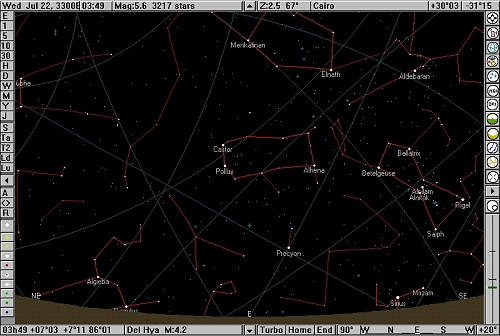
Plate 10: Rising of Sirius at sunset at the year 50 AD on the 25 December.
==============================


Curiously, the starry picture that is afforded is exactly the same as that seen in ancient Egypt in c. 3300 BC at DAWN when the 'birth' of Horus from the womb of Isis was celebrated by the heliacal rising of Sirius. Here is what an observer in Egypt would have witnessed:
================


At about 4 h 28 GMT, the sun begins to set in the west at 28 degrees N of W. Some 35 minutes later, at about 5 h 03 GMT, the sun has fully set in the west. In the east, at exactly the same time, Orion's belt sits on horizon, about 2 degrees S of E.


A further 51 minutes, at 5 h 54 GMT, the sun has gone down about - 10 degrees below the western horizon, and the sky is now dark enough to see the stars with the naked eye. Looking east at exactly the same time, the star Sirius is seen rising in the east (Orion's belt is now about 25 degrees higher up over the eastern horizon, giving the illusion that it has 'heralded' the rising of Sirius).


The celestial imagery, therefore, is that on the 25th December, right after sunset, the three stars of Orion's belt were seen rising in the east as if to 'herald' the coming of the birth-star Sirius, which followed about one hour after.


It would be very unlikely that such a powerful celestial sign which was known to denote the 'birth of the divine child' in Egypt since time immemorial would not have been unnoticed by the writer of the 'Matthew' Gospel. It seems evident that the introduction of a new divine child (Jesus) born from the Madonna (Mary) in Egypt and the Graeco-Roman world would benefit greatly by absorbing the older and very powerful mythology of Isis and her star, Sirius.


Plate 11: Madonna and Child (Leonardo Da Vinci)

Thus Isis and the child Horus were metamorphosed into the Madonna and child Jesus, and the star Sirius became the 'Star of the East' which the wise men saw and heralded the birth of Jesus. Much later, three wise men became known as the 'three kings' in Western tradition and, in keeping with stellar symbolism, they also became identified to the three stars of Orion's belt.


In his book Star Names: Their Lore and Meaning, the astronomer Richard H. Allen states that in European folklore the three stars in Orion's belt are often called the Magi or the Three Kings. And the Christian mythologist, Alvin Boyd Kuhn wrote:


"There is the legend of the 'Three Kings of the Orient' who came on Christmas to adorn the new-born God… from days of old the Three Kings were the three conspicuous stars in the belt of Orion… that so easily distinguishes this notable constellation… and their title was for long the Three Kings of Orion… They point almost in a direct line to the following…Sirius (which) was made in the type of Christ-soul in mankind. (Sirius) is preceded by the Three Kings who anticipate its coming (rising)…"


===========================

Kuhn then proceeds to give a variant of the popular Christmas carol:

"We three kings of Orion are,
bearing gifts we traverse afar,
fields and fountains, moors and mountains,
following yonder star…"

===========================

Today, in our modern calendar, we celebrate the changing of the New Year at midnight on the 31st December. It is a strange synchronicity that at exactly that time, for the year 1999 and 2000 the star Sirius reaches it culmination at the meridian.


The Egyptian authorities had planned to place a golden capstone on the summit of the Great Pyramid at midnight on the 31st December 1999, to mark the start of the new age. The idea was to have a 4 meters high pyramidion made of light metal covered with gold sheet lowered into place by a military helicopter, and laser beams reflected on its surface during a concert performed by French musician Jean-Michel Jarre.


This event, however, was cancelled at the last minute due to pressure from the Arab press which claimed a "Masonic" connotation with the glowing capstone seen on the US one-dollar bill.


The full implications of this curious affair are discussed in my new book, Secret Chamber (Century Books, 1999) and in an article entitled "The Great Pyramid and the Freemasons" (HERA magazine Issue 2 February 2000).


Plate 13: Artist's impression (courtesy : Ano Cero © )

Had the placing of the capstone ceremony taken place, the whole event would have been a spectacular "reunion" of Sirius and its symbol to mark the new millennium. For as seen from the north face of the Great Pyramid and in alignment with the North-South axis (i.e. along the meridian), the star Sirius would appear to hover on top of the summit of the pyramid at precisely midnight on the 31st December, as if to urge us that its principal symbol, the golden capstone, has been missing for far too long.


In many esoteric traditions the capstone of the Great Pyramid, and more especially its return to the summit of the Great Pyramid, will signal the return of the 'great initiate' which, according to some prophecies, such as those of Edgar Cayce, signifies the return of the Christ. Many have argued that the true start of the new millennium is, in fact, 31st December 2000.


If so, then the Egyptian authorities still have another opportunity to perform this powerful and evoking ceremony. What better signal than the ancient star of 'divine rebirth' seen hovering over the golden capstone on top of the Great Pyramid of Giza to symbolise the start of a new spiritual age for Humankind.


Plate 13: Sirius A and its "companion" Sirius B (the small spot to the left)


HOTEP*