A team led by a Cardiff University archaeologist has reconstructed a 3,000-year-old glass furnace, showing that Ancient Egyptian glass making methods were much more advanced than previously thought.
The reconstructed kiln built by Dr. Paul Nicholson of Cardiff University and Dr. Caroline Jackson of Sheffield University. (Credit: Cardiff University)
Dr Paul Nicholson, of the University's School of History and Archaeology, is leader of an Egypt Exploration Society team working on the earliest fully excavated glassmaking site in the world.
The site, at Amarna, on the banks of the Nile, dates back to the reign of Akhanaten (1352 - 1336 B.C.), just a few years before the rule of Tutankhamun.
It was previously thought that the Ancient Egyptians may have imported their glass from the Near East at around this time. However, the excavation team believes the evidence from Amarna shows they were making it themselves, possibly in a single stage operation.
Dr Nicholson and his colleague Dr Caroline Jackson of Sheffield University demonstrated this was possible, using local sand to produce a glass ingot from their own experimental reconstruction of a furnace near the site.
The team have also discovered that the glass works was part of an industrial complex which involved a number of other high temperature manufacturing processes.
The site also contained a potter's workshop and facilities for making blue pigment and faience - a material used in amulets and architectural inlays.
The site was near one of the main temples at Amarna and may have been used to produce materials in state buildings.
Dr Nicholson, who has been working at Amarna since 1983, said: "It has been argued that the Egyptians imported their glass and worked it into the artifacts that have been discovered from this time.
I believe there is now enough evidence to show that skilled craftsmen could make their own glass and were probably involved in a range of other manufacturing industries as well."
Dr Nicholson has now written a book detailing the discoveries made at Amarna.
Entitled Brilliant Things for Akhenaten, it is published by the Egypt Exploration Society (London) and available through Oxbow Books in the UK and The David Brown Book Company in the USA.
The Blue Lotus is Victory of Spirit over the senses. It signifies Wisdom of Knowledge. In various parts of the world, it has been a symbol of fertility, sunlight, transcendence, beauty and above all "Purity". The Lotus is one of the most ancient and deepest symbols of the planet. The sun-god who formed himself from chaos of Nun emerged from the Lotus petals as Ra. The forth Dynasty Egyptians greatly valued the "Sacred Lotus".
KEMETIC SCIENCE
Positive Progress Through The Benevolent Use Of Knowledge
Wednesday, May 4, 2011
Thursday, April 21, 2011
ANCIENT KMT STAR OF BETHLEHEM
STAR OF THE NILE
The brightest of all the fixed stars is Sirius. Known to astronomers as Alpha Canis Major, it is the principal star of the constellation Canis Major (the Big Dog). The ancient Egyptians called it Septit, the Hebrews knew it as Sihor, to the Greeks as Sothis and also as the "the Dog Star" that followed Orion the Hunter. Sirius has a magnitude of -1.42, which makes it nine times more brilliant than a standard first magnitude star. It can even been seen in daylight with a telescope having an aperture of 12 mm.
Plate 1: The star Sirius A in Canis Major
Its colour is a brilliant white with a tinge of blue and purple. Sometimes when atmospheric conditions are right, Sirius will scintillate with all the colours of the rainbow when seen low on the horizon. Classified as a type 'A1' star, Sirius is 23 times as bright as our sun and has almost twice its diameter. Being only 8.7 light-years away, Sirius is the fifth nearest star to our solar system, and the nearest after Alpha Centauri among the naked eye stars.
Because of this, Sirius has a very high apparent proper motion of -1.21 arc seconds per year. Some 100,000 years ago it was near Cancer on the 'east' side of the Milky Way. Since then it has crossed the Milky Way and now rests on its 'west' bank. In the last 2000 years, for example, the position of Sirius has shifted some 45 arc minutes (almost half a degree) which is about one-and-a-half times the apparent size of the moon.
Plate 2: Sky region of the Duat
Throughout recorded history, and probably long before, Sirius was the subject of much veneration and myth making throughout the world. Even as late as the 1970s it became the subject of a very controversial theory linked to extra-terrestrials and the Dogon tribe of Mali published by the scholar and author Robert Temple.
There is much speculation on the origin of its modern name which is generally thought to be derived from the Greek word "Sirio" meaning "scorching" or "sparkling", apparently because it rose in the height of the summer heat. Some etymologists, however, have suggested a connection with the ancient Egyptian god Osiris. But of all the various names and epithets that this star was given, none can match the notoriety of its role in history as the "Star of Isis".
Since earliest times the ancient Egyptian paid particular attention to Sirius, which they identified to the 'soul' of the Goddess Isis. There was a time, very long ago, that Sirius could not be seen in the sky from Egypt. This was because of a phenomenon known as the Precession of the Equinoxes.
The Precession is a very slow wobble of our planet taking the polar axis of the Earth in a circular swing of 47 degrees every 26,000 years. The general effect is that the stellar landscape appears to swing up and down like a pendulum. Before the 12th millennium BC Sirius was below the horizon line as seen from the region of Cairo/Giza. It made its first appearance in the skies at that place in c.10,500 BC.
Then it had a declination of about 58 degrees 43', which meant it would have just been visible in the south about 1.5 degree above the horizon line. For early man to witnessing the 'birth' of such a bright star must have been a very impressive sight rich with meaning and messages from the gods. Also the rising of Sirius occurred when the constellation of Virgo was rising in the east, which may partly explain why the star became the symbol of a virgin-goddess. We do not know when exactly Sirius became identified to the goddess Isis, but the idea certainly goes back to the origin of Egyptian culture. It was from the 'womb' of Isis-Sirius that was born the divine child, Horus.
Plate 3: Isis and the Child Horus
The conception and birth of Horus occurred in a magical way as told in the myth of Isis and Osiris:
"HORUS WHO IS IN SIRIUS"
Isis and Osiris were among the four children born from the womb of the sky-goddess, Nut and fathered by Ra, the sungod. The other two children were Seth and Nephtys. Osiris took Isis as his wife, and they became the first rulers of Egypt. At the age of 28 Osiris was brutally killed by his jealous brother Seth and his body cut into fourteen pieces.
Isis recovered all of the pieces of Osiris' body except the phallus, which she could not find. Isis fashioned an artificial phallus for Osiris, placed herself on it in the form of a kite, and became pregnant with his seed. She then went into hiding in the marshes of the Nile, and gave birth to Horus. From the Pyramid Texts and various other religious writings, it is clear that this myth has its counterpart in the stars, with Isis identified to Sirius and Osiris to the constellation of Orion. In the Pyramid Texts it is said of Osiris-Orion:
"Your sister Isis comes to you rejoicing for love of you. You have placed her on your phallus and your seed issues in her, she being ready as Sirius, and Horus Sopd (a star) has come forth from you as Horus who is in Sirius…" [Pyr. Text line 632]
Plate 4: Sirius-Isis following Orion-Osiris
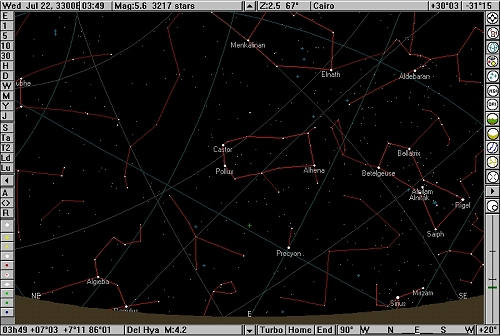
Recreating the ancient skies of the early Dynastic Era (c.3300 BC) which took place just before the great Pyramid Age (c.2750 - 2100 BC) we find that the star Sirius performed a very evocative cycle in the heavens which readily explains why it was associated to a magical birth.
Because the earth moves around the sun, the fixed background of the stars appears to shift throughout the year in relation to the sun. Yearly observations of Sirius, for example, would show that there is a time when the star sets in the west immediately after sunset. After that the star is no longer visible for a period of about 70 days.
It will reappear again, however, just before sunrise in the east. This reappearance is known as the heliacal rising of the star. In c. 3300 BC the heliacal rising of Sirius occurred exactly on the day of the summer solstice (21 June Gregorian). Precession has since caused that date to shift 45 days, and now the heliacal rising of Sirius occurs on the 5th August.
The striking conjunction of the heliacal rising of Sirius and the summer solstice in 3300 BC was, in itself, a powerful omen; but there was something else also occurring at the same time which, quite literally, caused the whole of Egypt to be reborn. This was the annual flooding of the Nile. Since the construction of the Aswan Dam in the 1960s, the annual flood of the Nile is fully controlled and regulated. But in ancient times (and until the turn of the late 19th century) the Nile would begin to swell in early June caused by the huge volume of water brought down river by the melting snows in the highlands of Central Africa.
By late June the water would begin to spill over the banks to eventually flood the whole Nile Valley by end July. We know for certain that the ancient Egyptians considered the heliacal rising of Sirius to be the magical cause of the Nile Flood. The heliacal rising of Sirius became the celestial sign that marked the beginning of the New Year. There are many ancient texts which refer to the conjunction of the 'New Year', the summer solstice, the start of the Flood and the appearance of Sirius which shows that this event was of the utmost importance to the Egyptians.
The oldest of these texts is carved on a small ivory tablet dated to the 1st Dynasty (c. 3100 BC) where it is said that "Sirius is the Opener of the Year's Flood". The very same notion is given in the Pyramid Texts (c. 2200 BC), where it is stated that: "It is Sirius, the beloved daughter (of Ra, the Sun-god), who prepares yearly sustenance (the flood) for you in her name of 'Year'". In his book Echoes of Ancient Skies, the archaeo-astronomer Dr. Ed Krupp writes that,
"After disappearing from the night sky (for 70 days) Sirius eventually reappears in the dawn, before the sun come up. The first time this occurs each year is called the star's heliacal rising, and on this day Sirius remains visible for only a short time before the sky gets too bright to see it. In ancient Egypt this annual reappearance of Sirius fell close to the summer solstice and coincided with the time of the Nile's inundation. Isis, as Sirius, was the 'Mistress of the Year's beginning', for the Egyptian new year was set by this event. New Year's ceremony texts at Dendera say Isis coaxes out the Nile and causes it to swell.
The metaphor is astronomical, hydraulic, and sexual, and it parallels the function of Isis in the myth. Sirius revives the Nile just as Isis revives Osiris. Her time in hiding from Seth is when Sirius is gone (70 days) from the night sky. She (Isis) gives birth to her son Horus, as Sirius gives birth to the new year, and in the texts Horus and the new year are equated. She is the vehicle for renewal of life and order. Shining for a moment, one morning in summer, she stimulates the Nile and starts the year."
SIRIUS AND THE GREAT PYRAMID
==========================
It is known that on the east of the Great Pyramid once stood a building called the 'temple of Isis'. On the Inventory Stella dated to the 26th Dynasty, Isis is called "Mistress of the Pyramid". It is also possible that the capstone that once stood on the summit of this monument may have been associated in some way to Isis and Sirius.
It has often been suggested that the Fifth Division of the Duat (afterworld) depicted in the Book of the Dead showing a giant double-sphinx guarding a huge pyramid may be a stylised representation of the Giza necropolis. If so, then an interesting association can be made, for the pyramid of the Fifth Division shows the 'Face of Isis' on the summit instead of the capstone.
Plate 5: Fifth Division of the Duat
(compare with Giza necropolis viewed from South-east)
Perhaps more convincing is the Egyptian name of Sirius itself, or rather the way it is written with three hieroglyphic signs, a five-pointed star, a half-circle and a small pointed triangle. According to E.C. Krupp:
"One last peculiarity of the Egyptian treatment of Sirius appears to link it, through the cult of Osiris, to the Pyramids. The hieroglyphic inscription of Sirius:
includes an obvious symbol of a star and two other symbols that may be related to the Benben. The half circle was used to signify the Benben. The long, thin triangle is most reminiscent of a pyramid, or perhaps an obelisk… Just as the Benben symbolised the emergence of existence from non-existence, of the birth of the world, so Sirius, as the Bennu (Phoenix), recommemorated creation by alighting upon the Benben, be it obelisk, observation platform or pyramid…"
The Benben which Krupp is referring to was a very sacred stone that was once kept in the 'Temple of the Phoenix' at Heliopolis and which served as a model for the capstones of monumental pyramids and obelisks, also called Benbens.
Plate 6: The Benben (pyramidion) of Amenemhet III (Cairo Museum)
==========================================
The 'Benben' (pyramidion) of the Great Pyramid has been missing since recorded history, and we cannot tell what it really looked like. It was probably made of black granite and covered with gold, possibly to symbolise the star. But perhaps the most convincing connection between the Great Pyramid and the star Sirius come from the interior design system of the pyramid.
From each of the two main chambers of the Great Pyramid i.e. the King's Chamber and the Queen's Chamber, emanate two long and narrow shafts, one going due north and the other going due south. It has been known since 1964 that these shafts had astronomical alignments to the stars when the pyramid was completed in c. 2500 BC.
Those of the King's Chamber were directed to the Pole Star Alpha Draconis (Thuban) in the north, and to the three stars of Orion's belt in the south. Over twenty years later, in 1987 I discovered that the southern shaft of the Queen's Chamber was directed to Sirius. Such associations between the Great Pyramid and Sirius is not surprising, as the pyramid was almost certainly the agency of astral rebirth of the pharaonic cult modeled on the myth of Osiris and Isis.
Plate 7: The Star shafts of the Great Pyramid (N-S cross section)
============================================
THE CHANGING SKY
===============
Throughout the ancient Egyptian civilisation the celebration of the birth of the divine child, Horus, from the womb of the goddess Isis was commemorated at the opening of the New Year when the star Sirius rose heliacally at dawn. But because of the effect of precession, the event shifted along the calendar at approximately the rate of 8.5 days every 1000 years. In 3300 BC the heliacal rising of Sirius occurred on the 21 June (Gregorian) as seen from Giza.
When Jesus was born the heliacal rising of Sirius occurred on the 19 July, and today it occurs on the 5 August. Some three hundred years before the birth of Jesus, Egypt had fallen under the rule of the so-called Ptolemys, Greek-pharaohs who ruled Egypt from 305 BC until 30 BC, the last being Queen Cleopatra VII. During this period the capital city of Egypt moved to Alexandria, where the pseudo-Egyptian cult of Sarapis was installed. Sarapis was a synthetic god modeled on the Egyptian god Asar-Hapi (Osiris-Apis), a name meaning 'Osiris of the Nile'.
Isis, quite naturally, became the consort of Sarapis and her cult flourished in Alexandria and the whole Mediterranean basin. It was adopted by many of the Roman legions and, through them, found its way into Western Europe. Temples of Isis have been found in Italy, France, Germany and as far as Oxford in England. Along with the cult of Isis also spread the celebration of the birth of Horus, called Hapocrates by the Greeks and identified to Apollo and Sol Invictus by the Romans. This event, as we have said, associated by the rising of the birth-star Sirius in the east at dawn.
Interestingly, when Julius Caesar introduced the so-called Julian Calendar, it was the Alexandrian astronomer Sosigenes who converted for Caesar the old lunar calendar into a solar one. There can be little doubt that Sosigenes borrowed the idea from the Egyptians, who had a solar calendar since at least 3300 BC.
This calendar, as we have seen, fixed the New Year with the heliacal rising of Sirius which, in Sosigenes' epoch, began in the month of 'July' and this, I would imagine, is probably why this particular month was named after Julius Caesar. His famous consort, the Egyptian Queen Cleopatra, was also a high priestess of Isis and Caesar dedicated in her honour a temple in the Rome Forum.
After the death of Cleopatra in 30 BC, Egypt became a Roman province, where there was a large Greek and Roman community in Alexandria as, more importantly, a great number of Jews who had fled Judea. With the rise of the newly formed Christianity in Egypt, the ancient mystery cult of the pharaohs that had mingled with those of the Greek and Romans, now also mingled with the Judeo-Christian ideologies.
Plate 8: Roman Isis and the child Horus (20 BC)
========================================
The basic tenets of these older mystery cults rested on the belief that "immortality" was achieved through the initiatory teachings of a "dying-resurrecting Son of God" and the symbolic re-enactment of his 'death' and 'rebirth'.
The Phoenician Adonis, the Phrygian Attis, the Egyptian Osiris and the Alexandrian Sarapis, were all contenders for such a doctrine. The Romans furthermore had imported into Egypt the mystery cult of Mithras who also was a "dying-resurrecting Son of God" and, more intriguingly, whose 'birthday" was celebrated at sunset on the 25th December.
It is no wonder, therefore, that the early Christian community also celebrated the 'birth' of their own dying and resurrecting 'Son of God', Jesus, on the 25th December and with the idea of a nativity 'star in the east' to mark this supernatural event. But which star?
THE MADONNA AND CHILD
================
It is a strange peculiarity among the four canonical gospels that only one of them, the Gospel of Matthew, speaks of the birth of Jesus in relation to the appearance of a star in the east and the Magi. The Gospel of Matthew is also unique in its narrative of the 'flight into Egypt' by the Holy Family. But if these event are historically true, then why are the other Gospels so conspicuously silent on such a crucial and important event in the birth of the Messiah? Could it be that the event was not 'historical' at all but mythical?
It has long been believed by scholars that the 'Matthew' Gospel was probably written between 40 and 80 AD in the city of Alexandria in Egypt. Now in Alexandria at the time of the writing of the 'Matthew' Gospel, the celebration of the new day and the new year were not anymore observed at dawn but at sunset to conform with both the Judeo-Christian tradition and Roman traditions of marking such events at sunset. In consideration of this, let us examine the sky at sunset looking east on the 25th December in c. 50 AD (the average date for the writing of the 'Matthew' Gospel) as seen from the latitude of Alexandria.
Plate 9: Heliacal Rising of Sirius at about one hour
before sunrise at the year 3300 BC on the Summer Solstice
================================
Plate 10: Rising of Sirius at sunset at the year 50 AD on the 25 December.
==============================
Curiously, the starry picture that is afforded is exactly the same as that seen in ancient Egypt in c. 3300 BC at DAWN when the 'birth' of Horus from the womb of Isis was celebrated by the heliacal rising of Sirius. Here is what an observer in Egypt would have witnessed:
================
At about 4 h 28 GMT, the sun begins to set in the west at 28 degrees N of W. Some 35 minutes later, at about 5 h 03 GMT, the sun has fully set in the west. In the east, at exactly the same time, Orion's belt sits on horizon, about 2 degrees S of E.
A further 51 minutes, at 5 h 54 GMT, the sun has gone down about - 10 degrees below the western horizon, and the sky is now dark enough to see the stars with the naked eye. Looking east at exactly the same time, the star Sirius is seen rising in the east (Orion's belt is now about 25 degrees higher up over the eastern horizon, giving the illusion that it has 'heralded' the rising of Sirius).
The celestial imagery, therefore, is that on the 25th December, right after sunset, the three stars of Orion's belt were seen rising in the east as if to 'herald' the coming of the birth-star Sirius, which followed about one hour after.
It would be very unlikely that such a powerful celestial sign which was known to denote the 'birth of the divine child' in Egypt since time immemorial would not have been unnoticed by the writer of the 'Matthew' Gospel. It seems evident that the introduction of a new divine child (Jesus) born from the Madonna (Mary) in Egypt and the Graeco-Roman world would benefit greatly by absorbing the older and very powerful mythology of Isis and her star, Sirius.
Plate 11: Madonna and Child (Leonardo Da Vinci)
Thus Isis and the child Horus were metamorphosed into the Madonna and child Jesus, and the star Sirius became the 'Star of the East' which the wise men saw and heralded the birth of Jesus. Much later, three wise men became known as the 'three kings' in Western tradition and, in keeping with stellar symbolism, they also became identified to the three stars of Orion's belt.
In his book Star Names: Their Lore and Meaning, the astronomer Richard H. Allen states that in European folklore the three stars in Orion's belt are often called the Magi or the Three Kings. And the Christian mythologist, Alvin Boyd Kuhn wrote:
"There is the legend of the 'Three Kings of the Orient' who came on Christmas to adorn the new-born God… from days of old the Three Kings were the three conspicuous stars in the belt of Orion… that so easily distinguishes this notable constellation… and their title was for long the Three Kings of Orion… They point almost in a direct line to the following…Sirius (which) was made in the type of Christ-soul in mankind. (Sirius) is preceded by the Three Kings who anticipate its coming (rising)…"
===========================
Kuhn then proceeds to give a variant of the popular Christmas carol:
"We three kings of Orion are,
bearing gifts we traverse afar,
fields and fountains, moors and mountains,
following yonder star…"
===========================
Today, in our modern calendar, we celebrate the changing of the New Year at midnight on the 31st December. It is a strange synchronicity that at exactly that time, for the year 1999 and 2000 the star Sirius reaches it culmination at the meridian.
The Egyptian authorities had planned to place a golden capstone on the summit of the Great Pyramid at midnight on the 31st December 1999, to mark the start of the new age. The idea was to have a 4 meters high pyramidion made of light metal covered with gold sheet lowered into place by a military helicopter, and laser beams reflected on its surface during a concert performed by French musician Jean-Michel Jarre.
This event, however, was cancelled at the last minute due to pressure from the Arab press which claimed a "Masonic" connotation with the glowing capstone seen on the US one-dollar bill.
The full implications of this curious affair are discussed in my new book, Secret Chamber (Century Books, 1999) and in an article entitled "The Great Pyramid and the Freemasons" (HERA magazine Issue 2 February 2000).
Plate 13: Artist's impression (courtesy : Ano Cero © )
Had the placing of the capstone ceremony taken place, the whole event would have been a spectacular "reunion" of Sirius and its symbol to mark the new millennium. For as seen from the north face of the Great Pyramid and in alignment with the North-South axis (i.e. along the meridian), the star Sirius would appear to hover on top of the summit of the pyramid at precisely midnight on the 31st December, as if to urge us that its principal symbol, the golden capstone, has been missing for far too long.
In many esoteric traditions the capstone of the Great Pyramid, and more especially its return to the summit of the Great Pyramid, will signal the return of the 'great initiate' which, according to some prophecies, such as those of Edgar Cayce, signifies the return of the Christ. Many have argued that the true start of the new millennium is, in fact, 31st December 2000.
If so, then the Egyptian authorities still have another opportunity to perform this powerful and evoking ceremony. What better signal than the ancient star of 'divine rebirth' seen hovering over the golden capstone on top of the Great Pyramid of Giza to symbolise the start of a new spiritual age for Humankind.
Plate 13: Sirius A and its "companion" Sirius B (the small spot to the left)
HOTEP*
Sunday, March 27, 2011
Exact Date Pinned to Great Pyramid's Construction?
Andrew Bossone in Cairo
for National Geographic News
The Egyptians started building the Great Pyramid of Giza on August 23, 2470 B.C., according to controversial new research that attempts to place an exact date on the start of the ancient construction project.
======================
A team of Egyptian researchers arrived at the date based on calculations of historical appearances of the star Sothis—today called Sirius.
Every year around the time of the Nile River floods, Sothis would rise in the early morning sky after a long absence.
"The appearance of this star indicates the beginning of an inundation period" for the Nile, said team leader Abdel-Halim Nur El-Din, former head of Egypt's Supreme Council of Antiquities.
Throughout their history, "Egyptians … started their main buildings, the tombs, and the temples at the beginning of the inundation"—an auspicious time, since floodwaters brought fresh soil, maintaining the region's fertility.
In addition, pharaohs always started building their tombs at the starts of their rules. Khufu, the pharaoh meant to be buried in the Great Pyramid, took power in 2470 B.C., according to Nur El-Din and colleagues.
The researchers therefore compared the modern calendar, the ancient Egyptian calendar, and the cycle of the star to find the exact day Sothis would have appeared that year.
The team believes the ancient Egyptians observed the star from July 17 to 19, and the inundation period began 35 days later—on August 23.
Pharaohs Reset the Clock
Using Sothis's arrival to keep track of the annual Nile floods made sense, said Mark Hammergren, an astronomer at the Adler Planetarium in Chicago who was not involved in the work.
"It happens at about the same time every solar year, so it corresponds to the seasons, and it provides them a good fixed date," he said.
Hammergren agrees with the days Nur El-Din's team calculated for Sothis, based on other researchers' estimates for the dates the star would have risen during ancient Egyptian times.
the "appearance" of the star is subject to weather conditions, which might have obscured its first rise in any given year.
Mahmoud Afifi, the general director of Giza antiquities, is also concerned about placing an exact year on the start of Khufu's rule.
Ancient Egyptian chronology reset to zero at the beginning of each pharaoh's reign, making it difficult to match Western calendar years with the dates given for ancient events.
What's more, dated lists of kings are unreliable, since the ancient Egyptians often had political motivations to alter the historical record.
Some unpopular pharaohs could have been left off the lists, for example, which would have changed the ruling dates of every pharaoh that followed.
Many scholars debate the precise year Khufu ascended to the throne, with some estimates as much as 139 years earlier than the date Nur El-Din and his team selected.
In addition, the design of the monumental Great Pyramid probably took considerable time to prepare, Afifi said, which might have delayed the start of construction beyond the first year of Khufu's reign.
Saturday, March 19, 2011
Mayan 2012 And Quetzalcoatl Egypt Astronomy
The Mayans.
The Mayans developed astronomy to the point where they could predict eclipses hundreds of years in the future. Their legends say they obtained their astronomical wisdom from the Olmecs. Little is known about the Olmecs, though traces of their culture have been found dating to about 2000 B.C.E. A Mayan stone calendar is shown at left.
Diagram 1:
The sky on December 21st, 2012 A.D. showing a rare astronomical alignment -the winter solstice sun is right in the "dark rift" in the Milky Way.
This is a feature of the Milky Way anyone can see on a clear midsummer’s night, away from the light pollution of industrial society. At dawn on the winter solstice of A.D. 2012, the sun will be right in this dark-rift, and the orientation is such that the Milky Way rims the horizon at all points around.
Thus, the Milky Way "sits" on the earth, touching it at all points around, opening up the cosmic sky portal. The galactic and solar planes are thus aligned. "Sky portal" is just a term to describe the "opened sky" scenario apparent when the Milky Way rims the horizon. This is not to be confused with the "dark-rift" itself.
In Mayan myth, the winter solstice sun corresponds to the deity One Hunahpu, also known as First Father. The Mayan Sacred Book, the Popol Vuh, is all about setting the stage so that the Hero Twins’ father (One Hunahpu) can be reborn, thus beginning a new World Age.
The dark rift has many mythic identities: it is the Black Road; it is the xibalba be (the Road to the Underworld); it is a crevice in the branches of the cosmic tree (the Milky Way); it is the mouth of the Cosmic Monster (often portrayed as a frog, jaguar or snake with tree-like features); it is the birth canal of the Cosmic Mother.
Overall, the dark-rift is best understood as the birth canal of the Cosmic Mother, who we may call First Mother, to complement First Father. In this way we can trace how these various metaphors are found in Mayan Creation Mythology. And the date of this alignment is, again, the end date of the 13-baktun Great Cycle - a cycle of approximately 5125 years.
Earth's Wobble
==============
The slow process by which the winter solstice sun comes to conjoin the dark-rift in the Milky Way is a function of a phenomenon known as the precession of the equinoxes.
This involves the slow wobbling of the earth’s axis, which causes the stellar frame to slowly shift. To observers on earth, it causes the position of the winter solstice sun to slowly move in relation to celestial background features such as the Milky Way. A full cycle is completed in roughly 26,000 years.
Approximately 2100 years ago, when both the Long Count calendar and the Popol Vuh were devised by the early Maya, the dark-rift in the Milky Way could be observed some 30 degrees above the dawning winter solstice sun
Diagram 2:
Winter solstice sunrise from the early Mayan site of Izapa,
50 B.C. Notice the dark rift in the Milky Way, the
celestial birth canal of Cosmic Mother, some 30 degrees above the rising sun.
When these early skywatchers discovered precession, they realized that every winter solstice the cosmic birth canal was moving closer and closer to the dawning sun.
The winter solstice sun was called the First Sun, the First Lord or First Father, because it is the first day of the year, the beginning of the sun’s annual rebirth into increasing daylight. They calibrated the process, and fixed their Creation Mythology to the future alignment as described.
Monuments from the early Mayan site of Izapa clearly portray, by way of mythological iconography, the anticipated astronomical alignment of the Long Count end date. In this way, the Long Count calendar and Popol Vuh Creation Mythology work together to describe the future astronomical alignment.
Diagram 3:
Stela 11 from Izapa shows Cosmic Father in the "mouth" of Cosmic Mother, the "dark rift" or "birth canal" in the Milky Way. This is an image of the celestial alignment which culminates in A.D. 2012.
The irony, perhaps, is that the impending solstice-galaxy alignment was first mentioned back in 1969 in Giorgio de Santillana and Hertha von Dechend’s groundbreaking book Hamlet’s Mill.
the astronomical alignment itself (which targets the opening of the new millennium) and the established end-date of the Mayan Calendar in A.D. 2012.
The ancient Maya apparently understood that the future alignment would have apocalyptic effects, and designed their World Age mythology to remind us of something essential. Myth, legend, or ancient message, whatever it is, clearly, it means we must all remember where we come from, where everything comes from: Mother.
====================
The Mayans and Aztecs have a legend of learning great things from a bearded "white man" who came to them sometime after 500 B.C.E. The Aztecs named him Quetzalcoatl, which means "Plumed Serpent.
There is some speculation that Quetzalcoatl could have come from Egypt, and that the "Plumed Serpent" represented the cobra with its hood expanded.
Mayan legend says that the Yucatan was originally inhabited by "people of the serpent," and their leader's name was "Serpent of the East." Mayans claimed that they got their writing from the Tula, and that their leaders sailed over the sea to the East to learn their wisdom.
Ancient Cosmology Points To Our Immediate Future
Based upon these simple facts, ancient skywatchers in Mesoamerica were apparently aware of a subtle celestial process, the precession of the equinoxes.
Knowledge of that process, and the fact that a major alignment in that process culminates at the end of their Great Cycle, strongly suggest a cosmological understanding which modern scholars have yet to explore. While today the conjunction is hidden behind the rays of the solstice sun, to early skywatchers the future convergence would have been the focus of intense calendar calculations and eschatological myth-making.
Mayans counted using a base 20 system. Their numbers used three symbols: a sea shell for zero, a dot for one, and a bar for five. They also had a small curved symbol that served as a filler around a small number of dots, for aesthetics.
====================
The Mayan Long Calendar. The Mayan timeline began on 13 August 3114 B.C.E. (very near the start of the Egyptian Old Kingdom). This is the starting point of the Mayan Long Calendar. The time divisions in the long calendar were:
1 kin = 1 day
20 kins = unial (20 days)
18 unials = tun (360 days)
20 tuns = katun (7200 days)
20 katuns = baktun (144,000 days, about 394.25 years)
13 baktuns = a Great Cycle (1,872,000 days, about 5,125.25 years)
A Great Cycle, or Age, is also known as a "Sun." Their legends state that at the end of each Sun there is a catastrophe, followed by a renewal. They count time in a cycle of five Suns, which therefore spans 9,360,000 days, or about 25,627 years. Some cite this Five Sun cycle as evidence of Mayan knowledge of precession of the equinoxes.
Mayans believed that we are currently in the Fifth Great Cycle, which will end, and a new First Sun begin, on 23 December 2012. Popular literature abounds with speculation on this event, and its near-coinciding with ecliptic crossing to the north of the Solar System's orbit around the Galatic Center.
The Mayan Vague Year Calendar (Haab). Mayans knew that the length of the Solar Year was about 365.25 days long but, like the Egyptians, they used a calendar of 365 days and did not use leap years. Because this calendar does not follow the true Solar Year, is is referred to as the Vague Year calendar, or Haab.
The Vague Year Calendar is divided into 20 months of 18 days each (360 days total), followed by a five-day period. The days of the month are numbered from 0 to 19. Each month is named after a Mayan god. These are:
Pop
Wo
Sip
Sots'
Sek
Xul
Yaxk'in
Mol
Ch'en
Yax
Sak
Keh
Mak
K'ank'in
Muwan
Pax
K'ayab
Kumk'u
Wayeb
—
The Mayan Ritual Calendar (Tzolkin). The third Mayan calendar was the Ritual Calendar, or Tzolkin, which had 13 months of 20 days each (260 days total). This 260-day cycle was related to the period of Venus. They Mayans knew that he Evening Star and the Morning Star were the same object, Venus, and had accurate tables of the planet's motion. The 20 days were named as follows:
Imix
Ik
Akbal
Kan
Chicchan
Cimi
Manik
Lamat
Muluc
Oc
Chuen
Eb
Ben
Ix
Men
Cib
Caban
Etz'nab
Cauac
Ahau
The numbers 1 through 13 increased along with the days. So for example the first day in the cycle was 1 Imix, the second was 2 Ik, and so on. After 260 days, every combination of name and number (1-13) would repeat.
The Mayan "Calendar Round." Every 52 years, the Vague Calendar and the Ritual Almanac coincide at the same beginning day. The Mayans called this a Calendar Round. They considered this an auspicious time, where the old would end and the new would begin. They rebuilt houses, refaced templed, and performed other such acts on this day. This custom has allowed us to accurately estimate the ages of many of their temples.
Mayans followed a longer cycle of 22 Calendar Rounds, consisting of 13 Heavens (the first 13 Calendar Rounds) followed by 9 Hells (the last 9 Calendar Rounds). The last cycle completed in 1987, placing us now in the first Heaven.
Lost Mayan Culture. Today, much of the ancient Mayan culture is lost forever. Their beliefs conflicted in many ways with the Roman Catholic Church, and the first Archbishop of Mexico claimed to have burned tens of thousands of Mayan books in the 1500s. Apart from remaining temple inscriptions, only four books remain today as the remnant of this ancient culture: the Dresden Codex, the Grolier Codex, the Madrid Codex, and the Paris Codex.
=======================================
ref: History Of Astronomy - The Mayans
Spirit Of Sankofa*
Sunday, February 20, 2011
Science of the Pharaohs
Mathematics
Measurements
Astronomy
Medical Composition
Magic
Agriculture
The scientific subjects that concerned the ancient Egyptian were confined to mathematics, medicine, chemistry, and astrology.
What we found shows the development and progress the ancient Egyptian achieved in these sciences. Accuracy was the most important characteristic, in addition to science that enabled him to build lofty edifice on scientific basis.
Mathematics:
What we found consisted of mathematical problems and exercises and its ideal solutions, but we found neither theories nor rules. For instance what we found in some papyruses such as in “ Rand’s Papyrus ” where there was a table to divide odd numbers on 2 and some mathematical.
Problems:
A circular piece of land its circumference is 9 khit (carat) find its area?
A circular vessel of 9 cubit height and 6 cubit circumference, what is the quantity of grains that fill it?
Measurements:
The standard dry measure was Bushel (a measure of grains equals 8 gallons nearly i.e. 32½ liters). As for liquid measure there were other measures of different names, but they did not match any measures that are used now.
To measure the length they used two kinds the first is the Royal cubit (long) which equals 52.3 cm and it was used in architecture, the second is the ordinary cubit (short) which equals 45 cm.
For distances they used a unit called fluvial unit equals 10305 km (20, 000 cubit).
Areas and weights:
Area unit is “ mest gat ” = 100 square cubit.
(⅔ Acre, acre = 4000 square meter).
Weight unit is “ dubn ” = 91 grams.
Time Measurement:
Time was measured by years, and the year was divided into 12 months, every month was 30 days, and the month was three weeks 10 days each. The year was divided into three seasons each was four months: - flood season, winter, and summer.
The length of an hour varied according to the seasons. To measure time they used sundials and water glasses which were accompanied by a graduation to set the length of an hour according to the months.
At the end of the year 5 complementary days were added so that the days of the year were 365 days. The day was 24 hours divided equally into day and night. The day was twenty four hours divided equally into day and night. The length of an hour varied according to the seasons.
To measure time they used sundials and water glasses which were accompanied by a graduation to set the length of an hour according to the month.
Astronomy:
The Egyptians were concerned about studying astronomy and due to the dry climate of Egypt and to the absence of fogs except rarely, the study of the skies was easy. The positions of the groups and the orbits of the plants were known because the observation processes began in as early time.
The most two important groups of stars were:
First: The Great Bear seven stars and they were known as the immortal stars.
Second: the Arion (Saho) group and it was worshipped.
The most important star they knew was (Sirus) or (Sotis) because its appearance was a sign of the flood. Its appearance was celebrated at dawn in summer as a religious feast.
This star was considered Isis’ soul and there is a fable that says that the tears shed by Isis on the anniversary of her husband’s Osiris death were the source of the flood.
Texts were found on tombs from the mirth dynasty and these texts were known by diametrical calendar or the diametrical star clock, these texts were given the names of the “ dicons ”
i.e. the stars that appear every 10 days at the time of the rising of the sun and they counted 36 stars of it. The texts were put on the tomb to help the dead distinguish the day from the night.
These texts developed and became more accurate as in Ramsis’ the sixth tomb. In the tombs of some of the kings of the modern state we found a statue of a sitting man who has a net of stars.
Also we found in the attached texts, concerned with the first and the sixth day or every month, the position of the stars in every hour: a star over the left ear then a star over the right ear and etc.
As for the position of the Zodiac it joined the Egyptian astronomy in the Ptolemaic and the Greek era.
Concerning the year and its length astronomers eliminated the lunar year which consisted of 360 days yet they preserved the division of the year into 12 months each of 30 days then they added 5 false days to make the year correspond with the feats of astronomy.
During the harmonic era there were 2 calendars: The civil calendar (the formal) and the solar calendar (The astronomic).
In the formal calendar the year consisted of 365 days and there were no leap years, this means that the year missed a day every four years. This calendar (in respect to Julius Caesar) on the 19th of June.
As for the astronomic calendar (the solon) it consisted of 365 ¼ days therefore by the passage of the time a day was added every 4 years to the calendar and this the formal year (the civilian) precedes the astronomic year by a month every 120 years, and the two calendars correspond every 1460 years for four days.
The astronomic calendar was used in agriculture and appointing the religious feasts. One of the Greeks called Censorious deduced two dates in two years in which a simultaneous rising of Sirius and the sun happened during the days of the pharaohs, and we reached texts which tell us the days of the rising of Sirius.
The importance of these texts lies in determining the periods of the rule of the kings during whose role a rising of the star Sirius.
Medical Composition:
It is well known that the ancient Egyptians worked with medicine and anatomizing the human body and as well treated a lot of diseases compositions we found were written on papyrus and three of them go back to the time of the twelfth family and they are of the oldest papyri.
Some of these compositions were written in hieroglyphic and not in Hieratic as usual (this shows that it was made up before it was written by a long time). One dealt with the hard limbs and another contained amulets and prescriptions for the pregnant and the nursing woman.
I respite of what the ancient Egyptians had reached in medicine, magic was from the essential matters in treat neat for them. They believed that most of the diseases were caused by the devils, thus medicine was used along with the amulets.
Medicines contained bloods and fats of the animals, herbs, honey, and known liquids. They also made ointments and it was mixed with honey or with the fats of the animals like geese fat.
The Egyptians practiced surgery and were excelled at it but they did not recourse to it except for treating injuries.
Edwer Smith’s papyrus was found explaining the right surgery to treat the injuries of the head and the chest. Another papyrus called after I Bris Blizbeg contained information about the surgical treatment of first blisters and cysts caused by burns, sound, on obstetrics and gynecology.
Do not you agree that the ancient Egyptians had studied and penetrated many fields that were complex, difficult to comprehend and mysterious for old nations and in spite of that the ancient Egyptians excelled in it?
Magic:
Like all the ancient nations the ancient Egyptians believed in magic and in the presence of mysterious forces that controlled them. Thus they practiced magic and excelled in it. Different kinds of magic were mentioned in many of the ancient Egyptian literature.
We found that the ancient Egyptians devoted whole papyri to talk about nothing but magic. We also found records that contain amulets against diseases and maladies. The ancient Egyptians made for everyday in the year a magic characteristic which nukes bad luck or an in between one. Thus, they made up a calendar of good fortune days and misfortune days to refer to when they need.
We find in a papyrus a group of dreaand their interpretations each dream starts by “ if a man sees himself in a dream ” then follows a brief description of the dream then a phrase shoring whether the dream is a good one or a bad one and finally comes the interpretation of the dream.
For example.....
If a man sees himself in a dream eating the meat of a donkey, good it means his promotion.
If staring in a deep well repaired.
If staring in a deep well, bad, it means the ruin of his possessions, that is cannot be repaired.
If sitting on a tree, good, it means curing of diseases.
According to this papyrus, the Egyptians practiced the interpretation of dreams penetrating the psychiatry of the dreamer and interpreting what he sees in his dreams.
Problems were solved by consulting fortune tellers. The high positions in the state, even the position of the king was decided sometimes through the inspiration of a fortune teller. Disputes between the opponents were solved by fortunetellers as many papyri stated.
There are also long amulets which contain small wraps of papyrus, with mysterious texts for protection from din asters written on. The pharaonic magic continued even after Egypt’s merge into the Roman Empire.
The ancient Egyptians used magic in life necessities:
To stop the hurricane and the storm, to protect one in the desert against the beasts or in water against the crocodiles, and every where in Egypt against snakes and scorpions and therefore the pyramids of the king were supplied with amulets against hazards.
Magic as well helped on giving birth was recited while preparing medicine and it fought all poisons and diseases. It fought the evil dead who were believed to leave the tombs and look for eirl spreading diseases. Therefore, the ancient Egyptians used amulets for protection from hazards. As well mothers used to hang amulets to their young for their protection.
Agriculture:
Discovering the agriculture was from the most important matters that changed the course of life of the ancient Egyptians before Christ, in that manner man transferred from life of hunting to the life of agriculture, and the ancient Egyptian transferred from life of wandering to the life of residence and settling.
The agricultural era started 8000 or 10,000 years ago (i.e. since the Neolithic period). And as we know Egypt’s culture was an agricultural first and the circumstances of the ancient Egyptian were better than the circumstances of other nations.
Although his life was hard he reaped the fruits of his work this satisfactory situation was due to the river Nile and to the stable climate. With the renewal of the flood, the ancient Egyptians had to plow the land, then to sow the seeds and to look after the yield until its harvest.
The agricultural year started after the retreat of the water of the flood. The land was prepared quickly before cultivation in order not to dry and solidify. This process included: cleaning the irrigation canals, filling up the holes, replanting the hand and putting limit signs in the fields.
This enormous work needed collective efforts and therefore. This work was inevitable that the Egyptians thought that it is a necessity in the After life, and since the Middle state the rich out Oshbanic statues, as we mentioned before to substitute them in the after life.
After preparing the land cultivating the crops starts sometimes they used canals for irrigation but almost they lift the crops to grow without more irrigation. Then in the modern state they used the continuous irrigation system.
Spring was the season of the harvest that usually ended in may then the land was lift uncultivated for two months before the arrival of the new flood and if the land was high it was irrigated by the Archimedean screw (shadoof) which raised water.
The most important crops were grains (like wild wheat, ordinary, and barley corn, and flax) flax was one of the important crops and was cultivated to get fibers for making linen cloth. Papyrus was one of the most important crops and it was used in writing.
The Egyptians used ploughs to breakup the land and as for the solid soil for which the plough is nit suitable it was broken up by axes and hocs. At the harvest time the grains were collected by wooden sickles then gathered in big baskets and transferred to stores on donkeys.
After collecting the grains the processes of threshing and hulling then storing comes. Cattle did the threshing, and it means separating the grains from straw, and during threshing the dead spikes were eliminated.
Hulling took place using wooden fans where the air resulting form the fans hulls the grains and at last the grains were transferred to silos for storage.
After the harvest, taxes must be paid, theoretically all Egypt’s lands were owned by the pharaoh but there were lands owned by individuals.
The pharaoh bestowed lands to temples, nobles, and some individuals. Therefore they had to pay the taxes.
In addition to the abovementioned important crops, there were tow more important crops: Oil and wine, and infect they were extracting industries. Oil substituted grains in barter and it was used in cooking, lighting and in the manufacture of perfumes ointments and mummifying. Oil was extorted from jerboa fruits, castor Oil plant, flax, sesame, radish, and as for wine it was extracted from grapes and dates.
Breeding and taming cattle and birds were the results of agriculture. It was not bred only for food but also because it had an important role in worship purposes and religious rituals where sacrifices were given everyday.
In addition to cattle the animals of the desert were bred like dears and gazelles. The cattle were tattoo marked using a two horn shaped instrument. The Egyptians peasant was proud of his cattle.
As for the birds, they tamed ducks and geese in addition to wild birds. Hunting the birds was a sport practiced by using a hooked hunting stick. As for cats it roused the birds in order to hunt them easily.
HOTEP
Egypt Astronomer Priestesses
World-renown historians of Egypt's early history trace the background of the three astronomer-priestesses who gave to the world higher mathematics.
English historian, Gerald Massey Ancient Egypt, The Light of the World tells us that they were of a long line of distinguished African women who would lead the travel of civilization from its southern origins until it arrived in the north in a land now known as Egypt.
This upper Nile was where the goddess Ater-Tshema-T is credited with having created calculus over 4700 years ago.
G. Michanowsky tells us that about 4000 B. C. there was a giant supernova in the southern constellation Vela.
This and other celestial phenomena inspired these southeastern African people to move to a part of Africa which afforded an unobstructed view of the heavens they found in the barren ground of what-is-now Egypt.
They constructed telescopes and observatories to record precise movements of heavenly bodies.
They drew the land as a right triangle of thirty-six, fifty-four and ninety degrees. Livio C. Stecchini says that this allowed these astronomer-priestesses to calculate all of the trigonometric functions of angles between zero and thirty-six degrees.
The astronomer-priestess Sheshet is credited with the creation of trigonometry.
According to Livio Stecchini, priestess Sheshet analyzed curves by dividing the area under a curve into a series of rectangles which is the basis of integral calculus. In analyzing the curvature of the earth she used rectangles six feet wide.
Geometry, created by the astronomer-priestesses Tekhi, evolved with the object of controlling the flow of the Nile River, so that maximum enrichment of the land would result.
According to E. A. Wallis Budge, Keeper of the Antiquities of the British Museum, in his book, The Gods of Egypt, and Moses Cotsworth say that these priestesses were the most learned of Egypt.
They say that they could measure the length of the year to 365.24219 of days. They were credited with placing the granite slab into the great pyramid, which, according to the French mathematician, Abbe Thomas Moreau, in his book The Mysterious Science of the Pharaohs, is the basis for the metric system.
This is due to the fact that the length of this granite slab is exactly one meter in length which is one ten-millionth of the distance from the North Pole to the Equator.
hotep*
Sunday, February 13, 2011
Housing in Ancient Egypt
Houses in Ancient Egypt were made out of mud bricks. Mud was in abundance after the annual flood. Brick makers placed the mud into wooden molds and let them bake and harden in the sun. After hardening, the bricks were stacked to be used for building.
The homes of the wealthy were made of double-thick walls that increased the security of the house. The homes of the poor were only one brick thick.
The average Egyptian home had four rooms—a central room with smaller rooms joined to it. The central room was usually higher than the other rooms so that small openings for air could be placed high in the wall. The average person had four rooms in the house.
A family spent most of their time in the central room and used it for sleeping quarters at night. Off of this central room was a kitchen and another room that was used for storage or as an extra bedroom. Off the street was an entry room, which led into the central room.
A nobleman’s house also had a central room in its building plan. There were more rooms surrounding the central room in a nobleman’s home, and the furniture was much more ornate. Flooring was made of mud tiles or covered with a plaster-like material.
Suitable wood for building was very rare in Ancient Egypt. Much of the wood had to be imported since the trees that grew naturally in the dry Egyptian climate did not produce good boards. Wood was used to support doorways, steps, and ceilings.
The roof of a house was frequently used as living space in Egypt, since the insides of houses were dimly lit. Stairs to the roof were part of most every home.
Subscribe to:
Posts (Atom)