Deep and dark is the inhabitance that fills my heart. There now are no doors no windows. No light. to brighten my skies of gray. With each passing day my world sets in darkness. Once Our Passion Sparkled like Amon Ra.. Romantic and Sweet like Osiris and Isis filled with so much Love. Unquely illuminizing the great Horizons. When we made Love, it was like a Beautiful Serenade. Everything We touched Together was Cosmicly made. I envisoned you My Orion Nebula Passing a Diamond Ring of a Total Eclipse. The belt of the hunter My True and Rising Canis Major. At this moment in time..There is nothing lefted than thoughts in a mere distance. Before the foundation of this Universe was created. We were meant to Be a Twin Flame of Balance. All I have are memories hieroglyphics inscriptions upon the walls of my Heart. A Da~Ja~Vue of sweet caress. Highlighted secretiions beholding our prime reason. Now I stand as a Queen of Fire. yet filled with so much Love and Desie. Orbiting your moon struck you calming my enflamed touch. I wonder if you ever take the time to consider. When your mind took flight. Unaware as you search for an Omeba. you departed. My Sun laughter all Light. And what few Stars there were.
*Dream Stella*
KEMETIC SCIENCE

Positive Progress Through The Benevolent Use Of Knowledge
Thursday, February 12, 2009

Wednesday, February 11, 2009
The Ahmes Papyrus
The Ahmes Papyrus
The Ahmes was written in hieratic, and probably originated from the Middle Kingdom: 2000-1800 BC. It claims to be a ``thorough study of all things, insight into all that exists, knowledge of all obscure secrets." In fact, it is somewhat less. It is a collection of exercises, substantially rhetorical in form, designed primarily for students of mathematics. Included are exercises in
fractions
notation
arithmetic
algebra
geometry
mensuration The practical mathematical tools for construction?
To illustrate the level and scope of Egyptian mathematics of this period, we select several of the problems and their solutions as found in the two papryi. For example, beer and bread problems are common in the Ahmes.
Problem 72. How many loaves of "strength" 45 are equivalent to 100 loaves of strength 10? Fact:
strength := Invoking the rule of three 5 , which was well known in the ancient world, we must solve the problem:
Answer : loaves.
Problem 63. 700 loaves are to be divided among recipients where the amounts they are to receive are in the continued proportion
Solution. Add
The first value is 400. This is the base number. Now multiply each fraction by 400 to obtain the recipient's amount. Note the algorithm nature of this solution. It reveals no principles at all. Only when converting to modern notation and using modern symbols do we see that this is correct We have
etc. This will be the case if there is a base number such that
Thus
Now add the fractions to get and solve to get
Now compute .
The solution of linear algebra problems is present in the Ahmes. Equations of the modern form
where and are known are solved. The unknown, , is called the heep . Note the rhetorical problem statement.
Problem 24. Find the heep if the heap and a seventh of the heep is 19. (Solve .)
Method. Use the method of false position . Let be the guess. Substitute . Now solve . Answer: . Why?
Solution. Guess .
Answer:
Geometry and Mensuration Most geometry is related to mensuration. The Ahmes contains problems for the areas of
isosceles triangles (correct)
isosceles trapezoids (correct)
quadrilaterals (incorrect)
frustum (correct)
circle (incorrect)
curvilinear areas
In one problem the area for the quadrilateral was given by
which of course is wrong in general but correct for rectangles. Yet the ``Rope stretchers" of ancient Egypt, that is the land surveyers, often had to deal with irregular quadrilaterals when measuring areas of land. This formula is quite accurate if the quadrilateral in question is nearly a rectangle.
The area for the triangle was given by replacement in the quadrilateral formula
On Rigor
There is in Egyptian mathematics a search for relationships, but the Egyptians had only a vague distinction between the exact and the approximate . Formulas were not evident. Only solutions to specific problems were given, from which the student was left to generalize to other circumstances. Yet, as we shall see, several of the great Greek mathematicians, Pythagoras , Thales, and Eudoxus to name just three, went to Egypt to study. There must have been more there than some student exercises to consider!
Problem 79. This problem cites only ``seven houses, 49 cats, 343 mice, 2401 ears of spelt, 16,807 hekats."
Note the similarity to our familiar nursery rhyme:
As I was going to St. Ives,
I met a man with seven wives;
Every wife had seven sacks,
Every sack had seven cats,
Every cat had seven kits.
Kits, cats, sacks, and wives,
How many were going to St. Ives? This rhyme asked for the very impractical sum of all and thus illustrates some knowledge and application of geometric progressions.
Problem 50. A circular field of diameter 9 has the same area as a square of side 8. This gives an effective .
Problem 48 gives a hint of how this formula is constructed.
Trisect each side. Remove the corner triangles. The resulting octagonal figure approximates the circle. The area of the octagonal figure is:
Thus the number
plays the role of . That this octagonal figure, whose area is easily calculated, so accurately approximates the area of the circle is just plain good luck. Obtaining a better approximation to the area using finer divisions of a square and a similar argument is not easy.
Geometry and Mensuration Problem 56 indicates an understanding of the idea of geometric similarity. This problem discusses the ratio
The problem essentially asks to compute the for some angle . Such a formula would be need for building pyramids.
Note the obvious application to the construction of a pyramid for which the formula for the volume, , was known. (How did they find that?)
Geometry and Mensuration The are numerous myths about the presumed geometric relationship among the dimensions of the Great Pyramid. Here's one:
[perimeter of base]=
[circumference of a circle of radius=height] Such a formula would yield an effective , not , as already discussed.
Next: The Moscow Papyrus Up: $FILE Previous: Counting and Aritmetic
Don Allen 2001-04-21
The Ahmes was written in hieratic, and probably originated from the Middle Kingdom: 2000-1800 BC. It claims to be a ``thorough study of all things, insight into all that exists, knowledge of all obscure secrets." In fact, it is somewhat less. It is a collection of exercises, substantially rhetorical in form, designed primarily for students of mathematics. Included are exercises in
fractions
notation
arithmetic
algebra
geometry
mensuration The practical mathematical tools for construction?
To illustrate the level and scope of Egyptian mathematics of this period, we select several of the problems and their solutions as found in the two papryi. For example, beer and bread problems are common in the Ahmes.
Problem 72. How many loaves of "strength" 45 are equivalent to 100 loaves of strength 10? Fact:
strength := Invoking the rule of three 5 , which was well known in the ancient world, we must solve the problem:
Answer : loaves.
Problem 63. 700 loaves are to be divided among recipients where the amounts they are to receive are in the continued proportion
Solution. Add
The first value is 400. This is the base number. Now multiply each fraction by 400 to obtain the recipient's amount. Note the algorithm nature of this solution. It reveals no principles at all. Only when converting to modern notation and using modern symbols do we see that this is correct We have
etc. This will be the case if there is a base number such that
Thus
Now add the fractions to get and solve to get
Now compute .
The solution of linear algebra problems is present in the Ahmes. Equations of the modern form
where and are known are solved. The unknown, , is called the heep . Note the rhetorical problem statement.
Problem 24. Find the heep if the heap and a seventh of the heep is 19. (Solve .)
Method. Use the method of false position . Let be the guess. Substitute . Now solve . Answer: . Why?
Solution. Guess .
Answer:
Geometry and Mensuration Most geometry is related to mensuration. The Ahmes contains problems for the areas of
isosceles triangles (correct)
isosceles trapezoids (correct)
quadrilaterals (incorrect)
frustum (correct)
circle (incorrect)
curvilinear areas
In one problem the area for the quadrilateral was given by
which of course is wrong in general but correct for rectangles. Yet the ``Rope stretchers" of ancient Egypt, that is the land surveyers, often had to deal with irregular quadrilaterals when measuring areas of land. This formula is quite accurate if the quadrilateral in question is nearly a rectangle.
The area for the triangle was given by replacement in the quadrilateral formula
On Rigor
There is in Egyptian mathematics a search for relationships, but the Egyptians had only a vague distinction between the exact and the approximate . Formulas were not evident. Only solutions to specific problems were given, from which the student was left to generalize to other circumstances. Yet, as we shall see, several of the great Greek mathematicians, Pythagoras , Thales, and Eudoxus to name just three, went to Egypt to study. There must have been more there than some student exercises to consider!
Problem 79. This problem cites only ``seven houses, 49 cats, 343 mice, 2401 ears of spelt, 16,807 hekats."
Note the similarity to our familiar nursery rhyme:
As I was going to St. Ives,
I met a man with seven wives;
Every wife had seven sacks,
Every sack had seven cats,
Every cat had seven kits.
Kits, cats, sacks, and wives,
How many were going to St. Ives? This rhyme asked for the very impractical sum of all and thus illustrates some knowledge and application of geometric progressions.
Problem 50. A circular field of diameter 9 has the same area as a square of side 8. This gives an effective .
Problem 48 gives a hint of how this formula is constructed.
Trisect each side. Remove the corner triangles. The resulting octagonal figure approximates the circle. The area of the octagonal figure is:
Thus the number
plays the role of . That this octagonal figure, whose area is easily calculated, so accurately approximates the area of the circle is just plain good luck. Obtaining a better approximation to the area using finer divisions of a square and a similar argument is not easy.
Geometry and Mensuration Problem 56 indicates an understanding of the idea of geometric similarity. This problem discusses the ratio
The problem essentially asks to compute the for some angle . Such a formula would be need for building pyramids.
Note the obvious application to the construction of a pyramid for which the formula for the volume, , was known. (How did they find that?)
Geometry and Mensuration The are numerous myths about the presumed geometric relationship among the dimensions of the Great Pyramid. Here's one:
[perimeter of base]=
[circumference of a circle of radius=height] Such a formula would yield an effective , not , as already discussed.
Next: The Moscow Papyrus Up: $FILE Previous: Counting and Aritmetic
Don Allen 2001-04-21
Thursday, February 5, 2009
The Hell of Ancient Egypt*
Chapter 125 from the Book of the Dead:
"Papyrus of Ani"---Weighing of the Heart"*
God, during civilization's early years, was not much of a public figure. Indeed, prior to Moses, even the Jew's appear to have worshipped pagan gods, and apparently, prior to the handing down of the Ten Commandments, he was "unpublished". In fact, most scholars believe that, only much later, were the earliest books of the Bible provided to mankind. Early on, God seems to have revealed himself to specific individuals, but not necessarily to his creations in general.
Therefore, the Christian, Jewish and Islamic visions of the afterlife are relatively new ones, including their concept of hell. In fact, hell may very well have been invented by the ancient Egyptians, at least as a public reference. To put the whole of this more simply, the recorded concept of hell in ancient Egypt predates the recorded concept of hell in our modern religions.
The principal sources for our knowledge of the Egyptian concept of hell are the Books of the Netherworld which are found inscribed on the walls of the royal tombs of the New Kingdom in the Valley of the Kings at Thebes, and then later on papyrus and other funerary objects belonging to commoners.
The concept of hell in the ancient Egyptian religion is very similar to those of our modern religions. Those who were judged unfavorably faced a very similar fate to our modern concept of hell, and perhaps even more specifically to the more Middle Age concept of it as a specific region beneath the earth. For the damned, the entire, uncontrollable rage of the deity was directed against those who were condemned through their evils. They were tortured in every imaginable way and "destroyed", thus being consigned to nonexistence. They were deprived of their sense organs, were required to walk on their heads and eat their own excrement. They were burned in ovens and cauldrons and were forced to swim in their own blood, which Shezmu, the god of the wine press, squeezed out of them.
One difference between our modern concept of heaven and the ancient Egyptian one is that even the blessed faced perilous obstacles in the Netherworld, such as demons that guarded the gates of the netherworld, which required a knowledge of spells to overcome. It sometimes appear that they had to travel through the same hell of the damned, but conceptually, at least, they occupied a very different space.
This nocturnal journey of the blessed, along with the sun god through the underworld was not a prominent theme in the oldest royal mortuary literature, the Pyramid Text and the descriptions of hell are therefore absent from these spells. By contrast, the concept that emerges from the Books of the Netherworld is reflected in the non-royal funerary spells found in the Coffin Text and the Book of the Dead (The Book of Coming Forth by Day), even though these do not contain elaborate descriptions of hell either. That is not very surprising, considering that these spells take for granted that their owners will not be judged favorably in the weighing of their hearts in the afterlife. Spells that mention the dangers of the world of the damned, which the blessed dead pass on their nightly journey are plentiful, but these spells are aimed principally at steering clear of such dangers, and the subject of the fate of the damned is therefore usually avoided as well.
On the other hand, the role of the dead king is different. During his life he was required, as the incarnation and representative of the sun god, to maintain the cosmic and social order (ma'at) established by the god of creation. He had to repel the forces of chaos which constantly threatened the order of the world. After his death, the king united with the sun disk and his divine body merged with his creator. In this new role he continued to perform the task of subduing the powers of chaos. This active role of the king and sun god necessitated a detailed description of the punishment of the damned, who represent the forces of evil. Their fate is therefore described in terms similar to those used for earthly adversaries of the king and of Egypt. They became enemies who are "reckoned with," "overthrown," "repelled," and "felled". The precise nature of the deeds that bought them to this fate are never stipulated, nor is there a direct relationship between their punishment and the crimes that they committed during their lives. There are no separate areas in hell for different categories of evildoers, nor is there any sort of Purgatory, where sinners can repent and be admitted to the company of the followers of Re at a later stage.
The crimes of those who are condemned to hell consist of nothing more and nothing less than having acted against the divine world order established at the beginning of creation. Hence, they have excluded themselves from ma'at, while at the same time revealing themselves as agents of chaos. After death, they became forever reduced to a state of nonbeing., which was the chaotic state of the cosmos before creation. For them, there is no renewal and no regeneration of life, but only a second, definitive death. Rather than being the followers of Re, they are the "gang of Seth." Seth is the god who brought death into the world by murdering Osiris. They might also be referred to as the "children of Nut." Nut was the mother of Seth, and therefore of the first generation of mankind who rebelled against Re.
In every respect, the fate of the damned is the opposite of that of the blessed. When the righteous died and were mummified and buried with the proper rites, they could expect to start a new life in the company of Re and Osiris. The ritual known as the Opening of the Mouth ensured that they would regain control over their senses. Their bodies rest in their tombs until sunrise, when Re is reborn form the underworld in the east. Then, their ba-souls leave the tomb unhindered and join the sun god. They spend a wonderful time in the Field of Rushes (paradise), where they have abundant cool air, food, drink and even sexual pleasures. At night, when Re once more enters the underworld in the west and unites with Osiris, they return to their mummified bodies.
However, when the damned died, their flesh was torn away by demons and their mummy wrappings were removed so that their bodies were left to decompose. In the underworld that the blessed successfully navigate, their order of things is reversed, even to the extent that the damned have to walk upside down, eat their own excrement and drink their own urine. Their hands are tied behind their backs, often around stakes. Their heads and limbs are severed from their bodies and their flesh is cut off their bones. Their hearts are removed and their ba-souls are separated from their bodies, forever unable to return to them. They even loose their shadows, which were considered an important part of the ancient Egyptian being. They have no air and suffer from hunger and thirst, as they receive no funerary offerings. Worst of all, they are denied the reviving light of the sun god, who ignores them, even as they cry out load and wail when he passes them in the underworld at night.
Hence, they are excluded from the eternal cosmic cycle of renewal and are instead assigned to the "outer darkness, the primeval chaotic world before creation, which is situated in the deepest recesses of the underworld, outside the created world. They are continuously punished by demons, who are the representatives of chaos. Indeed, the demons are often recruited from the ranks of the damned themselves, so that they torture and kill one another. They are subjected to knives and swords and to the fire of hell, often kindled by fire spitting snakes.
These horrible punishments were carried out in the "slaughtering place" or "place of destruction", and presided over by the fierce goddess Sekhmet, whose butchers hack their victims to pieces and burn them with inextinguishable fire, sometimes in deep pits or in cauldrons in which they are scorched, cooked and reduced to ashes. Demons feed on their entrails and drink their blood.
Another location was the Lake of Fire, which was first mentioned in the Book of Two Ways in the Coffin Text (Spell 1054/1166) and illustrated in the Book of the Dead (Chapter 126). Like the "outer darkness," it is a place of regeneration for the sun god and his blessed followers, to whom it provides nourishment and cool water, but a place of destruction for the damned. Birds even fly away from it when they experience the burning, bloody water and small the stench of putrefaction which rises from it. In chapter 126 of the Book of the Dead, its shores are guarded by four baboons who sit at the bow of the barque of Re and who are usually connected to the sunrise. There, they act as judges of the divine tribunal in order to decide who might be granted access through "the secret portals of the West" and who will be delivered to the hellhound, who, according to another spell, is in charge of this place. That demon is the "Swallower of Millions," responsible for devouring corpses, or their shadows, snatching hearts and inflicting injury without being seen.
Judgment of the Dead from the Book of the Dead
By the end of the 18th Dynasty, a similar demon appears in chapter 125 of the Book of the Dead that depicts the judgment of the deceased before the divine tribunal. This is the better known judgment of the dead in which the heart of the deceased is weighed against the feather of Ma'at on a scale. In many cases, the Lake of Fire in Chapter 126 is also shown in this chapter. A late, Demontic text tells us that if the deceased's "evil deeds outnumber his good deeds he is delivered to the Swallower....; his soul as well as his body are destroyed and never will he breath again." In the vignette this monster is called the "Swallower of the Damned". The demon (Ammit) is represented with the head of a crocodile, the forelegs and body of a lion and the hindquarters of a hippopotamus. The demon might also sometimes be referred to as the "beast of destiny". She usually sits near the balance, ready to devour her victim. However, since the owner of the Book of the Dead in question is naturally supposed to survive the judgment, the Swallower is almost never shown grabbing her victim.
*******************************************

Ani Papyrus * Afterlife from the book of coming forth by day.
There are, however, a few late instances dating to Roman times that do show the demon's wrath. In one instance, the monster is sitting beside a fiery cauldron into which the emaciated bodies of the damned, stripped of their mummy wrappings, are thrown. At this late period, Egyptian concepts began to be influenced by images from elsewhere in the Hellenistic world, as is illustrated by a representation of the Swallower that is very reminiscent of the Greek Sphinx, who was also a demon of fate and death.
In turn, later Egyptian representations of the Christian hell, from Coptic and other early Christian texts, may well have influenced medieval European descriptions and depictions of the Inferno.
********************************
References:
Title Author Date Publisher Reference Number
Ancient Gods Speak, The: A Guide to Egyptian Religion Redford, Donald B. 2002 Oxford University Press ISBN 0-19-515401-0
Complete Gods and Goddesses of Ancient Egypt, The Wilkinson, Richard H. 2003 Thames & Hudson, LTD ISBN 0-500-05120-8
Dictionary of Ancient Egypt, The Shaw, Ian; Nicholson, Paul 1995 Harry N. Abrams, Inc., Publishers ISBN 0-8109-3225-3
Life of the Ancient Egyptians Strouhal, Eugen 1992 University of Oklahoma Press ISBN 0-8061-2475-x
Oxford Encyclopedia of Ancient Egypt, The Redford, Donald B. (Editor) 2001 American University in Cairo Press, The ISBN 977 424 581 4
Oxford History of Ancient Egypt, The Shaw, Ian 2000 Oxford University Press ISBN 0-19-815034-2

Egyptian Heaven and Hell*
THE EARLIEST EGYPTIAN CONCEPTION OF THE OTHER WORLD.
HAVING briefly referred to the origin and development of the magical, religious, and purely funeral texts which, sometimes with and sometimes without illustrations, formed the "Guides" to the Ancient Egyptian Underworld, the form of the conceptions concerning the place of departed spirits as it appears in the Recensions of the XVIIIth and XIXth Dynasties must now be considered. To reconstruct the form which they took in the Predynastic Period is impossible, for no materials exist, and the documents of the Early Empire are concerned chiefly with providing the deceased with an abundance of meat, drink, and other material comforts, and numbers of wives and concubines, and a place in Sekhet-Aaru, a division of Sekhet-hetepet, to which the name "Elysian Fields" has not inaptly been given. In later times Sekhet-Aaru, or Sekhet-Aanru, comprised all Sekhet-hetepet. Of Sekhet-hetepet as a whole the earliest known pictures are those which are painted on the coffins of
p. 28
Al-Barsha, and of no portion of this region have we any detailed illustrations of the occupations of its inhabitants older than the XVIIIth Dynasty. To the consideration of Sekhet-Aaru, which was the true heaven of every faithful worshipper of Osiris, from the time when he became the judge and benevolent god and friend of the dead down to the, Ptolemaïc Period, that is to say, for a period of four thousand years at least, the scribes and artists of the XVIIIth Dynasty devoted much attention, and the results of their views are set forth in the copies of PER-EM-HRU, or the Theban Book of the Dead, which have come down to us.
In one of the oldest copies of PER-EM-HRU, i.e., in the Papyrus of Nu, 1 is a vignette of the Seven Arits, or divisions of Sekhet-Aaru; the portion shown of each Arit is the door, or gate, which is guarded by a gatekeeper, by a watcher, who reports the arrival of every comer, and by a herald, who receives and announces his name. All these beings save two have the head of an animal, or bird, on a human body, a fact which indicates the great antiquity of the ideas that underlie this vignette. Their names are:--
Arit I. Gatekeeper. SEKHET-HRA-ASHT-ARU.
Watcher. SEMETU.
Herald. HU-KHERU.
p. 29
Click to view
The Seven Arits, each with its Gatekeeper, its Watcher, and its Herald.
p. 31
Arit II. Gatekeeper. TUN-HAT.
Watcher. SEQET-HRA.
Herald. SABES.
Arit III. Gatekeeper. AM-HUAT-ENT-PEHUI-FI.
Watcher. RES-HRA.
Herald. UAAU.
Arit IV. Gatekeeper. KHESEF-HRA-ASHT-KHERU.
Watcher. RES-AB.
Herald. NETEKA-HRA-KHESEF-ATU.
Arit V. Gatekeeper. ANKH-EM-FENTU.
Watcher. ASHEBU.
Herald. TEB-HER-KEHAAT.
Arit VI. Gatekeeper. AKEN-TAU-K-HA-KHERU.
Watcher. AN-HRA.
Herald. METES-HRA-ARI-SHE.
Arit VII. Gatekeeper. METES-SEN.
Watcher. AAA-KHERU.
Herald. KHESEF-HRA-KHEMIU.
From another place in the same papyrus, 1 and from other papyri, we learn that the "Secret Gates of the House of Osiris in Sekhet-Aaru" were twenty-one in number; the Chapter (CXLVI.) gives the name of each Gate, and also that of each Gatekeeper up to No. X., thus:--
I. Gate. NEBT-SETAU-QAT-SEBT-HERT-NEBT-KHEBKHEBT-SERT-METU-KHESEFET-NESHENIU-NEHEMET-UAI-EN-I-UAU.
p. 32
Gatekeeper. NERI.
II. Gate. NEBT-PET-HENT-TAUI-NESBIT-NEBT-TEMEMU-TENT-BU-NEBU.
Gatekeeper. MES-PEH. (or, MES-PTAH).
Click to view
Gate I.
Click to view
Gate II.
III. Gate. NEBT-KHAUT-AAT-AABET-SENETCHEMET-NETER-NEB-AM-S-HRU-KHENT-ER-ABTU.
Gatekeeper. ERTAT-SEBANQA.
IV. Gate. SEKHEMET-TESU-HENT-TAUI-HETCHET-KHEFTI-NU-URT-AB-ARIT-SARU-SHUT-EM-AU.
Gatekeeper. NEKAU.
p. 33
Click to view
Gate III.
Click to view
Gate IV.
V. Gate. NEBT-REKHU-RESHT-TEBHET-TATU-AN-AQ-ERES-UN-TEP-F.
Gatekeeper. HENTI-REQU.
Click to view
Gate V.
Click to view
Gate VI.
p. 34
VI. Gate. NEBT-SENKET-AAT-HEMHEMET-AN-REKH-TU-QA-S-ER-USEKH-S-AN-QEMTU-QET-S-EM-SHAA-AU-HEFU-HER-S-AN-REKH-TENNU-MES-EN-THU-KHER-HAT-URTU-AB.
Gatekeeper. SMAMTI.
Click to view
Gate VII.
Click to view
Gate VIII.
VII. Gate. AKKIT-HEBSET-BAK-AAKEBIT-MERT-SEHAP-KHAT.
Gatekeeper. AKENTI.
VIII. Gate. REKHET-BESU-AKHMET-TCHAFU-SEPT-PAU-KHAT-TET-SMAM-AN-NETCHNETCH-ATET-SESH-HER-S-EN-SENT-NAH-S.
Gatekeeper. KHU-TCHET-F.
p. 35
IX. Gate. AMT-HAT-NEBT-USER-HERT-AB-MESTET-NEB-S-KHEMT-SHAA-. . . .-EM-SHEN-S-SATU-EM-UATCHET-QEMA-THESET-BES-HEBSET-BAK-FEQAT-NEB-S-RA-NEB.
Gatekeeper. TCHESEF.
Click to view
Gate IX.
Click to view
Gate X.
X. Gate. QAT-KHERU-NEHESET-TENATU-SEBHET-ER-QA-EN-KHERU-S-NERT-NEBT-SHEFSHEFT-AN-TER-S-NETET-EM-KHENNU-S.
Gatekeeper. SEKHEN-UR.
XI. Gate. NEMT-TESU-UBTET-SEBAU-HENT-ENT-SEBKHET-NEBT-ARU-NES-AHEHI-HRU-EN-ANKHEKH. 1
p. 36
XII. Gate. NAST-TAUI-SI-SEKSEKET-NEMMATU-EM-NEHEPU-QAHIT-NEBT-KHU-SETEMTH-KHERU-NEB-S.
XIII. Gate. STA-EN-ASAR-AAUI-F-HER-S-SEHETCHET-HAP-EM-AMENT-F.
XIV. Gate. NEBT-TENTEN-KHEBT-HER-TESHERU-ARU-NES-HAKER-HRU-EN-SETEMET-AU.
XV. Gate. BATI-TESHERU-QEMHUT-AARERT-PERT-EM-KERH-SENTCHERT-SEBA-HER-QABI-F-ERTAT-AAUI-S-EN-URTU-AB-EM-AT-F-ART-ITET-SHEM-S.
XVI. Gate. NERUTET-NEBT-AATET-KHAA-KHAU-EM-BA-EN-RETH-KHEBSU-MIT-EN-RETH-SERT-PER-QEMAMET-SHAT.
XVII. Gate. KHEBT-HER-SENF-AHBIT-NEBT-UAUIUAIT.
XVIII. Gate. MER-SETAU-AB-ABTU-MERER-S-SHAT-TEPU-AMKHIT-NEBT-AHA-UHSET-SEBAU-EM-MASHERU.
XIX. Gate. SERT-NEHEPU-EM-AHA-S-URSH-SHEMMET-NEBT-USERU-ANU-EN-TEHUTI-TCHESEF.
XX. Gate. AMT-KHEN-TEPEH-NEB-S-HEBS-REN-S-AMENT-QEMAMU-S-THETET-HATI-EN-AM-S.
XXI. Gate. TEM-SIA-ER-METUU-ARI-HEMEN-HAI-NEBAU-S.
From the above lists, and from copies of them which are found in the Papyrus of Ani, and other
p. 37
finely illustrated Books of the Dead, it is quite clear that, according to one view, Sekhet-Aaru, the land of the blessed, was divided into seven sections, each of which was entered through a Gate having three attendants, and that, according to other traditions, it had sections varying in number from ten to twenty-one, for each of the Gates mentioned above must have been intended to protect a division. It will be noted that the names of the Ten Gates are in reality long sentences, which make sense and can be translated, but there is little doubt that under the XVIIIth Dynasty these sentences were used as purely magical formulae, or words of power, which, provided the deceased knew how to pronounce them, there was no great need to understand. In other words, it was not any goodness or virtue of his own which would enable him to pass through the Gates of Sekhet-Aaru, and disarm the opposition of their warders, but the knowledge of certain formulæ, or words of power, and magical names. We are thus taken back to a very remote period by these ideas, and to a time when the conceptions as to the abode of the blessed were of a purely magical character; the addition of pictures to the formulae, or names, belongs to a later period, when it was thought right to strengthen them by illustrations. The deceased, who not only possessed the secret name of a god or demon, but also a picture of him whereby he could easily recognize him when he met him, was doubly armed against danger.
p. 38
In addition to the Seven Arits, and the Ten, Fourteen, or Twenty-one Gates (according to the manuscript authority followed), the Sekhet-Hetepet possessed Fourteen or Fifteen Aats, or Regions, each of which was presided over by a god. Their names, as given in the Papyrus of Nu, 1 are as follows:--
Aat I. AMENTET wherein a man lived on cakes and ale; its god was AMSU-QET, or MENU-QET.
Aat II. SEKHET-AARU. Its walls are of iron. The wheat here is five cubits high, the barley
Click to view
Aat I.
Click to view
Aat II.
is seven cubits high, and the Spirits who reap them are nine cubits high. The god of this Aat is RA-HERUKHUTI.
Aat III. AATENKHU. Its god was OSIRIS or RA.
Aat IV. TUI-QAUI-AAUI. Its god was SATI-TEMUI.
Aat V. AATENKHU. The Spirits here live upon the inert and feeble. Its god was probably OSIRIS.
p. 39
Click to view
Aat III.
Click to view
Aat IV.
Click to view
Aat V.
Aat VI. AMMEHET, which is presided over either by SEKHER-AT or SEKHER-REMUS. This was sacred to the gods, the Spirits could not find it out, and it was accursed for the dead.
Aat VII. ASES, a region of burning, fiery flame, wherein the serpent REREK lives.
Aat VIII. HA-HETEP, a region containing roaring torrents of water, and ruled over by a god called QA-HA-HETEP. A variant gives the name of this Aat as HA-SERT, and that of its god as FA-PET.
Click to view
Aat VI.
Click to view
Aat VII.
Click to view
Aat VIII.
p. 40
Click to view
Aat IX.
Click to view
Aat X.
Aat IX. AKESI, a region which is unknown even to the gods; its god was MAA-THETEF, and its only inhabitant is the "god who dwelleth in his egg."
Aat X. NUT-ENT-QAHU, i.e., the city of Qahu. It was also known by the name APT-ENT-QAHU. The gods of this region appear to have been NAU, KAPET, and NEHEB-KAU.
Aat XI. ATU, the god of which was SEPT (Sothis).
Aat XII. UNT, the god of which was HETEMET-BAIU; also called ASTCHETET-EM-AMENT.
Click to view
Aat XI.
Click to view
Aat XII.
p. 41
Aat XIII. UART-ENT-MU: its deity was the hippopotamus-god called HEBT-RE-F.
Aat XIV. The mountainous region of KHER-AHA, the god of which was HAP, the Nile.
A brief examination of this list of Aats, or Regions, suggests that the divisions of Sekhet-hetepet given in it are arranged in order from south to north, for it is well known that Amentet, the first Aat, was entered from the neighbourbood of Thebes, and that the last-mentioned Aat, i.e., Kher-aha, represents a region quite
Click to view
Aat XIII.
Click to view
Aat XIV.
close to Heliopolis; if this be so, Sekhet-Aaru was probably situated at no great distance from Abydos, near which was the famous "Gap" in the mountains, whereby the spirits of the dead entered the abode set apart for them. We see from this list also that the heaven provided for the blessed was one such as an agricultural population would expect to have, and a nation of farmers would revel in the idea of living among fields of wheat and barley, the former being
p. 42
between seven and eight feet, and the latter between nine and ten feet high. The spirits who reaped this grain are said to have been nine cubits, i.e., over thirteen feet, in height, a statement which seems to indicate that a belief in the existence of men of exceptional height in very ancient days was extant in Egypt traditionally.
Other facts to be gleaned from the list of Aats concerning Sekhet-Aaru are that:--1. One section at least was filled with fire. 2. Another was filled with rushing, roaring waters, which swept everything away before them. 3. In another the serpent Rerek lived. 4. In another the Spirits lived upon the inert and the feeble. 5. In another lived the "Destroyer of Souls." 6. The great antiquity of the ideas about the Aats is proved by the appearance of the names of Hap, the Nile-god, Sept, or Sothis, and the Hippopotamus-goddess, Hebt-re-f, in connection with them.
The qualification for entering the Aats was not so much the living of a good life upon earth as a knowledge of the magical figures which represented them, and their names; these are given twice in the Papyrus of Nu, and as they are of great importance for the study of magical pictures they have been reproduced above.
Of the general form and the divisions of Sekhet-Aaru, or the "Field of Reeds," and Sekhet-hetepet, or the "Field of Peace," thanks to the funeral papyri of the XVIIIth Dynasty, much is known, and they
p. 43
may now be briefly described. From the Papyrus of Nebseni 1 we learn that Sekhet-hetep was rectangular in shape, and that it was intersected by canals, supplied from the stream by which the whole region was enclosed. In one division were three pools of water,
Click to view
Sekhet-Hetepet (Papyrus of Nebseni, British Museum, No. 9900, sheet 17).
in another four pools, and in a third two pools; a place specially set apart was known as the "birthplace of the god of the region," and the "great company of the
p. 44
gods in Sekhet-hetep" occupied another section of it. At the end of a short canal was moored a boat, provided with eight oars or paddles, and each end of it terminated in a serpent's head; in it was a flight of steps. The deceased, as we see, also possessed a boat wherein he sailed about at will, but its form is different from that of the boat moored at the end of the canal. The operations of ploughing, and of seed-time and harvest, are all represented. As to the deceased himself, we see him in the act of offering incense to the "great company of the gods," and he addresses a bearded figure, which is intended probably to represent his father, or some near relation; we see him paddling in a boat, and also sitting on a chair of state smelling a flower, with a table of offerings before him. None of the inscriptions mentions Sekhet-Aaru, but it is distinctly said that the reaping of the grain by the deceased is taking place in Sekhet-hetep, or Sekhet-hetepet.
In chronological order the next picture of Sekhet-hetepet to be considered is that from the Papyrus of Ani, and it will be seen at a glance that in details it differs from that already described. Ani adores the gods in the first division, but he burns no incense; the boat in which he paddles is loaded with offerings, and he is seen dedicating an offering to the bearded figure. The legend reads, "Living in peace in Sekhet--winds for the nostrils." The second division contains scenes
p. 45
Click to view
Sekhet-Hetepet (Papyrus of Ani, British Museum, No. 10,740, sheet 32).
p. 47
of' reaping and treading out of corn, but only three pools of water instead of four. In the third division we see An! ploughing the land by the side of a stream of untold length and breadth, which is said to contain neither fish nor worms. It is important to note that this division is described as SEKHET-AANRU. The eyot which represents the birthplace of the god of the city has no title, and the larger island, which is separated from it by a very narrow strip of ground, contains a flight of steps, but no gods. In the left-hand corner is a place which is described as "the seat of the Spirits, who are seven cubits in height"; the "grain is three cubits high, and it is the perfect Spirits who reap it." In the other portion of this section are two boats instead of one as in the Papyrus of Nebseni.
In connection with the two pictures of Sekhet-hetepet described above, it is important to consider the text which accompanies the older of them, i.e., that of the Papyrus of Nebseni. The deceased is made to say that he sails over the Lake of Hetep (i.e., Peace) in a boat which he brought from the house of Shu, and that he has come to the city of Hetep under the favour of the god of the region, who is also called Hetep. He says, "My mouth is strong, I am equipped [with words of power to use as weapons] against the Spirits let them not have dominion over me. Let me be rewarded with thy fields, O thou god Hetep. That
p. 48
which is thy wish do, O lord of the winds. May I become a spirit therein, may I eat therein, may I drink therein, may I plough therein, may I reap therein, may I fight therein, may I make love therein, may my words be powerful therein, may I never be in a state of servitude therein, and may I be in authority therein . . . . . . [Let me] live with the god Hetep, clothed, and not despoiled by the 'lords of the north,' 1 and may the lords of divine things bring food unto me. May he make me to go forward and may I come forth; may he bring my power to me there, may I receive it, and may my equipment be from the god Hetep. May I gain dominion over the great and mighty word which is in my body in this my place, and by it I shall have memory and not forget." The pools and places in Sekhet-hetepet which the deceased mentions as having a desire to visit are UNEN-EM-HETEP, the first large division of the region; NEBT-TAUI, a pool in the second division; NUT-URT, a pool in the first division; UAKH, a pool in the second division, where the kau, or "doubles," dwell; TCHEFET, a portion of the third division, wherein the deceased arrays himself in the apparel of Ra; UNEN-EM-HETEP, the birthplace of the Great God; QENQENTET, a pool in the first division, where he sees his father, and
p. 49
looks upon his mother, and has intercourse with his wife, and where he catches worms and serpents and frees himself from them; the Lake of TCHESERT, wherein he plunges, and so cleanses himself from all impurities; HAST, where the god ARI-EN-AB-F binds on his head for him; USERT, a pool in the first division, and SMAM, a pool in the third division of Sekhet-hetepet. Having visited all these places, and recited all the words of power with which he was provided, and ascribed praises to the gods, the deceased brings his boat to anchor, and, presumably, takes up his abode in the Field of Peace for ever.
From the extract from the Chapter of Sekhet-Aaru and Sekhet-hetepet given above, it is quite clear that the followers of Osiris hoped and expected to do in the next world exactly what they had done in this, and that they believed they would obtain and continue to live their life in the world to come by means of a word of power; and that they prayed to the god Hetep for dominion over it, so that they might keep it firmly in their memories, and not forget it. This is another proof that in the earliest times men relied in their hope of a future life more on the learning and remembering of a potent name or formula than on the merits of their moral and religious excellences. From first to last throughout the chapter there is no mention of the god Osiris, unless he be the "Great God" whose birthplace is said to be in the region Unen-em-hetep, and nowhere in it is there any suggestion that the
p. 50
permission or favour of Osiris is necessary for those who would enter either Sekhet-Aaru or Sekhet-hetep. This seems to indicate that the conceptions about the Other World, at least so far as the "realms of the blest" were concerned, were evolved in the minds of Egyptian theologians before Osiris attained to the high position which he occupied in the Dynastic Period. On the other hand, the evidence on this point which is to be deduced from the Papyrus of Ani must be taken into account.
At the beginning of this Papyrus we have first of all Hymns to Ra and Osiris, and the famous Judgment Scene which is familiar to all. We see the heart of Ani being weighed in the Balance against the symbol of righteousness in the presence of the Great Company of the Gods, and the weighing takes place at one end of the house of Osiris, whilst Osiris sits in his shrine at the other. The "guardian of the Balance" is Anubis, and the registrar is Thoth, the scribe of the gods, who is seen noting the result of the weighing. In the picture the beam of the Balance is quite level, which shows that the heart of Ani exactly counterbalances the symbol of righteousness. This result Thoth announces to the gods in the following words, "In very truth the heart of Osiris hath been weighed, and his soul hath stood as a witness for him; its case is right (i.e., it hath been found true by trial) in the Great Balance. No wickedness hath been found in him, he hath not purloined the offerings in the
p. 51
temples, 1 and he hath done no evil by deed or word whilst he was upon earth." The gods in their reply accept Thoth's report, and declare that, so far as they are concerned, Ani has committed neither sin nor evil. Further, they go on to say that he shall not be delivered over to the monster Amemet, and they order that he shall have offerings, that he shall have the power to go into the presence of Osiris, and that he shall have a homestead, or allotment, in Sekhet-hetepet for ever. We next see Ani being led into the presence of Osiris by Horus, the son of Isis, who reports that the heart of Ani hath sinned against no god or goddess; as it hath also been found just and righteous according to the written laws of the gods, he asks that Ani may have cakes and ale given to him, and the power to appear before Osiris, and that he may take his place among the "Followers of Horus," and be like them for ever.
Now from this evidence it is clear that Ani was considered to have merited his reward in Sekhet-hetepet by the righteousness and integrity of his life upon earth as regards his fellow-man, and by the reverence and worship which he paid to every god and every goddess; in other words, it is made to appear that he had earned his reward, or had justified himself by his works. Because his heart had emerged
p. 52
triumphantly from its trial the gods decreed for him the right to appear in the presence of the god Osiris, and ordered him to be provided with a homestead in Sekhet-hetep. There is no mention of any repentance on Ani's part for wrong done; indeed, he says definitely, "There is no sin in my body. I have not uttered wittingly that which is untrue, and I have committed no act having a double motive [in my mind]." As he was troubled by no remembrance of sin, his conscience was clear, and he expected to receive his reward, not as an act of mercy on the part of the gods, but as an act of justice. Thus it would seem that repentance played no part in the religion of the primitive inhabitants of Egypt, and that a man atoned for his misdeeds by the giving of offerings, by sacrifice, and by worship. On the other hand, Nebseni is made to say to the god of Sekhet-hetep, "Let me be rewarded with thy fields, O Hetep; but do thou according to thy will, O lord of the winds." This petition reveals a frame of mind which recognizes submissively the omnipotence of the god's will, and the words "do thou according to thy will" are no doubt the equivalent of those which men of all nations and in every age have prayed--"Thy will be done."
The descriptions of the pictures of Sekhet-hetep given above make it evident that the views expressed in the Papyrus of Nebseni differ in some important details from those which we find in the Papyrus of Ani, but whether this difference is due to some general
p. 53
Click to view
Sekhet-hetepet, showing the Sekhet-Aaru, with the magical boat and flight of steps, the birthplace of the gods, &c. (From the inner coffin of Kua-tep, British Museum, No. 30,840.)
p. 55
Click to view
Sekhet-hetepet, showing the Sekhet-Aaru with the magical boat, the nine lakes, the birthplace of the gods, &c. (From the outer coffin of Sen, British Museum, No. 30,841.)
p. 57
development in religious thought, which took place in the interval between the periods when the papyri were written, cannot be said. There is abundant evidence in the Papyrus of Ani that Ani himself was a very religious man, and we are not assuming too much when we say that he was the type of a devout worshipper of Osiris, whose beliefs, though in some respects of a highly spiritual character, were influenced by the magic and gross material views which seem to have been inseparable from the religion of every Egyptian. Though intensely logical in some of their views about the Other World, the Egyptians were very illogical in others, and they appear to have seen neither difficulty nor absurdity in holding at the same time beliefs which were inconsistent and contradictory. It must, however, in fairness be said that this characteristic was due partly to their innate conservatism in religious matters, and their respect for the written word, and partly to their fear that they might prejudice their interests in the future life if they rejected any scripture or picture which antiquity, or religious custom, or tradition had sanctioned.
Certain examples, however, prove that the Egyptians of one period were not afraid to modify or develop ideas which had come down to them from another, as may be seen from the accompanying illustration. The picture which is reproduced on p. 53 is intended to represent Sekhet-hetepet, and is taken from the inner coffin of Kua-Tep, which was found at Al-Barsha, and is now
p. 58
in the British Museum (No. 30,840); it dates front the period of the XIth Dynasty. From this we see that the country of the blessed was rectangular in shape, and surrounded by water, and intersected by streams, and that, in addition to large tracts of land, there were numbers of eyots belonging to it. In many pictures these eyots are confounded with lakes, but it is pretty clear that the "Islands of the Blessed" were either fertile eyots, or oases which appeared to be green islands in a sea of sand. Near the first section were three, near the second four, near the third four, three, being oval, and one triangular; the fourth section was divided into three parts by means of a canal with two arms, and contained the birthplace of the god, and near it were seven eyots; the fifth is the smallest division of all, and has only one eyot near it. Each eyot has a name which accorded with its chief characteristic; the dimensions of three of the streams or divisions are given, the region where ploughing takes place is indicated, and the positions of the staircase and the mystic boat are clearly shown. The name of the god Hetep occurs twice, and that of Osiris once.
If now we compare this picture with that front the Papyrus of Nebseni we shall find that the actual operations of ploughing, reaping, and treading out of the corn are depicted on the Papyrus, and that several figures of gods and the deceased have been added. The text speaks of offerings made by the deceased, and of his sailing in a boat, &c., therefore the artist
p. 59
Click to view
Sekhet-hetepet. (From the Papyrus of Anhai--XXIInd Dynasty.)
p. 61
Click to view
Sekhet-hetepet. (From the Turin Papyrus-Ptolemaïc Period.)
p. 63
added scenes in which he is depicted doing these things; and the lower part of the picture in the Papyrus has been modified considerably. In the second division it may be noted that Nebseni is seen laying both hands on the back of the Bennu bird; there is no authority for this in the older copy of the picture. In the illustration on p. 55, which is reproduced from the coffin of Sen, in the British Museum (No. 30,841), a still simpler form of Sekhet-hetepet is seen; here we have only nine eyots, which are grouped together, and no inscription of any kind.
Still further modifications were introduced into the pictures of Sekhet-hetepet drawn in later times, and, in order that the reader may be enabled to trace some of the most striking of these, copies of Sekhet-hetepet from the Papyrus of Anhai (about B.C. 1040), and from that of Auf-ankh (Ptolemaïc Period), are reproduced on pp. 59 and 61.
--------------------------------------------------------------------------------
Footnotes
28:1 British Museum, No. 10,477, sheet 26 (Chapter cxliv.).
31:1 Sheet 25.
35:1 The names of the gatekeepers of Gates XL-XXI. are not given in the papyri.
38:1 Sheets 28, 29, and 30.
43:1 British Museum, No. 9,900, sheet 17.
48:1 Probably the marauding seamen who traded on the coasts of the Mediterranean, and who sometimes landed and pillaged the region near which the primitive Elysian Fields were supposed to have been situated.
51:1 Ani was the receiver of the ecclesiastical revenues of the gods of Thebes and Abydos, and the meaning here is that he did not divert, to his own use any portion of the goods he received.
HAVING briefly referred to the origin and development of the magical, religious, and purely funeral texts which, sometimes with and sometimes without illustrations, formed the "Guides" to the Ancient Egyptian Underworld, the form of the conceptions concerning the place of departed spirits as it appears in the Recensions of the XVIIIth and XIXth Dynasties must now be considered. To reconstruct the form which they took in the Predynastic Period is impossible, for no materials exist, and the documents of the Early Empire are concerned chiefly with providing the deceased with an abundance of meat, drink, and other material comforts, and numbers of wives and concubines, and a place in Sekhet-Aaru, a division of Sekhet-hetepet, to which the name "Elysian Fields" has not inaptly been given. In later times Sekhet-Aaru, or Sekhet-Aanru, comprised all Sekhet-hetepet. Of Sekhet-hetepet as a whole the earliest known pictures are those which are painted on the coffins of
p. 28
Al-Barsha, and of no portion of this region have we any detailed illustrations of the occupations of its inhabitants older than the XVIIIth Dynasty. To the consideration of Sekhet-Aaru, which was the true heaven of every faithful worshipper of Osiris, from the time when he became the judge and benevolent god and friend of the dead down to the, Ptolemaïc Period, that is to say, for a period of four thousand years at least, the scribes and artists of the XVIIIth Dynasty devoted much attention, and the results of their views are set forth in the copies of PER-EM-HRU, or the Theban Book of the Dead, which have come down to us.
In one of the oldest copies of PER-EM-HRU, i.e., in the Papyrus of Nu, 1 is a vignette of the Seven Arits, or divisions of Sekhet-Aaru; the portion shown of each Arit is the door, or gate, which is guarded by a gatekeeper, by a watcher, who reports the arrival of every comer, and by a herald, who receives and announces his name. All these beings save two have the head of an animal, or bird, on a human body, a fact which indicates the great antiquity of the ideas that underlie this vignette. Their names are:--
Arit I. Gatekeeper. SEKHET-HRA-ASHT-ARU.
Watcher. SEMETU.
Herald. HU-KHERU.
p. 29
Click to view
The Seven Arits, each with its Gatekeeper, its Watcher, and its Herald.
p. 31
Arit II. Gatekeeper. TUN-HAT.
Watcher. SEQET-HRA.
Herald. SABES.
Arit III. Gatekeeper. AM-HUAT-ENT-PEHUI-FI.
Watcher. RES-HRA.
Herald. UAAU.
Arit IV. Gatekeeper. KHESEF-HRA-ASHT-KHERU.
Watcher. RES-AB.
Herald. NETEKA-HRA-KHESEF-ATU.
Arit V. Gatekeeper. ANKH-EM-FENTU.
Watcher. ASHEBU.
Herald. TEB-HER-KEHAAT.
Arit VI. Gatekeeper. AKEN-TAU-K-HA-KHERU.
Watcher. AN-HRA.
Herald. METES-HRA-ARI-SHE.
Arit VII. Gatekeeper. METES-SEN.
Watcher. AAA-KHERU.
Herald. KHESEF-HRA-KHEMIU.
From another place in the same papyrus, 1 and from other papyri, we learn that the "Secret Gates of the House of Osiris in Sekhet-Aaru" were twenty-one in number; the Chapter (CXLVI.) gives the name of each Gate, and also that of each Gatekeeper up to No. X., thus:--
I. Gate. NEBT-SETAU-QAT-SEBT-HERT-NEBT-KHEBKHEBT-SERT-METU-KHESEFET-NESHENIU-NEHEMET-UAI-EN-I-UAU.
p. 32
Gatekeeper. NERI.
II. Gate. NEBT-PET-HENT-TAUI-NESBIT-NEBT-TEMEMU-TENT-BU-NEBU.
Gatekeeper. MES-PEH. (or, MES-PTAH).
Click to view
Gate I.
Click to view
Gate II.
III. Gate. NEBT-KHAUT-AAT-AABET-SENETCHEMET-NETER-NEB-AM-S-HRU-KHENT-ER-ABTU.
Gatekeeper. ERTAT-SEBANQA.
IV. Gate. SEKHEMET-TESU-HENT-TAUI-HETCHET-KHEFTI-NU-URT-AB-ARIT-SARU-SHUT-EM-AU.
Gatekeeper. NEKAU.
p. 33
Click to view
Gate III.
Click to view
Gate IV.
V. Gate. NEBT-REKHU-RESHT-TEBHET-TATU-AN-AQ-ERES-UN-TEP-F.
Gatekeeper. HENTI-REQU.
Click to view
Gate V.
Click to view
Gate VI.
p. 34
VI. Gate. NEBT-SENKET-AAT-HEMHEMET-AN-REKH-TU-QA-S-ER-USEKH-S-AN-QEMTU-QET-S-EM-SHAA-AU-HEFU-HER-S-AN-REKH-TENNU-MES-EN-THU-KHER-HAT-URTU-AB.
Gatekeeper. SMAMTI.
Click to view
Gate VII.
Click to view
Gate VIII.
VII. Gate. AKKIT-HEBSET-BAK-AAKEBIT-MERT-SEHAP-KHAT.
Gatekeeper. AKENTI.
VIII. Gate. REKHET-BESU-AKHMET-TCHAFU-SEPT-PAU-KHAT-TET-SMAM-AN-NETCHNETCH-ATET-SESH-HER-S-EN-SENT-NAH-S.
Gatekeeper. KHU-TCHET-F.
p. 35
IX. Gate. AMT-HAT-NEBT-USER-HERT-AB-MESTET-NEB-S-KHEMT-SHAA-. . . .-EM-SHEN-S-SATU-EM-UATCHET-QEMA-THESET-BES-HEBSET-BAK-FEQAT-NEB-S-RA-NEB.
Gatekeeper. TCHESEF.
Click to view
Gate IX.
Click to view
Gate X.
X. Gate. QAT-KHERU-NEHESET-TENATU-SEBHET-ER-QA-EN-KHERU-S-NERT-NEBT-SHEFSHEFT-AN-TER-S-NETET-EM-KHENNU-S.
Gatekeeper. SEKHEN-UR.
XI. Gate. NEMT-TESU-UBTET-SEBAU-HENT-ENT-SEBKHET-NEBT-ARU-NES-AHEHI-HRU-EN-ANKHEKH. 1
p. 36
XII. Gate. NAST-TAUI-SI-SEKSEKET-NEMMATU-EM-NEHEPU-QAHIT-NEBT-KHU-SETEMTH-KHERU-NEB-S.
XIII. Gate. STA-EN-ASAR-AAUI-F-HER-S-SEHETCHET-HAP-EM-AMENT-F.
XIV. Gate. NEBT-TENTEN-KHEBT-HER-TESHERU-ARU-NES-HAKER-HRU-EN-SETEMET-AU.
XV. Gate. BATI-TESHERU-QEMHUT-AARERT-PERT-EM-KERH-SENTCHERT-SEBA-HER-QABI-F-ERTAT-AAUI-S-EN-URTU-AB-EM-AT-F-ART-ITET-SHEM-S.
XVI. Gate. NERUTET-NEBT-AATET-KHAA-KHAU-EM-BA-EN-RETH-KHEBSU-MIT-EN-RETH-SERT-PER-QEMAMET-SHAT.
XVII. Gate. KHEBT-HER-SENF-AHBIT-NEBT-UAUIUAIT.
XVIII. Gate. MER-SETAU-AB-ABTU-MERER-S-SHAT-TEPU-AMKHIT-NEBT-AHA-UHSET-SEBAU-EM-MASHERU.
XIX. Gate. SERT-NEHEPU-EM-AHA-S-URSH-SHEMMET-NEBT-USERU-ANU-EN-TEHUTI-TCHESEF.
XX. Gate. AMT-KHEN-TEPEH-NEB-S-HEBS-REN-S-AMENT-QEMAMU-S-THETET-HATI-EN-AM-S.
XXI. Gate. TEM-SIA-ER-METUU-ARI-HEMEN-HAI-NEBAU-S.
From the above lists, and from copies of them which are found in the Papyrus of Ani, and other
p. 37
finely illustrated Books of the Dead, it is quite clear that, according to one view, Sekhet-Aaru, the land of the blessed, was divided into seven sections, each of which was entered through a Gate having three attendants, and that, according to other traditions, it had sections varying in number from ten to twenty-one, for each of the Gates mentioned above must have been intended to protect a division. It will be noted that the names of the Ten Gates are in reality long sentences, which make sense and can be translated, but there is little doubt that under the XVIIIth Dynasty these sentences were used as purely magical formulae, or words of power, which, provided the deceased knew how to pronounce them, there was no great need to understand. In other words, it was not any goodness or virtue of his own which would enable him to pass through the Gates of Sekhet-Aaru, and disarm the opposition of their warders, but the knowledge of certain formulæ, or words of power, and magical names. We are thus taken back to a very remote period by these ideas, and to a time when the conceptions as to the abode of the blessed were of a purely magical character; the addition of pictures to the formulae, or names, belongs to a later period, when it was thought right to strengthen them by illustrations. The deceased, who not only possessed the secret name of a god or demon, but also a picture of him whereby he could easily recognize him when he met him, was doubly armed against danger.
p. 38
In addition to the Seven Arits, and the Ten, Fourteen, or Twenty-one Gates (according to the manuscript authority followed), the Sekhet-Hetepet possessed Fourteen or Fifteen Aats, or Regions, each of which was presided over by a god. Their names, as given in the Papyrus of Nu, 1 are as follows:--
Aat I. AMENTET wherein a man lived on cakes and ale; its god was AMSU-QET, or MENU-QET.
Aat II. SEKHET-AARU. Its walls are of iron. The wheat here is five cubits high, the barley
Click to view
Aat I.
Click to view
Aat II.
is seven cubits high, and the Spirits who reap them are nine cubits high. The god of this Aat is RA-HERUKHUTI.
Aat III. AATENKHU. Its god was OSIRIS or RA.
Aat IV. TUI-QAUI-AAUI. Its god was SATI-TEMUI.
Aat V. AATENKHU. The Spirits here live upon the inert and feeble. Its god was probably OSIRIS.
p. 39
Click to view
Aat III.
Click to view
Aat IV.
Click to view
Aat V.
Aat VI. AMMEHET, which is presided over either by SEKHER-AT or SEKHER-REMUS. This was sacred to the gods, the Spirits could not find it out, and it was accursed for the dead.
Aat VII. ASES, a region of burning, fiery flame, wherein the serpent REREK lives.
Aat VIII. HA-HETEP, a region containing roaring torrents of water, and ruled over by a god called QA-HA-HETEP. A variant gives the name of this Aat as HA-SERT, and that of its god as FA-PET.
Click to view
Aat VI.
Click to view
Aat VII.
Click to view
Aat VIII.
p. 40
Click to view
Aat IX.
Click to view
Aat X.
Aat IX. AKESI, a region which is unknown even to the gods; its god was MAA-THETEF, and its only inhabitant is the "god who dwelleth in his egg."
Aat X. NUT-ENT-QAHU, i.e., the city of Qahu. It was also known by the name APT-ENT-QAHU. The gods of this region appear to have been NAU, KAPET, and NEHEB-KAU.
Aat XI. ATU, the god of which was SEPT (Sothis).
Aat XII. UNT, the god of which was HETEMET-BAIU; also called ASTCHETET-EM-AMENT.
Click to view
Aat XI.
Click to view
Aat XII.
p. 41
Aat XIII. UART-ENT-MU: its deity was the hippopotamus-god called HEBT-RE-F.
Aat XIV. The mountainous region of KHER-AHA, the god of which was HAP, the Nile.
A brief examination of this list of Aats, or Regions, suggests that the divisions of Sekhet-hetepet given in it are arranged in order from south to north, for it is well known that Amentet, the first Aat, was entered from the neighbourbood of Thebes, and that the last-mentioned Aat, i.e., Kher-aha, represents a region quite
Click to view
Aat XIII.
Click to view
Aat XIV.
close to Heliopolis; if this be so, Sekhet-Aaru was probably situated at no great distance from Abydos, near which was the famous "Gap" in the mountains, whereby the spirits of the dead entered the abode set apart for them. We see from this list also that the heaven provided for the blessed was one such as an agricultural population would expect to have, and a nation of farmers would revel in the idea of living among fields of wheat and barley, the former being
p. 42
between seven and eight feet, and the latter between nine and ten feet high. The spirits who reaped this grain are said to have been nine cubits, i.e., over thirteen feet, in height, a statement which seems to indicate that a belief in the existence of men of exceptional height in very ancient days was extant in Egypt traditionally.
Other facts to be gleaned from the list of Aats concerning Sekhet-Aaru are that:--1. One section at least was filled with fire. 2. Another was filled with rushing, roaring waters, which swept everything away before them. 3. In another the serpent Rerek lived. 4. In another the Spirits lived upon the inert and the feeble. 5. In another lived the "Destroyer of Souls." 6. The great antiquity of the ideas about the Aats is proved by the appearance of the names of Hap, the Nile-god, Sept, or Sothis, and the Hippopotamus-goddess, Hebt-re-f, in connection with them.
The qualification for entering the Aats was not so much the living of a good life upon earth as a knowledge of the magical figures which represented them, and their names; these are given twice in the Papyrus of Nu, and as they are of great importance for the study of magical pictures they have been reproduced above.
Of the general form and the divisions of Sekhet-Aaru, or the "Field of Reeds," and Sekhet-hetepet, or the "Field of Peace," thanks to the funeral papyri of the XVIIIth Dynasty, much is known, and they
p. 43
may now be briefly described. From the Papyrus of Nebseni 1 we learn that Sekhet-hetep was rectangular in shape, and that it was intersected by canals, supplied from the stream by which the whole region was enclosed. In one division were three pools of water,
Click to view
Sekhet-Hetepet (Papyrus of Nebseni, British Museum, No. 9900, sheet 17).
in another four pools, and in a third two pools; a place specially set apart was known as the "birthplace of the god of the region," and the "great company of the
p. 44
gods in Sekhet-hetep" occupied another section of it. At the end of a short canal was moored a boat, provided with eight oars or paddles, and each end of it terminated in a serpent's head; in it was a flight of steps. The deceased, as we see, also possessed a boat wherein he sailed about at will, but its form is different from that of the boat moored at the end of the canal. The operations of ploughing, and of seed-time and harvest, are all represented. As to the deceased himself, we see him in the act of offering incense to the "great company of the gods," and he addresses a bearded figure, which is intended probably to represent his father, or some near relation; we see him paddling in a boat, and also sitting on a chair of state smelling a flower, with a table of offerings before him. None of the inscriptions mentions Sekhet-Aaru, but it is distinctly said that the reaping of the grain by the deceased is taking place in Sekhet-hetep, or Sekhet-hetepet.
In chronological order the next picture of Sekhet-hetepet to be considered is that from the Papyrus of Ani, and it will be seen at a glance that in details it differs from that already described. Ani adores the gods in the first division, but he burns no incense; the boat in which he paddles is loaded with offerings, and he is seen dedicating an offering to the bearded figure. The legend reads, "Living in peace in Sekhet--winds for the nostrils." The second division contains scenes
p. 45
Click to view
Sekhet-Hetepet (Papyrus of Ani, British Museum, No. 10,740, sheet 32).
p. 47
of' reaping and treading out of corn, but only three pools of water instead of four. In the third division we see An! ploughing the land by the side of a stream of untold length and breadth, which is said to contain neither fish nor worms. It is important to note that this division is described as SEKHET-AANRU. The eyot which represents the birthplace of the god of the city has no title, and the larger island, which is separated from it by a very narrow strip of ground, contains a flight of steps, but no gods. In the left-hand corner is a place which is described as "the seat of the Spirits, who are seven cubits in height"; the "grain is three cubits high, and it is the perfect Spirits who reap it." In the other portion of this section are two boats instead of one as in the Papyrus of Nebseni.
In connection with the two pictures of Sekhet-hetepet described above, it is important to consider the text which accompanies the older of them, i.e., that of the Papyrus of Nebseni. The deceased is made to say that he sails over the Lake of Hetep (i.e., Peace) in a boat which he brought from the house of Shu, and that he has come to the city of Hetep under the favour of the god of the region, who is also called Hetep. He says, "My mouth is strong, I am equipped [with words of power to use as weapons] against the Spirits let them not have dominion over me. Let me be rewarded with thy fields, O thou god Hetep. That
p. 48
which is thy wish do, O lord of the winds. May I become a spirit therein, may I eat therein, may I drink therein, may I plough therein, may I reap therein, may I fight therein, may I make love therein, may my words be powerful therein, may I never be in a state of servitude therein, and may I be in authority therein . . . . . . [Let me] live with the god Hetep, clothed, and not despoiled by the 'lords of the north,' 1 and may the lords of divine things bring food unto me. May he make me to go forward and may I come forth; may he bring my power to me there, may I receive it, and may my equipment be from the god Hetep. May I gain dominion over the great and mighty word which is in my body in this my place, and by it I shall have memory and not forget." The pools and places in Sekhet-hetepet which the deceased mentions as having a desire to visit are UNEN-EM-HETEP, the first large division of the region; NEBT-TAUI, a pool in the second division; NUT-URT, a pool in the first division; UAKH, a pool in the second division, where the kau, or "doubles," dwell; TCHEFET, a portion of the third division, wherein the deceased arrays himself in the apparel of Ra; UNEN-EM-HETEP, the birthplace of the Great God; QENQENTET, a pool in the first division, where he sees his father, and
p. 49
looks upon his mother, and has intercourse with his wife, and where he catches worms and serpents and frees himself from them; the Lake of TCHESERT, wherein he plunges, and so cleanses himself from all impurities; HAST, where the god ARI-EN-AB-F binds on his head for him; USERT, a pool in the first division, and SMAM, a pool in the third division of Sekhet-hetepet. Having visited all these places, and recited all the words of power with which he was provided, and ascribed praises to the gods, the deceased brings his boat to anchor, and, presumably, takes up his abode in the Field of Peace for ever.
From the extract from the Chapter of Sekhet-Aaru and Sekhet-hetepet given above, it is quite clear that the followers of Osiris hoped and expected to do in the next world exactly what they had done in this, and that they believed they would obtain and continue to live their life in the world to come by means of a word of power; and that they prayed to the god Hetep for dominion over it, so that they might keep it firmly in their memories, and not forget it. This is another proof that in the earliest times men relied in their hope of a future life more on the learning and remembering of a potent name or formula than on the merits of their moral and religious excellences. From first to last throughout the chapter there is no mention of the god Osiris, unless he be the "Great God" whose birthplace is said to be in the region Unen-em-hetep, and nowhere in it is there any suggestion that the
p. 50
permission or favour of Osiris is necessary for those who would enter either Sekhet-Aaru or Sekhet-hetep. This seems to indicate that the conceptions about the Other World, at least so far as the "realms of the blest" were concerned, were evolved in the minds of Egyptian theologians before Osiris attained to the high position which he occupied in the Dynastic Period. On the other hand, the evidence on this point which is to be deduced from the Papyrus of Ani must be taken into account.
At the beginning of this Papyrus we have first of all Hymns to Ra and Osiris, and the famous Judgment Scene which is familiar to all. We see the heart of Ani being weighed in the Balance against the symbol of righteousness in the presence of the Great Company of the Gods, and the weighing takes place at one end of the house of Osiris, whilst Osiris sits in his shrine at the other. The "guardian of the Balance" is Anubis, and the registrar is Thoth, the scribe of the gods, who is seen noting the result of the weighing. In the picture the beam of the Balance is quite level, which shows that the heart of Ani exactly counterbalances the symbol of righteousness. This result Thoth announces to the gods in the following words, "In very truth the heart of Osiris hath been weighed, and his soul hath stood as a witness for him; its case is right (i.e., it hath been found true by trial) in the Great Balance. No wickedness hath been found in him, he hath not purloined the offerings in the
p. 51
temples, 1 and he hath done no evil by deed or word whilst he was upon earth." The gods in their reply accept Thoth's report, and declare that, so far as they are concerned, Ani has committed neither sin nor evil. Further, they go on to say that he shall not be delivered over to the monster Amemet, and they order that he shall have offerings, that he shall have the power to go into the presence of Osiris, and that he shall have a homestead, or allotment, in Sekhet-hetepet for ever. We next see Ani being led into the presence of Osiris by Horus, the son of Isis, who reports that the heart of Ani hath sinned against no god or goddess; as it hath also been found just and righteous according to the written laws of the gods, he asks that Ani may have cakes and ale given to him, and the power to appear before Osiris, and that he may take his place among the "Followers of Horus," and be like them for ever.
Now from this evidence it is clear that Ani was considered to have merited his reward in Sekhet-hetepet by the righteousness and integrity of his life upon earth as regards his fellow-man, and by the reverence and worship which he paid to every god and every goddess; in other words, it is made to appear that he had earned his reward, or had justified himself by his works. Because his heart had emerged
p. 52
triumphantly from its trial the gods decreed for him the right to appear in the presence of the god Osiris, and ordered him to be provided with a homestead in Sekhet-hetep. There is no mention of any repentance on Ani's part for wrong done; indeed, he says definitely, "There is no sin in my body. I have not uttered wittingly that which is untrue, and I have committed no act having a double motive [in my mind]." As he was troubled by no remembrance of sin, his conscience was clear, and he expected to receive his reward, not as an act of mercy on the part of the gods, but as an act of justice. Thus it would seem that repentance played no part in the religion of the primitive inhabitants of Egypt, and that a man atoned for his misdeeds by the giving of offerings, by sacrifice, and by worship. On the other hand, Nebseni is made to say to the god of Sekhet-hetep, "Let me be rewarded with thy fields, O Hetep; but do thou according to thy will, O lord of the winds." This petition reveals a frame of mind which recognizes submissively the omnipotence of the god's will, and the words "do thou according to thy will" are no doubt the equivalent of those which men of all nations and in every age have prayed--"Thy will be done."
The descriptions of the pictures of Sekhet-hetep given above make it evident that the views expressed in the Papyrus of Nebseni differ in some important details from those which we find in the Papyrus of Ani, but whether this difference is due to some general
p. 53
Click to view
Sekhet-hetepet, showing the Sekhet-Aaru, with the magical boat and flight of steps, the birthplace of the gods, &c. (From the inner coffin of Kua-tep, British Museum, No. 30,840.)
p. 55
Click to view
Sekhet-hetepet, showing the Sekhet-Aaru with the magical boat, the nine lakes, the birthplace of the gods, &c. (From the outer coffin of Sen, British Museum, No. 30,841.)
p. 57
development in religious thought, which took place in the interval between the periods when the papyri were written, cannot be said. There is abundant evidence in the Papyrus of Ani that Ani himself was a very religious man, and we are not assuming too much when we say that he was the type of a devout worshipper of Osiris, whose beliefs, though in some respects of a highly spiritual character, were influenced by the magic and gross material views which seem to have been inseparable from the religion of every Egyptian. Though intensely logical in some of their views about the Other World, the Egyptians were very illogical in others, and they appear to have seen neither difficulty nor absurdity in holding at the same time beliefs which were inconsistent and contradictory. It must, however, in fairness be said that this characteristic was due partly to their innate conservatism in religious matters, and their respect for the written word, and partly to their fear that they might prejudice their interests in the future life if they rejected any scripture or picture which antiquity, or religious custom, or tradition had sanctioned.
Certain examples, however, prove that the Egyptians of one period were not afraid to modify or develop ideas which had come down to them from another, as may be seen from the accompanying illustration. The picture which is reproduced on p. 53 is intended to represent Sekhet-hetepet, and is taken from the inner coffin of Kua-Tep, which was found at Al-Barsha, and is now
p. 58
in the British Museum (No. 30,840); it dates front the period of the XIth Dynasty. From this we see that the country of the blessed was rectangular in shape, and surrounded by water, and intersected by streams, and that, in addition to large tracts of land, there were numbers of eyots belonging to it. In many pictures these eyots are confounded with lakes, but it is pretty clear that the "Islands of the Blessed" were either fertile eyots, or oases which appeared to be green islands in a sea of sand. Near the first section were three, near the second four, near the third four, three, being oval, and one triangular; the fourth section was divided into three parts by means of a canal with two arms, and contained the birthplace of the god, and near it were seven eyots; the fifth is the smallest division of all, and has only one eyot near it. Each eyot has a name which accorded with its chief characteristic; the dimensions of three of the streams or divisions are given, the region where ploughing takes place is indicated, and the positions of the staircase and the mystic boat are clearly shown. The name of the god Hetep occurs twice, and that of Osiris once.
If now we compare this picture with that front the Papyrus of Nebseni we shall find that the actual operations of ploughing, reaping, and treading out of the corn are depicted on the Papyrus, and that several figures of gods and the deceased have been added. The text speaks of offerings made by the deceased, and of his sailing in a boat, &c., therefore the artist
p. 59
Click to view
Sekhet-hetepet. (From the Papyrus of Anhai--XXIInd Dynasty.)
p. 61
Click to view
Sekhet-hetepet. (From the Turin Papyrus-Ptolemaïc Period.)
p. 63
added scenes in which he is depicted doing these things; and the lower part of the picture in the Papyrus has been modified considerably. In the second division it may be noted that Nebseni is seen laying both hands on the back of the Bennu bird; there is no authority for this in the older copy of the picture. In the illustration on p. 55, which is reproduced from the coffin of Sen, in the British Museum (No. 30,841), a still simpler form of Sekhet-hetepet is seen; here we have only nine eyots, which are grouped together, and no inscription of any kind.
Still further modifications were introduced into the pictures of Sekhet-hetepet drawn in later times, and, in order that the reader may be enabled to trace some of the most striking of these, copies of Sekhet-hetepet from the Papyrus of Anhai (about B.C. 1040), and from that of Auf-ankh (Ptolemaïc Period), are reproduced on pp. 59 and 61.
--------------------------------------------------------------------------------
Footnotes
28:1 British Museum, No. 10,477, sheet 26 (Chapter cxliv.).
31:1 Sheet 25.
35:1 The names of the gatekeepers of Gates XL-XXI. are not given in the papyri.
38:1 Sheets 28, 29, and 30.
43:1 British Museum, No. 9,900, sheet 17.
48:1 Probably the marauding seamen who traded on the coasts of the Mediterranean, and who sometimes landed and pillaged the region near which the primitive Elysian Fields were supposed to have been situated.
51:1 Ani was the receiver of the ecclesiastical revenues of the gods of Thebes and Abydos, and the meaning here is that he did not divert, to his own use any portion of the goods he received.
Friday, January 30, 2009
History of Algebra*
The history of Algebra begins in Egypt, Babylon, and India. Although it was in these areas that the roots of Algebra began, the message and teachings of it would eventually spread throughout the world. The Arabs first practiced this mathematical form, and they are given credit for spreading the teachings of Algebra to the world. It was they who brought Algebra from Egypt, Babylon, and India, and spread it to Europe and, eventually, the world.
The history of algebra itself is broken into several sub-categories, and has been expanded upon by several hundred of the world greatest mathematicians. Some of the sub-categories include the Fundamental Theorem of Algebra, abstract linear spaces, as well as quadratic, cubic and quartic equations.
Not only can Algebra be divided into sub-categories as subjects, but the groups that studied, or developed them can also categorize them. Egyptian Algebra, Babylonian Algebra, Greek Geometric Algebra, Diophantine Algebra, Hindu Algebra, Arabic Algebra, European Algebra since 1500, and modern Algebra are the most popular categories. All the different theories within Algebra each have been worked millions of times, checked and rechecked for their validity
Wednesday, January 28, 2009
Blackness Laid The Foundation of Modern Theology*
Christ's African roots

April 22, 2000
By Selwin R Cudjoe
==================
Today Christians all over the world celebrate the resurrection of Christ: the symbolic triumph of life over death. According to Christians, Christ was crucified on Good Friday, rose from the dead on Easter Sunday and ascended into heaven subsequently.
Thus, the certitude that those who believe in Him will also have everlasting life in the company of God and His panoply of angels.Few Christians know that this exciting story is taken from the Egyptian (read African) religion, the base upon which Judeo-Christianity and Islam is built.
In fact, Christianity and Islam are nothing more than African religions adapted to fill the needs of a specific time and place.Their theology represents the development of African theology. Ideas such as the one, eternal God; the creation of the world; the future life; and three persons in one God are taken directly from the Egyptian religion.
The very cross, symbol of eternal life to which Christians cling, is taken from Egyptian religion. Otto Meinardus notes that "the ankh, originally the pharaonic symbol of life, was not employed in a specifically Christian context, that is, representing salvation through the vicarious death of Christ, before the fifth or sixth century, or one or two centuries after the Christianisation of the Nile Valley."
(Two Thousand years of Coptic Religion.)Three thousand years before Christianity, the Egyptians proclaimed the doctrine of eternal life and the resurrection of a spiritual body. The prayers, hymns and short litanies inscribed upon the walls of the tombs of the Egyptian kings referred to the presence of life after death.
In his introduction to the Egyptian Book of the Dead (1500 BC), Wallis Budge notes that "The chief features of the Egyptian religion remained unchanged from the Vth and VI dynasties down to the period when the Egyptians embraced Christianity, after the preaching of St Mark, the Apostle in Alexandria, AD 69, so firmly had the early beliefs taken possession of the Egyptian mind.
"The resurrection story is based upon the ancient story of the resurrection of Osiris. Like Christ, he was the victim of a cruel death and a horrible mutilation before he ascended into heaven.
The Egyptians believed his brother Set, who dismembered his body to deny him a second life, killed Osiris. Through her magical powers, Isis, his wife, collected the various parts of his body.
Three days later, she restored him to life in the underworld where he became judge of the dead, exercising functions similar to those attributed to God. Osiris was killed on a Friday and restored on a Sunday.
Plutarch rendered one version of the Osiris story. To him, "Osiris was the god through whose sufferings and death the Egyptian hoped that his body might rise again in some transformed or glorified shape. To him who had conquered death and had become the king of the other world, the Egyptian appealed in prayer for eternal life though his victory and power" (Egyptian Book of the Dead).
Every funeral inscription written between 31 BC in Egypt right down to the prayers on the coffins of the Roman period noted that "what is done for Osiris is done also for the deceased.
The state and condition of Osiris are the state and condition of the deceased." Just as Christians identified with Christ and his resurrection, followers of Egypt's monotheistic religion identified with the life and resurrection of Osiris.
The Egyptians also celebrated Easter. In the month of Choiak, ceremonies connected with Osiris's sufferings, death and resurrection were very popular. Religious observances took place in the temples and in the country while ceremonies connected with the burial of the dead, the use of amulets, and certain aspects of funeral rituals also took place.
On this Easter Sunday, it is an African religion that offers us the possibility of redemption. When Paul introduced the concept of a Redeemer born into a wicked world "who gave himself for our sins, that he might deliver us from this evil world" (Galatians: 3-4), he elaborated a theology of the Cross.
He was not speaking of the Roman cross of punishment but the Egyptian ankh (cross), a symbol of Christ's victory over death that early Christians adopted during the first three centuries of their existence.
In the 5th century AD the Roman-Latin cross became the Christian symbol.Until then, the Egyptian ankh represented the living Christ: "I am crucified with Christ: nevertheless I live: yet not I but the Christ within me.
"The latter was a Gnostic concept. Christianity's triumph over Egyptian monotheism occurred because it represented a more democratic tendency and was suited better to the aspirations of the everyday person.
Whereas Egyptian monotheism was designed so that only kings and rich persons could gain everlasting life, they alone could afford the expensive burial cost that assured the afterlife, Christianity offered the promise of eternal life to everyone.
One only had to be baptized and believe in a risen Christ. As Christianity began to spread, Jesus and Osiris were presented as saviours to whom men and women could turn to be assured of immortality.
Although the Gnostics, one of the early branches of the Christian church, regarded the resurrection as a spiritual rather than a physical event, the physicality of Christ's death and resurrection captured the imagination of the common person.
By the second century AD, orthodoxy and rigidity began to shape the early Christian Church. Irenaeus, a Christian writer of the second century, argued that there could only be one Church that must be orthodox (right-thinking), catholic (universal) and apostolic (Petrine). Outside that Church "there is no salvation.
"By 325 AD, the Council of Nicea asserted Christ's "divinity" and assured its members that He was "begotten of the Father;" the "true God of true God. "After Nicea, the Egyptian influence on the Christian Church diminished. By 2000 AD few of us are aware of the African contribution to this important salvific event.
As we enter a new millennium, it must be remembered that blackness laid the foundation of modern theology, which offers salvation to so many people.

April 22, 2000
By Selwin R Cudjoe
==================
Today Christians all over the world celebrate the resurrection of Christ: the symbolic triumph of life over death. According to Christians, Christ was crucified on Good Friday, rose from the dead on Easter Sunday and ascended into heaven subsequently.
Thus, the certitude that those who believe in Him will also have everlasting life in the company of God and His panoply of angels.Few Christians know that this exciting story is taken from the Egyptian (read African) religion, the base upon which Judeo-Christianity and Islam is built.
In fact, Christianity and Islam are nothing more than African religions adapted to fill the needs of a specific time and place.Their theology represents the development of African theology. Ideas such as the one, eternal God; the creation of the world; the future life; and three persons in one God are taken directly from the Egyptian religion.
The very cross, symbol of eternal life to which Christians cling, is taken from Egyptian religion. Otto Meinardus notes that "the ankh, originally the pharaonic symbol of life, was not employed in a specifically Christian context, that is, representing salvation through the vicarious death of Christ, before the fifth or sixth century, or one or two centuries after the Christianisation of the Nile Valley."
(Two Thousand years of Coptic Religion.)Three thousand years before Christianity, the Egyptians proclaimed the doctrine of eternal life and the resurrection of a spiritual body. The prayers, hymns and short litanies inscribed upon the walls of the tombs of the Egyptian kings referred to the presence of life after death.
In his introduction to the Egyptian Book of the Dead (1500 BC), Wallis Budge notes that "The chief features of the Egyptian religion remained unchanged from the Vth and VI dynasties down to the period when the Egyptians embraced Christianity, after the preaching of St Mark, the Apostle in Alexandria, AD 69, so firmly had the early beliefs taken possession of the Egyptian mind.
"The resurrection story is based upon the ancient story of the resurrection of Osiris. Like Christ, he was the victim of a cruel death and a horrible mutilation before he ascended into heaven.
The Egyptians believed his brother Set, who dismembered his body to deny him a second life, killed Osiris. Through her magical powers, Isis, his wife, collected the various parts of his body.
Three days later, she restored him to life in the underworld where he became judge of the dead, exercising functions similar to those attributed to God. Osiris was killed on a Friday and restored on a Sunday.
Plutarch rendered one version of the Osiris story. To him, "Osiris was the god through whose sufferings and death the Egyptian hoped that his body might rise again in some transformed or glorified shape. To him who had conquered death and had become the king of the other world, the Egyptian appealed in prayer for eternal life though his victory and power" (Egyptian Book of the Dead).
Every funeral inscription written between 31 BC in Egypt right down to the prayers on the coffins of the Roman period noted that "what is done for Osiris is done also for the deceased.
The state and condition of Osiris are the state and condition of the deceased." Just as Christians identified with Christ and his resurrection, followers of Egypt's monotheistic religion identified with the life and resurrection of Osiris.
The Egyptians also celebrated Easter. In the month of Choiak, ceremonies connected with Osiris's sufferings, death and resurrection were very popular. Religious observances took place in the temples and in the country while ceremonies connected with the burial of the dead, the use of amulets, and certain aspects of funeral rituals also took place.
On this Easter Sunday, it is an African religion that offers us the possibility of redemption. When Paul introduced the concept of a Redeemer born into a wicked world "who gave himself for our sins, that he might deliver us from this evil world" (Galatians: 3-4), he elaborated a theology of the Cross.
He was not speaking of the Roman cross of punishment but the Egyptian ankh (cross), a symbol of Christ's victory over death that early Christians adopted during the first three centuries of their existence.
In the 5th century AD the Roman-Latin cross became the Christian symbol.Until then, the Egyptian ankh represented the living Christ: "I am crucified with Christ: nevertheless I live: yet not I but the Christ within me.
"The latter was a Gnostic concept. Christianity's triumph over Egyptian monotheism occurred because it represented a more democratic tendency and was suited better to the aspirations of the everyday person.
Whereas Egyptian monotheism was designed so that only kings and rich persons could gain everlasting life, they alone could afford the expensive burial cost that assured the afterlife, Christianity offered the promise of eternal life to everyone.
One only had to be baptized and believe in a risen Christ. As Christianity began to spread, Jesus and Osiris were presented as saviours to whom men and women could turn to be assured of immortality.
Although the Gnostics, one of the early branches of the Christian church, regarded the resurrection as a spiritual rather than a physical event, the physicality of Christ's death and resurrection captured the imagination of the common person.
By the second century AD, orthodoxy and rigidity began to shape the early Christian Church. Irenaeus, a Christian writer of the second century, argued that there could only be one Church that must be orthodox (right-thinking), catholic (universal) and apostolic (Petrine). Outside that Church "there is no salvation.
"By 325 AD, the Council of Nicea asserted Christ's "divinity" and assured its members that He was "begotten of the Father;" the "true God of true God. "After Nicea, the Egyptian influence on the Christian Church diminished. By 2000 AD few of us are aware of the African contribution to this important salvific event.
As we enter a new millennium, it must be remembered that blackness laid the foundation of modern theology, which offers salvation to so many people.
Monday, January 26, 2009
High Priest of Amun Ra*
Kings and Queens
4th dynastySeneferu, Khufu, Khafre, Menkaure, Djedefre, etc.5th dynastyUserkaf, Sahure, Neferirkare, Niuserre, Djedkare Isesi, Unas, etc6th dynastyTeti, Userkare, Pepi I, Nemtyemsaf I, Pepi II, Nitocris, etc.11th dynastyKings named Mentuhotep and Intef12th dynastyAmenemhet I - IV, Senusret I-III18th dynastyAmenhotep I-IV, Tuthmosis I-IV, Akhenaten, Tutankhamen, Aye, Horemheb, etc.19th dynastySety I-II, Ramesses I-II, Merenptah, Amenmesses, Tawosret.20th dynastySethnakht, Ramesses IIIRamesses IV - XI 25th dynastyAlara, Kashta, Piye,Shabaka, Shabataka,Taharqa, Tanutamun, etc.Cleopatra VII PhilopatorQueens (D1-6)- Old KingdomQueens (D11-13) Middle Kingd.Queens (D16-20)- New KingdomQueens (D21-29)- Late Period Officials, Priesthood etc.
Viziers (New Kingdom)High Priests of AmunGod's Wives of AmunHigh Priests of PtahViceroys of NubiaWho's who of New Kingdom Amarna Period
AkhenatenQueen Nefertitiinscriptions Queen Nefertiti.Queen KiyaSmenkhareTutankhamenTombs at AmarnaHouses at Amarna Tombs:
Valley of the Kings, Valley of the QueensTheban Tombs,Tombs at AbydosTombs at El Kab Tombs in AswanEarly dynastic SaqqaraNew Kingdom SaqqaraThe Unis Cemetary Mastabas at the Giza Plateau
Giza Mastabas 1000 cemetaryGiza Mastaba 2000 cemetary Giza Mataba 2300 cemetaryGiza Mastaba 4000 cemetary Giza Mastaba 5000 cemetary Giza Mastaba 6000 cemetary Giza Mastaba 7000 cemetary Mummy Caches
Tomb DB320Tomb KV35
The High Priests of Amun
(Thanks to Sesen and Rozette for some of these)I have attempted to provide some references for these officials. This is not meant to be a thorough bibliography (alas, not enough time..) but an attempt to show at least some places where the existence of these individuals is attested.
18th dynasty
Thuty: First Prophet of Amun and Overseer of the treasurers. Time of Ahmose. From funerary cone in the Metropolitan Museum. The cone is inscribed for “The First Prophet of Amun and Overseer of Treasurers, Thuty The funerary cones make mention of “The good God Neb-pehty-Re (Ahmose) (The Scepter of Egypt II, by W. C. Hayes pg 44 and 59.)Minmontu : Known from a funerary cone from Thebes. UC37666. Temp Ahmose.A heart scarab of Minmontu called Senres is in the collection of the Kunsthistorisches Museum."The owner of this jadeite heart scarab was one of the first high priests of Amun of Karnak. His name was Min-Montu, and he was called Senres, meaning "The brother has awakened again". It seems likely that an older brother died before his birth and his parents recognised their dead child in the new-born. He lived during the reign of the first king of the 18th Dynasty, Ahmose. The underside is inscribed with the heart spell." Text from the Global Egyptian Museum (GEM)Hapuseneb, High priest of Amun, Temp. Hatshepsut TT67. Parents: Hepu (third lector of Amun) and Ahhotep (Royal concubine); Wife: Amenhotep. Brother: Sa-Amun; Sister: Ahmose; Sons: Djehutjmes-machet, User-pekht, Aa-cheper-ka-ra-nefer; Daughters: Henut, Henut-nefert, Sen-seneb, Ta-em-resefu http://www.maat-ka-ra.de/english/personen/hapuseneb/hapuseneb.htm From Topographical Bibliography etc (pdf): "Hepusoneb (H . pw-snb), First prophet of Amun, etc., headless, son of Hepu (H. pw) and Ahhotep (J i h. -h.tp ), with text mentioning Amun lord of the Thrones of the Two Lands, in Bologna, Museo Civico Archeologico, 1822. (Probably from Thebes.)"Five cones belonging to Hapuseneb are in the collection of the Metropolitan Museum. His titles are Hereditary Prince and Count, Treasurer of the King of Upper and Lower Egypt, First Prophet of Amun, Overseer of the Priest of Upper and Lower Egypt, and Overseer of All the Works of the King. The Scepter of Egypt II, by W. C. Hayes pg. 113Hapuseneb was the first HPA to also hold the title of Overseer of the hem priests of Upper and Lower Egypt. The second Priest of Amun Puyemre was related to Hapuseneb through marriage: he was married to Hapuseneb’s daughter Seniseneb. Seniseneb was a divine adoratrice of Amun and a temple singer. Thutmose III: A New Biography, by O’Conner and Cline (eds) pg. 107, 110Senenu was High Priest of Amun and High Priest of Hathor in Hatshepsut’s Deir el-Bahari Temple. Thutmose III: A New Biography, by O’Conner and Cline (eds) pg.125Menkheperraseneb (I), High priest of Amun, Temp. Tuthmosis III (Possibly TT 86?). Possibly the uncle of Menkheperreseneb II? It was assumed up until recently (1990s ?) that there was one High Priest of Amun with the name of Menkheperraseneb. It was assumed that this individual had two Theban tombs (TT86 and TT112). There is a precenence for people with two tomb (Senenmut - favorite of Hatshepsut - for instance). Recently it seems to have become more widely accepted that there were two High Priests with the same name.Menkheperraseneb (II), High priest of Amun, Temp. Tuthmosis III TT 112. High Priest of Amun, Superintendent of the Gold and silver treasuries, Chief of the Overseers of Craftsmen Parents: Amenemhet and Taonet (King's nurse) Fazzini, Richard A., A Statue of a High Priest Menkheperreseneb in The Brooklyn Museum, in: Studies Simpson (pdf), 209-225. (ill.).See also funerary cones: UC 37578 - 79 - 80 - 81 - 82 - 83 Items of the High Priest(s) Menkheperre-soneb at the Metropolitan Museum include several funerary cones, a vase inscribed with his namesfrom Saqqara, and a scarab on which he is referred to by the title “Overseer of the Crafts of Amun” The Scepter of Egypt II, by W. C. Hayes pg. 129Dorman has argued that there are two HPA by the name of Menkheperre-seneb. A discussion of the identification and dating of the two HPA can be found in Thutmose III: A New Biography, by O’Conner and Cline (eds) pg108-109Ahmose - First Prophet in Deir el Bahari Temple A funerary cone of the Second Prophet of Amun Ahmose also records that he was First Prophet of Amun in Henket-ankh (Mortuary Temple of Tuthmosis III in Thebes) [Hayes pg.118]Amenemhat, high priest of Amun, Temp. Amenhotep II (?) TT 97. Father: Djehutyhotep (wab-priest, Overseer of the sandal makers of Amun)A funerary cone exists in the collection of University College, London: UC 37551Funerary cones of the First Prophet of Amun Amenemhet are in the collection of the Metropolitan Museum. The Scepter of Egypt II, by W. C. Hayes pg.147Amenemhet, high priest of Amun in Karnak left an inscription outlining his career at Gebel el-Silsila. Thutmose III: A New Biography, by O’Conner and Cline (eds) pg.157Mery, high priest of Amun, Temp Amenhotep II TT 95 and 84. Parents: Nebpehtire (First prophet of Min of Koptos) and Hunayt (Chief nurse of the Lord of the Two Lands).; Wife: Dey On digitalegypt his titles are listed as: overseer of the priests of Upper and Lower Egypt, high priest of Amun, overseer of the fields of Amun, steward of Amun, overseer of the granaries (of Amun), overseer of the treasury. See UC37790 and UC37791From: Topographical Bibliography etc (pdf): "Mery (Mrjj), First prophet of Amun , with text mentioning Amun and Hathor mistress of Dendera, black granite in Cairo Mus. CG 973."The HPA Mery usurped the tomb of the royal herald Iamunedjeh for himself and his mother Thutmose III: A New Biography, by O’Conner and Cline (eds) pg. 89Ptahmose High Priest of Amen, Vizier of the South, Mayor of Thebes, Overseer of all the works, Overseer of all the Priests of Upper and Lower Egypt, Fan-bearer on the right side of the king. Served during the early part of the reign of Amenhotep III . (Redford thinks he served during the latter part of the reign.) Ptahmose is also known from a stela now in the museum in Lyon.Ptahmose is shown with his wife Apeny (Aypy), his sons Thutmosis (High priest of Horus) and Huy (met jeugdlok) as well as his daughters Nefertari, Mutemwia, Hemetnetjer, Mutnofret and another daughter named Nefertari. See: Varille A. Une stèle du vizir Ptahmes, contemporain d'Aménophis III (n° 88 du Musée de Lyon) [avec 1 planche]. 497-507 1,76 Bifao030_art_45.pdf See also museum page from LyonFunerary cones of the First Prophet of Amun Ptahmose are in the collection of the Metropolitan Museum. The Scepter of Egypt II, by W. C. Hayes pg.27 See also: Amenhotep III, by O’Conner and Cline (eds), pg.194, 202
Stela of Ptahmose, from Lyon.This is a low gif image. See pdf file above for original.Meryptah, First prophet of Amen, etc., Temp Amenhotep III. Known from a statue mentioning Meryptah with Anen, Amenemhat and Si-Mut who were 2nd, 3rd and 4th prophet respectively. Aldred thinks that Meryptah succeeded Ptahmose and served until the end of the reign of Amenhotep III. Meryptah would have served from ca. year 20 of Amenhotep's reign until the end of that reign.Meryptah was granted burial in Thebes (Qurna). Some funerary items were recovered from a pit excavated in the early 19th century.Items include a kneeling statue of Meryptah singing a hymn of praise to Re. Two Theban Notables during the Later Reign of Amenophis III, by Cyril Aldred (Journal of Near Eastern Studies 1959)The Oriental Institute in Chicago has a statue of Meryptah: Meryptah (Mrjj-pt), First prophet of Amun, etc., with text mentioning Amun-Re lord of the Thrones of the Two Lands and Ptah [south of his] wall, in Chicago (Ill.), Oriental Institute Museum, 10796.From: Topographical Bibliography etc (pdf)The Metropolitan Museum possesses three stamped mud bricks inscribed for The First Prophet of Amun Mery-ptah The Scepter of Egypt II, by W. C. Hayes pg. 306Sennufer: Sn(.j)-nfr First prophet of Amun in Khentnufer, Chief steward of the King, Overseer of prophets of Min lord of Ipu and of Ptah foremost of ( Tje)nent, etc. Ägyptisches Museum, 21595. (Probably from Tell Bast), Ref Topographical Bibliography (pdf - s16)Maya, High Priest of Amen until year 4 of Akhenaten. Redford speculates that Maya is short for Ptahmose and that Ptahmose served from the end of the reign of Amenhotep III until the beginning of the time of Akhenaten.Donald B. Redford: The Identity of the High-Priest of Amun at the Beginning of Akhenaten's Reign Journal of the American Oriental Society ; Vol. 83, No. 2 (Apr., 1963), pp. 240-241Parennefer (also called Wennefer) was High Priest of Amen during the reigns of Tutankhamen and Horemheb Kampp, F., and K. J. Seyfried, Eine Rückkehr nach Theben, Antike Welt, Mainz 26 (1995), 325-342. (ill. incl. colours, plans). Kampp-Seyfried, Friederike, Die Verfemung des Namens pA-rn-nfr, in: Stationen. R. Stadelmann gewidmet, 303-319. (pl.).Kampp, F., Vierter Vorbericht über die Arbeiten des Ägyptologischen Instituts der Universität Heidelberg in thebanischen Gräbern der Ramessidenzeit, MDAIK 50 (1994), 175-188. (fig., plans, pl.).Nebwa: High Priest of Amun-Re of Paju; From the time of Horemheb. From Topographical Bibliography (pdf - s14) Nebwa Nb-wi, First prophet of Amun-Re of P3-jw (Tell el-Balamûn), son of Huy H.jj With wife Mutnefert(t) Mwt-nfr(t), Songstress of Amun of P3-jw, in Cairo Mus. CG 883 (JE 29092).
19th Dynasty
Nebneteru Tenry was High Priest of Amun under Sety I His wife Merytre was Chief of the Harem of Amun. Both are known from monuments of their son, the vsier Paser.Nebneteru Tenry and Merytre are mentioned in TT 106, the tomb of their son Paser, Governor of the Town and Vizier as well as on statues belonging to Paser. Topographical Bibliography etc (pdf): A statue in Copenhagen mentions Paser P3-sr , Governor of the Town and Vizier, etc. son of Nebneteru Tenry (Nb-ntrw Tnrj) and Merytre (Mrjjt-r) with text mentioning Amun-Re, Thoth, etc.A stamped brick (Museo Arch. Nazionale/Museo Egizio) can be found on the Global Egyptian Museum Site. The text reads:
r-pat hAty-a n niwt PAsr mAa-xrw sA tpy n Hm nTr Imn NbnTrw Dd-f *nryHereditary Prince and Count, Paser, justified, son of the First Prophet of Amun, Nebneteru, called TjenryNebwenenef, High priest of Amun, Temp Rameses II. TT 157. His wife was named Takhat. She held the titles of Chief of the Harem of Amun, and Songstress of IsisNebwenenef is shown followed by a fan-bearer appearing before Rameses II and (Merymut) Nefertari in a palace window. Nebwenenef is being appointed as High priest of Amun (year 1 of Rameses II). Before being appointed High Priest of Amun, Nebwenenef was High Priest of Hathor at Dendera and High Priest of Anhur at Thinis. After his appointment as High Priest of Amun, his son Sementawy became High Priest of HAthor. This post had apparently always been held by his family.Nebwnenef's tomb is discussed on the website maintained by the Universities of Heidelberg and Leipzig. Nebwenenef was also the owner of a mortuary temple at Thebes. Nebwenenef is one of only a select group of commoners who were allowed to construct a temple here. A plan of the temple as well as some photographs of stelaea and foundation deposits can be found at Digitalegypt (University College London)Ritner, R. K., Denderite Temple Hierarchy and the Family of Theban High Priest Nebwenenef: Block Statue OIM 10729, in: For His Ka. Essays Baer, 205-226. (fig.).
Nebwenenef (Detroit Museum) and statues of Nebwenenef and Takhat (TT157)Bekenkhons (I), High priest of Amun, Temp. Ramesses II. (TT35).Parents: Roma (First and Second Prophet of Amun) and Roma (Singer of Amun). Wife: Mertesger (Chief of the Harem of Amun) Jansen-Winkeln, K., The Career of the Egyptian High Priest Bakenkhons, Journal of Near Eastern Studies, 52 (1993), 221-225.On the Global Egyptian Museum Site: "The rose-coloured granite sarcophagus belonging to Bakenkhonsu, First High Priest of Amun during the reign of Ramesses II. It is decorated with representations of funerary deities and bands of text."
Granite sarcophagus of Bakenkhons(u), now in the Liverpool MuseumUnnefer (Wennefer) : Time of Rameses II. Known from a family statue (in Copenhagen) dedicated to him by his son Ameneminet . The father of Unnefer is Minhotep, mother Maya. From Topographical Bibliography etc (pdf): "Unnufer (Wnn-nfr), First prophet of Amun, etc., son of Minhotep (Mnw-tp) and Maya (Mj3), dedicated by son Amenemonet (Jmn-m-jnt) , Overseer of works on all monuments of Ramesses II, etc., with text mentioning Amun-Re lord of the Thrones of the Two Lands, Min-Hor in Koptos, Ptah-Sokari lord of Shetyt, etc., in Copenhagen, Ny Carlsberg Glyptotek."Unnefer was married to Isis, who was Chief of the Musicians of Amun; From Topographical Bibliography etc (pdf):Family group statue of Amenemonet (Jmn-m-jnt) , Chief of the Medjay, Overseer of works on the monuments of His Majesty etc., son of Unnufer (Wnn-nfr) , First prophet of Amun, and Esi (3st), Chief of the harîm of Amun, with twenty-two mummiform figures of relatives, in Naples, Museo Archeologico NazionalePaser: temp Rameses II. It is possible that this is the same man who served as Vizier for many years. If this is the case, then Paser was awarded the position of High Priest of Amun later in his career. Paser the Vizier was the son of the high priest of Amun Nebneteru Tenry, but the High Priest of Amun Paser never refers to his parents in the monuments he left as high priest.From Topographical Bibliography etc (pdf): "Paser (P3-sr) , First prophet of Amun, lower part, with text mentioning Amun, black granite, now in St Petersburg, State Hermitage Museum."Rama(ray), high priest of Amun, Rameses II - Merenptah. TT 283.
Statue of Roma-RoyWife: Tamut (name in niche in court), Tabest (name on stela in Museum in Leiden) On the stela Ramaray is given the titles: The Prince and Count, the God's Father, clean of hands, Priest of Kamutef, Overseer of the prophets of all the gods, Third Prophet of Amun, Second Prophet of Amun, First Prophet of Amun. (H.D. Schneider and M.J. Raven, Life and Death Under the Pharaohs, Australia, 1999 (?) , pg 40-41)Roy : temp Seti II. Son of Rama(ray) (the previous High Priest) according to a statue mentioned here His titles include: Greatest of Ra-Atum's seers in Thebes, second prophet of Amun, and first prophet of Amun. He has a son named Bakenkhonsu.Ramose : Known from a statue. It is possible that Ramose was a high priest of Amun at another temple (i.e. not Karnak). There was also an active cult of Amun at the temple of Deir el-Bahari for instance.From Topographical Bibliography etc (pdf): Ramosi (R -ms), First prophet of Amun, holding pedestal with the Theban Triad (head of Mut lost), Dyn. 19, in auction in Luzern. Minmose : Known from a statue in Leipzig. It is possible that Minmose was a high priest of Amun at another temple (i.e. not Karnak). There was also an active cult of Amun at the temple of Deir el-Bahari for instance.From Topographical Bibliography etc (pdf): Minmosi (Mnw-ms), First prophet of Amun, sandstone, end of Dyn. 19 or early Dyn. 20 in Leipzig, Ägyptisches Museum, Inv. 6021.A High Priest of Amun named Minmose is also mentioned on a statue of (Pa)Rahotep. On the statue, Rahotep's father the High priest of Ptah Pahemnetjer is shown with "his brother" Minmose, High priest of Amun. It is not clear to me if Minmose is a "brother" of Rahotep, or of Pahemnetjer. The name of Minmose is translated as Amsu-mose, but the hieroglyphs used are the same as those that are translated as Minmose.This statue is mentioned in: Proceedings of the Society of Biblical Archaeology; v.14 (1891-92)Hori : High Priest of Amun.Traditionally this High Priest is placed at the end of the 19th dynasty. Pammiger argues that Hori must date to the reign of Ramesses II (more precisely ca year 24). Hori is known to have had a son, the lieutenant-commander of chariotry, Kanakht.Pammiger, P., Hori, Hoherpriester des Amun, JEA 85 (1999), 226-230.Bakenkhons(II): temp Sethnakht to Ramesses III. Known from several monuments including a black granite statue at Boston Museum of Fine Arts. Son of Amenemopet. From Topographical Bibliography etc (pdf): "Bekenkhons (B3k-n-nsw), First prophet of Amun, etc., son of Amenemopet (Jmn-m-jpt), head and base with feet lost, with figure of Hathor chieftainess of Thebes in Djeser (Deir el-Bari) on front, sandstone, now in Louvre, (Probably from Deir el-Bari.)"And: "Bekenkhons B3k-n-nsw, First prophet of Amun, etc., son of Amenemopet Jmn-m-jpt, Overseer of recruits of the temple of Amun, with mention of deified Amenhotep I, lower part, granodiorite in Berlin, Ägyptisches Museum, 2082."From Topographical Bibliography etc (pdf): "Statue of Bekenkhons (B3k-n-h . nsw) , First prophet of Amun, etc., son of Amenemopet (Jmn-m-jpt), holding ram-headed standard, with text mentioning Amun-Re lord of the Thrones of the Two Lands, now in Boston MA, Museum of Fine Arts, 07.645. (Probably from Karnak.) "Ramessesnakht, High priest of Amun, Temp. Ramesses IV - Ramesses IX Tomb: TT 293. Father: Merubaste (Chief Steward of the Lord of the Two Lands) Ramessesnakht was married to Adjedet-Aat and had at least two sons: Nebamun and Amenhotep, and a daughter Tamerit. Tamerit was married to the Third Prophet of Amun, Amenemope and is identified as the daughter of Ramessesnakht and Adjedet-Aat in Amenemope's tomb (TT148).Ramessesnakht's wife was the daughter of the First Prophet of Nekhbet named Setau in El Kab. Ramessesnakht is depicted in Setau's tomb in El Kab. (see osirisnet)It is known that Ramessesnakht went on a quarrying expedition to the Wadi Hammamat during the reign of Ramesses IV and secured gold and galena (for eye paint) under Ramesses VII and IX. (f.i. Chapter 2 of Egyptian Historical Inscriptions of the Twentieth Dynasty by A. J. Peden.) Ramessesnakht was buried during the reign of Ramesses IX.Rock cut stela in the Wadi Hammamat record expeditions. In year 3 of Ramesses IV the High Priest Ramessesnakht lead an expedition consisting of some 8,368 men including a fully organized division of the Egyptian army (The Scepter of Egypt II, by W. C. Hayes pg.371)Amenhotep, The vizier, great confidante of his mater, first prophet of Amun-resonther, Ramses IX - XI.Son of Ramessesnakht.During the reign of Ramesses XI, the Viceroy of Nubia attacked Thebes to restore order. Paneshy besieged the high priest at the fortified temple of Medinet Habu. It is not known if the High Priest, Amenhotep, survived this attack.See: The Suppression of the High Priest Amenhotep, by Edward F. Wente, Journal of Near Eastern Studies 1966Morales, A. J., The Suppression of the High Priest Amenhotep: A Suggestion to the Role of Panhesi, GM 181 (2001), 59-75.
Niwinski, A., Bürgerkrieg, militärischer Staatsstreich und Ausnahmezustand in Ägypten unter Ramses XI. Ein Versuch neuer Interpretation der alten Quellen, in: Gegengabe Brunner-Traut, 235-262. Discusses HPA Amenhotep, Panehesy and Herihor.Panehesy: The Viceroy of Nubia also became High Priest of Amun? This could be another individual or even another temple though.A shabti of the First Prophet of Amun Panehesy is in the collection of the Metropolitan Museum. The Scepter of Egypt II, by W. C. Hayes pg.427Herihor: Temp Ramses XI. Herihor also served as general. Herihor was married to the lady Nodjmet, who may have been a sister of Ramses XI.Pa-ankh: temp Rameses XI His name is sometimes written as Piankhi. He was also a general and later founded the 21st dynasty. Possibly son-in-law of Herihor. Piankhi's wife is named Hereret.The order and family relation of Herihor and Piankh is not clear. See:Jansen-Winkeln, K., Das Ende des Neuen Reiches, Zeitschrift für ägyptische Sprache und Altertumskunde.119 (1992), 22-37.Rossler-Kohler, U., Pianch - Nedjemet - Anchefenmut -- eine Kleinigkeit, Göttinger Miszellen, 167 (1998), 7-8.Gundlach, R., Das Königtum des Herihor. Zum Umbruch in der ägyptischen Königsideologie am Beginn der 3. Zwischenzeit, in: Aspekte spätägyptischer Kultur. Festschrift Winter, 133-138. (also discusses Pinudjem I)
21st DynastyFor a genealogy of the family of 21st Dynasty HIgh Priests of Amun, see http://www.cesras.org/Prd/TIP/21a-family.htmlPinudjem I: Vizier and Generalissimo. From year 16 of Nesibanebdjedet I he took on full Pharaonic titles. Son of Piankhi by Hereret. Father of Djedkhonsiufankh, Masaharta and Psusennes I. Wife: Isetemkheb II.A shabti can be found On the Global Egyptian Museum SiteSee also: http://www.tt320.eu01.org/pinodjem_i.htmlMasaharta: Son of Pinudjem I and Isetemkheb II. Also served as Generalissimo. Served from at least year 16 until Year 24 of Nesibanebdjedet I. The mummies of Masaharta, his wife Tahuyeret and daughter Isetemkheb were found in TT320 (the Deir el-Bahari cache). See also: http://www.cesras.org/Roi/21D/Masaharta.htmlMenkheperre II: Son of Pinudjem I. Became HPA after his brothers during year 25 of Nesibanebdjedet I. Also served as Generalissimo.Sliwa, J., An unpublished stamped brick of Menkheperre, High Priest of Amun, Studies in Ancient Art and Civilization, Kraków 2 (1992), 23-26. (fig., ill.). Romer, M., Gottes- und Priesterherrschaft in Ägypten am Ende des Neuen Reiches. Ein religionsgeschichtliches Phänomen und seine Grundlagen, Wiesbaden, Harrassowitz Verlag, 1994 Quote from AEB 94.0572: ".. an examination of the titles employed by Herihor and his successors Paiankh, Painedjem, Masaharta, and Menkheperre."Nesibanebdjedet II (Smendes II): Son of Menkeperre II and Isetemkheb III. Served as high Steward under his father and ultimately became HPA himself. Served as HPA under Amenemipet, Osorkon and Siamen. Pinudjem II: Son of Menkheperre II and Isetemkheb III. Followed his brother Nesibanebdjedet II as HPA.Pinudjem was married to his niece Nesikhonsu, the daughter of the High Priest of Amun Nesibanebdjedet and his wife Tahentdjehuty.An inscription on the wall of DB320 mentions: "Year 10 4 prt 20. Day of burial (krs) of the Osiris, high priest of Amon-Re king of the gods, great chief of the army, the leader Pinudjem, by the god's father of Amun, overseer of the treasury Djedkhonsiufankh; the god's father of Amun, scribe of the army, chief inspector Nespakashuty; the prophet of Amun ...enamun; the god's father of Amun Wennufer; by the king's scribe of the Place of Truth Bakenmut; the chief workman Pediamun; the chief workman Amenmose; the god's father of Amun, chief of secrets, Pediamun son of Ankhefenkhons" Other linen dockets are inscribed with:"Linen which the high priest of Amun Pinudjem son of Menkheperre made for Amun (in) Yr 7""Linen which the high priest of Amun Pinudjem (son of) Menkheperre made for Khons in Yr 9"(ref: Theban Royal Mummy Project)See also: http://www.tt320.eu01.org/pinodjem_ii.htmlMunro, I., Der Totenbuch-Papyrus des Hohenpriesters Pa-nedjem II. (pLondon BM 10793/pCampbell). ISBN 3-447-03843-8[Publication of the important B.D. papyrus of the High Priest of Amun Pinodjem II (Pap. BM London 10793, also known as Pap. Campbell).]Psusennes? Von Beckerath argues for the existence of a Tanite king named Psusennes II who reigned after Siamun, and the existence of a Theban High Priest of Amun bearing the same name. (from: AEB 92.0450)von Beckerath, J., Noch einmal Psusennes II., GM 130 (1992), 17-19.
22nd DynastyShoshenq II: Son of Osorkon I and Maatkare II. Served as HPA at Karnak for large part of his father’s reign.Known from: A statuette of Bes, dedicated by Sheshonk Ššnk, First prophet of Amun-Re, Great general in chief, son of Osorkon I, Now in Durham, Oriental Museum, N.313. Topographical Bibliography (pdf - s26)Iuput: Son of Shoshenq I HPA for most of his father’s reign, and into the reign of his brother Osorkon II. 944-924 BCThis High Priest is mentioned on linenin the cache in DB320. Year 10 of Shoshenq I/Iuput: "Noble linen which the dual king (nsw bity) lord of he two lands Hedjkheperre son of Re lord of appearings Shoshenq-meramun made for his father Amun (in) year 10; noble linen which the high priest of Amon-Re, great chief of the army Iuput, true of voice, king's son of the lord of the two lands Shoshenq-meramun, made for his father Amun (in) Year 10"Another shorter inscription from year 11 is mentioned (ref: Theban Royal Mummy Project)Iuwlot: Son of Osorkon I. Probably became HPA late in the reign of Osorkon I and served until the early years of Takelot I. He records the height of the Nile in Karnak in year 5 of Takelot I. 924-894 BCNesibanebdjedet III: Son of Osorkon I. Served as HPA during the middle of the reign of his brother Takelot I. He records the height of the Nile in Karnak in years 8 and 14 of Takelot I. Also called Smendes. 884-874 BCHarsiese: Son of Soshenq II. Promoted to HPA under Osorkon II. 874-860 BC[…du/aw…] Possibly Pedubast. Son of Harsiese.. May have become HPA on the elevation of Harsiese to kingship. 860-855 BCNimlot III: Son of Osorkon II. Became HPA after year 16 . The name of his predecessor […du/aw…] was erased. 855-845 BCTakelot F: Son of Nimlot III. Followed his father as HPA before probably becoming a Theban King as Takelot II. 845-840 BCOsorkon B: Eldest son of Takelot II. Probably became HPA after his father assumed kingship. 840-785 BC Later took the throne as Osorkon III.Osorkon F: probably son of Rudamun and grand-son of Osorkon III. ?Harsiese B, son of […du/aw…] i.e. Pedubast? 835-800 BC.
25th DynastyHaremakhet: Son of Shabaka 704?-660 BCHarkhebi: Son of Haremakhet, Grand-son of Shabaka. Served as HPA until at least year 14 of Psamtik I. 660-644 BC[ 2 unattested HPA or vacant? 644-595]Ankhnes-Neferibre, The God's Wife of Amun also served as High Priest of Amun. 595-560 BCNitocris B, Daughter of Pharaoh Ahmose (II). 560-550?
Later PeriodsPafiy First prophet of Amun-Re from early Dyn. 26, From Statue inscription: Pefiy P3.f-jj, First prophet of Amun-Re, etc., son of Nakht Nh.t (i.e. Harnakht H.rw-nh.t) now in Moscow, State Pushkin Museum of Fine Arts Topographical Bibliography (pdf - s20)
4th dynastySeneferu, Khufu, Khafre, Menkaure, Djedefre, etc.5th dynastyUserkaf, Sahure, Neferirkare, Niuserre, Djedkare Isesi, Unas, etc6th dynastyTeti, Userkare, Pepi I, Nemtyemsaf I, Pepi II, Nitocris, etc.11th dynastyKings named Mentuhotep and Intef12th dynastyAmenemhet I - IV, Senusret I-III18th dynastyAmenhotep I-IV, Tuthmosis I-IV, Akhenaten, Tutankhamen, Aye, Horemheb, etc.19th dynastySety I-II, Ramesses I-II, Merenptah, Amenmesses, Tawosret.20th dynastySethnakht, Ramesses IIIRamesses IV - XI 25th dynastyAlara, Kashta, Piye,Shabaka, Shabataka,Taharqa, Tanutamun, etc.Cleopatra VII PhilopatorQueens (D1-6)- Old KingdomQueens (D11-13) Middle Kingd.Queens (D16-20)- New KingdomQueens (D21-29)- Late Period Officials, Priesthood etc.
Viziers (New Kingdom)High Priests of AmunGod's Wives of AmunHigh Priests of PtahViceroys of NubiaWho's who of New Kingdom Amarna Period
AkhenatenQueen Nefertitiinscriptions Queen Nefertiti.Queen KiyaSmenkhareTutankhamenTombs at AmarnaHouses at Amarna Tombs:
Valley of the Kings, Valley of the QueensTheban Tombs,Tombs at AbydosTombs at El Kab Tombs in AswanEarly dynastic SaqqaraNew Kingdom SaqqaraThe Unis Cemetary Mastabas at the Giza Plateau
Giza Mastabas 1000 cemetaryGiza Mastaba 2000 cemetary Giza Mataba 2300 cemetaryGiza Mastaba 4000 cemetary Giza Mastaba 5000 cemetary Giza Mastaba 6000 cemetary Giza Mastaba 7000 cemetary Mummy Caches
Tomb DB320Tomb KV35
The High Priests of Amun
(Thanks to Sesen and Rozette for some of these)I have attempted to provide some references for these officials. This is not meant to be a thorough bibliography (alas, not enough time..) but an attempt to show at least some places where the existence of these individuals is attested.
18th dynasty
Thuty: First Prophet of Amun and Overseer of the treasurers. Time of Ahmose. From funerary cone in the Metropolitan Museum. The cone is inscribed for “The First Prophet of Amun and Overseer of Treasurers, Thuty The funerary cones make mention of “The good God Neb-pehty-Re (Ahmose) (The Scepter of Egypt II, by W. C. Hayes pg 44 and 59.)Minmontu : Known from a funerary cone from Thebes. UC37666. Temp Ahmose.A heart scarab of Minmontu called Senres is in the collection of the Kunsthistorisches Museum."The owner of this jadeite heart scarab was one of the first high priests of Amun of Karnak. His name was Min-Montu, and he was called Senres, meaning "The brother has awakened again". It seems likely that an older brother died before his birth and his parents recognised their dead child in the new-born. He lived during the reign of the first king of the 18th Dynasty, Ahmose. The underside is inscribed with the heart spell." Text from the Global Egyptian Museum (GEM)Hapuseneb, High priest of Amun, Temp. Hatshepsut TT67. Parents: Hepu (third lector of Amun) and Ahhotep (Royal concubine); Wife: Amenhotep. Brother: Sa-Amun; Sister: Ahmose; Sons: Djehutjmes-machet, User-pekht, Aa-cheper-ka-ra-nefer; Daughters: Henut, Henut-nefert, Sen-seneb, Ta-em-resefu http://www.maat-ka-ra.de/english/personen/hapuseneb/hapuseneb.htm From Topographical Bibliography etc (pdf): "Hepusoneb (H . pw-snb), First prophet of Amun, etc., headless, son of Hepu (H. pw) and Ahhotep (J i h. -h.tp ), with text mentioning Amun lord of the Thrones of the Two Lands, in Bologna, Museo Civico Archeologico, 1822. (Probably from Thebes.)"Five cones belonging to Hapuseneb are in the collection of the Metropolitan Museum. His titles are Hereditary Prince and Count, Treasurer of the King of Upper and Lower Egypt, First Prophet of Amun, Overseer of the Priest of Upper and Lower Egypt, and Overseer of All the Works of the King. The Scepter of Egypt II, by W. C. Hayes pg. 113Hapuseneb was the first HPA to also hold the title of Overseer of the hem priests of Upper and Lower Egypt. The second Priest of Amun Puyemre was related to Hapuseneb through marriage: he was married to Hapuseneb’s daughter Seniseneb. Seniseneb was a divine adoratrice of Amun and a temple singer. Thutmose III: A New Biography, by O’Conner and Cline (eds) pg. 107, 110Senenu was High Priest of Amun and High Priest of Hathor in Hatshepsut’s Deir el-Bahari Temple. Thutmose III: A New Biography, by O’Conner and Cline (eds) pg.125Menkheperraseneb (I), High priest of Amun, Temp. Tuthmosis III (Possibly TT 86?). Possibly the uncle of Menkheperreseneb II? It was assumed up until recently (1990s ?) that there was one High Priest of Amun with the name of Menkheperraseneb. It was assumed that this individual had two Theban tombs (TT86 and TT112). There is a precenence for people with two tomb (Senenmut - favorite of Hatshepsut - for instance). Recently it seems to have become more widely accepted that there were two High Priests with the same name.Menkheperraseneb (II), High priest of Amun, Temp. Tuthmosis III TT 112. High Priest of Amun, Superintendent of the Gold and silver treasuries, Chief of the Overseers of Craftsmen Parents: Amenemhet and Taonet (King's nurse) Fazzini, Richard A., A Statue of a High Priest Menkheperreseneb in The Brooklyn Museum, in: Studies Simpson (pdf), 209-225. (ill.).See also funerary cones: UC 37578 - 79 - 80 - 81 - 82 - 83 Items of the High Priest(s) Menkheperre-soneb at the Metropolitan Museum include several funerary cones, a vase inscribed with his namesfrom Saqqara, and a scarab on which he is referred to by the title “Overseer of the Crafts of Amun” The Scepter of Egypt II, by W. C. Hayes pg. 129Dorman has argued that there are two HPA by the name of Menkheperre-seneb. A discussion of the identification and dating of the two HPA can be found in Thutmose III: A New Biography, by O’Conner and Cline (eds) pg108-109Ahmose - First Prophet in Deir el Bahari Temple A funerary cone of the Second Prophet of Amun Ahmose also records that he was First Prophet of Amun in Henket-ankh (Mortuary Temple of Tuthmosis III in Thebes) [Hayes pg.118]Amenemhat, high priest of Amun, Temp. Amenhotep II (?) TT 97. Father: Djehutyhotep (wab-priest, Overseer of the sandal makers of Amun)A funerary cone exists in the collection of University College, London: UC 37551Funerary cones of the First Prophet of Amun Amenemhet are in the collection of the Metropolitan Museum. The Scepter of Egypt II, by W. C. Hayes pg.147Amenemhet, high priest of Amun in Karnak left an inscription outlining his career at Gebel el-Silsila. Thutmose III: A New Biography, by O’Conner and Cline (eds) pg.157Mery, high priest of Amun, Temp Amenhotep II TT 95 and 84. Parents: Nebpehtire (First prophet of Min of Koptos) and Hunayt (Chief nurse of the Lord of the Two Lands).; Wife: Dey On digitalegypt his titles are listed as: overseer of the priests of Upper and Lower Egypt, high priest of Amun, overseer of the fields of Amun, steward of Amun, overseer of the granaries (of Amun), overseer of the treasury. See UC37790 and UC37791From: Topographical Bibliography etc (pdf): "Mery (Mrjj), First prophet of Amun , with text mentioning Amun and Hathor mistress of Dendera, black granite in Cairo Mus. CG 973."The HPA Mery usurped the tomb of the royal herald Iamunedjeh for himself and his mother Thutmose III: A New Biography, by O’Conner and Cline (eds) pg. 89Ptahmose High Priest of Amen, Vizier of the South, Mayor of Thebes, Overseer of all the works, Overseer of all the Priests of Upper and Lower Egypt, Fan-bearer on the right side of the king. Served during the early part of the reign of Amenhotep III . (Redford thinks he served during the latter part of the reign.) Ptahmose is also known from a stela now in the museum in Lyon.Ptahmose is shown with his wife Apeny (Aypy), his sons Thutmosis (High priest of Horus) and Huy (met jeugdlok) as well as his daughters Nefertari, Mutemwia, Hemetnetjer, Mutnofret and another daughter named Nefertari. See: Varille A. Une stèle du vizir Ptahmes, contemporain d'Aménophis III (n° 88 du Musée de Lyon) [avec 1 planche]. 497-507 1,76 Bifao030_art_45.pdf See also museum page from LyonFunerary cones of the First Prophet of Amun Ptahmose are in the collection of the Metropolitan Museum. The Scepter of Egypt II, by W. C. Hayes pg.27 See also: Amenhotep III, by O’Conner and Cline (eds), pg.194, 202


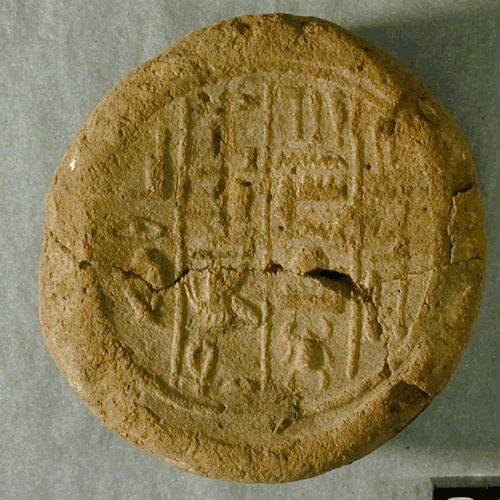
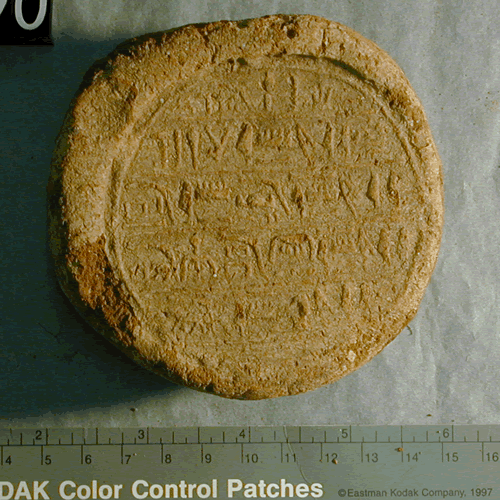

Stela of Ptahmose, from Lyon.This is a low gif image. See pdf file above for original.Meryptah, First prophet of Amen, etc., Temp Amenhotep III. Known from a statue mentioning Meryptah with Anen, Amenemhat and Si-Mut who were 2nd, 3rd and 4th prophet respectively. Aldred thinks that Meryptah succeeded Ptahmose and served until the end of the reign of Amenhotep III. Meryptah would have served from ca. year 20 of Amenhotep's reign until the end of that reign.Meryptah was granted burial in Thebes (Qurna). Some funerary items were recovered from a pit excavated in the early 19th century.Items include a kneeling statue of Meryptah singing a hymn of praise to Re. Two Theban Notables during the Later Reign of Amenophis III, by Cyril Aldred (Journal of Near Eastern Studies 1959)The Oriental Institute in Chicago has a statue of Meryptah: Meryptah (Mrjj-pt), First prophet of Amun, etc., with text mentioning Amun-Re lord of the Thrones of the Two Lands and Ptah [south of his] wall, in Chicago (Ill.), Oriental Institute Museum, 10796.From: Topographical Bibliography etc (pdf)The Metropolitan Museum possesses three stamped mud bricks inscribed for The First Prophet of Amun Mery-ptah The Scepter of Egypt II, by W. C. Hayes pg. 306Sennufer: Sn(.j)-nfr First prophet of Amun in Khentnufer, Chief steward of the King, Overseer of prophets of Min lord of Ipu and of Ptah foremost of ( Tje)nent, etc. Ägyptisches Museum, 21595. (Probably from Tell Bast), Ref Topographical Bibliography (pdf - s16)Maya, High Priest of Amen until year 4 of Akhenaten. Redford speculates that Maya is short for Ptahmose and that Ptahmose served from the end of the reign of Amenhotep III until the beginning of the time of Akhenaten.Donald B. Redford: The Identity of the High-Priest of Amun at the Beginning of Akhenaten's Reign Journal of the American Oriental Society ; Vol. 83, No. 2 (Apr., 1963), pp. 240-241Parennefer (also called Wennefer) was High Priest of Amen during the reigns of Tutankhamen and Horemheb Kampp, F., and K. J. Seyfried, Eine Rückkehr nach Theben, Antike Welt, Mainz 26 (1995), 325-342. (ill. incl. colours, plans). Kampp-Seyfried, Friederike, Die Verfemung des Namens pA-rn-nfr, in: Stationen. R. Stadelmann gewidmet, 303-319. (pl.).Kampp, F., Vierter Vorbericht über die Arbeiten des Ägyptologischen Instituts der Universität Heidelberg in thebanischen Gräbern der Ramessidenzeit, MDAIK 50 (1994), 175-188. (fig., plans, pl.).Nebwa: High Priest of Amun-Re of Paju; From the time of Horemheb. From Topographical Bibliography (pdf - s14) Nebwa Nb-wi, First prophet of Amun-Re of P3-jw (Tell el-Balamûn), son of Huy H.jj With wife Mutnefert(t) Mwt-nfr(t), Songstress of Amun of P3-jw, in Cairo Mus. CG 883 (JE 29092).
19th Dynasty
Nebneteru Tenry was High Priest of Amun under Sety I His wife Merytre was Chief of the Harem of Amun. Both are known from monuments of their son, the vsier Paser.Nebneteru Tenry and Merytre are mentioned in TT 106, the tomb of their son Paser, Governor of the Town and Vizier as well as on statues belonging to Paser. Topographical Bibliography etc (pdf): A statue in Copenhagen mentions Paser P3-sr , Governor of the Town and Vizier, etc. son of Nebneteru Tenry (Nb-ntrw Tnrj) and Merytre (Mrjjt-r) with text mentioning Amun-Re, Thoth, etc.A stamped brick (Museo Arch. Nazionale/Museo Egizio) can be found on the Global Egyptian Museum Site. The text reads:
r-pat hAty-a n niwt PAsr mAa-xrw sA tpy n Hm nTr Imn NbnTrw Dd-f *nryHereditary Prince and Count, Paser, justified, son of the First Prophet of Amun, Nebneteru, called TjenryNebwenenef, High priest of Amun, Temp Rameses II. TT 157. His wife was named Takhat. She held the titles of Chief of the Harem of Amun, and Songstress of IsisNebwenenef is shown followed by a fan-bearer appearing before Rameses II and (Merymut) Nefertari in a palace window. Nebwenenef is being appointed as High priest of Amun (year 1 of Rameses II). Before being appointed High Priest of Amun, Nebwenenef was High Priest of Hathor at Dendera and High Priest of Anhur at Thinis. After his appointment as High Priest of Amun, his son Sementawy became High Priest of HAthor. This post had apparently always been held by his family.Nebwnenef's tomb is discussed on the website maintained by the Universities of Heidelberg and Leipzig. Nebwenenef was also the owner of a mortuary temple at Thebes. Nebwenenef is one of only a select group of commoners who were allowed to construct a temple here. A plan of the temple as well as some photographs of stelaea and foundation deposits can be found at Digitalegypt (University College London)Ritner, R. K., Denderite Temple Hierarchy and the Family of Theban High Priest Nebwenenef: Block Statue OIM 10729, in: For His Ka. Essays Baer, 205-226. (fig.).
Nebwenenef (Detroit Museum) and statues of Nebwenenef and Takhat (TT157)Bekenkhons (I), High priest of Amun, Temp. Ramesses II. (TT35).Parents: Roma (First and Second Prophet of Amun) and Roma (Singer of Amun). Wife: Mertesger (Chief of the Harem of Amun) Jansen-Winkeln, K., The Career of the Egyptian High Priest Bakenkhons, Journal of Near Eastern Studies, 52 (1993), 221-225.On the Global Egyptian Museum Site: "The rose-coloured granite sarcophagus belonging to Bakenkhonsu, First High Priest of Amun during the reign of Ramesses II. It is decorated with representations of funerary deities and bands of text."
Granite sarcophagus of Bakenkhons(u), now in the Liverpool MuseumUnnefer (Wennefer) : Time of Rameses II. Known from a family statue (in Copenhagen) dedicated to him by his son Ameneminet . The father of Unnefer is Minhotep, mother Maya. From Topographical Bibliography etc (pdf): "Unnufer (Wnn-nfr), First prophet of Amun, etc., son of Minhotep (Mnw-tp) and Maya (Mj3), dedicated by son Amenemonet (Jmn-m-jnt) , Overseer of works on all monuments of Ramesses II, etc., with text mentioning Amun-Re lord of the Thrones of the Two Lands, Min-Hor in Koptos, Ptah-Sokari lord of Shetyt, etc., in Copenhagen, Ny Carlsberg Glyptotek."Unnefer was married to Isis, who was Chief of the Musicians of Amun; From Topographical Bibliography etc (pdf):Family group statue of Amenemonet (Jmn-m-jnt) , Chief of the Medjay, Overseer of works on the monuments of His Majesty etc., son of Unnufer (Wnn-nfr) , First prophet of Amun, and Esi (3st), Chief of the harîm of Amun, with twenty-two mummiform figures of relatives, in Naples, Museo Archeologico NazionalePaser: temp Rameses II. It is possible that this is the same man who served as Vizier for many years. If this is the case, then Paser was awarded the position of High Priest of Amun later in his career. Paser the Vizier was the son of the high priest of Amun Nebneteru Tenry, but the High Priest of Amun Paser never refers to his parents in the monuments he left as high priest.From Topographical Bibliography etc (pdf): "Paser (P3-sr) , First prophet of Amun, lower part, with text mentioning Amun, black granite, now in St Petersburg, State Hermitage Museum."Rama(ray), high priest of Amun, Rameses II - Merenptah. TT 283.
Statue of Roma-RoyWife: Tamut (name in niche in court), Tabest (name on stela in Museum in Leiden) On the stela Ramaray is given the titles: The Prince and Count, the God's Father, clean of hands, Priest of Kamutef, Overseer of the prophets of all the gods, Third Prophet of Amun, Second Prophet of Amun, First Prophet of Amun. (H.D. Schneider and M.J. Raven, Life and Death Under the Pharaohs, Australia, 1999 (?) , pg 40-41)Roy : temp Seti II. Son of Rama(ray) (the previous High Priest) according to a statue mentioned here His titles include: Greatest of Ra-Atum's seers in Thebes, second prophet of Amun, and first prophet of Amun. He has a son named Bakenkhonsu.Ramose : Known from a statue. It is possible that Ramose was a high priest of Amun at another temple (i.e. not Karnak). There was also an active cult of Amun at the temple of Deir el-Bahari for instance.From Topographical Bibliography etc (pdf): Ramosi (R -ms), First prophet of Amun, holding pedestal with the Theban Triad (head of Mut lost), Dyn. 19, in auction in Luzern. Minmose : Known from a statue in Leipzig. It is possible that Minmose was a high priest of Amun at another temple (i.e. not Karnak). There was also an active cult of Amun at the temple of Deir el-Bahari for instance.From Topographical Bibliography etc (pdf): Minmosi (Mnw-ms), First prophet of Amun, sandstone, end of Dyn. 19 or early Dyn. 20 in Leipzig, Ägyptisches Museum, Inv. 6021.A High Priest of Amun named Minmose is also mentioned on a statue of (Pa)Rahotep. On the statue, Rahotep's father the High priest of Ptah Pahemnetjer is shown with "his brother" Minmose, High priest of Amun. It is not clear to me if Minmose is a "brother" of Rahotep, or of Pahemnetjer. The name of Minmose is translated as Amsu-mose, but the hieroglyphs used are the same as those that are translated as Minmose.This statue is mentioned in: Proceedings of the Society of Biblical Archaeology; v.14 (1891-92)Hori : High Priest of Amun.Traditionally this High Priest is placed at the end of the 19th dynasty. Pammiger argues that Hori must date to the reign of Ramesses II (more precisely ca year 24). Hori is known to have had a son, the lieutenant-commander of chariotry, Kanakht.Pammiger, P., Hori, Hoherpriester des Amun, JEA 85 (1999), 226-230.Bakenkhons(II): temp Sethnakht to Ramesses III. Known from several monuments including a black granite statue at Boston Museum of Fine Arts. Son of Amenemopet. From Topographical Bibliography etc (pdf): "Bekenkhons (B3k-n-nsw), First prophet of Amun, etc., son of Amenemopet (Jmn-m-jpt), head and base with feet lost, with figure of Hathor chieftainess of Thebes in Djeser (Deir el-Bari) on front, sandstone, now in Louvre, (Probably from Deir el-Bari.)"And: "Bekenkhons B3k-n-nsw, First prophet of Amun, etc., son of Amenemopet Jmn-m-jpt, Overseer of recruits of the temple of Amun, with mention of deified Amenhotep I, lower part, granodiorite in Berlin, Ägyptisches Museum, 2082."From Topographical Bibliography etc (pdf): "Statue of Bekenkhons (B3k-n-h . nsw) , First prophet of Amun, etc., son of Amenemopet (Jmn-m-jpt), holding ram-headed standard, with text mentioning Amun-Re lord of the Thrones of the Two Lands, now in Boston MA, Museum of Fine Arts, 07.645. (Probably from Karnak.) "Ramessesnakht, High priest of Amun, Temp. Ramesses IV - Ramesses IX Tomb: TT 293. Father: Merubaste (Chief Steward of the Lord of the Two Lands) Ramessesnakht was married to Adjedet-Aat and had at least two sons: Nebamun and Amenhotep, and a daughter Tamerit. Tamerit was married to the Third Prophet of Amun, Amenemope and is identified as the daughter of Ramessesnakht and Adjedet-Aat in Amenemope's tomb (TT148).Ramessesnakht's wife was the daughter of the First Prophet of Nekhbet named Setau in El Kab. Ramessesnakht is depicted in Setau's tomb in El Kab. (see osirisnet)It is known that Ramessesnakht went on a quarrying expedition to the Wadi Hammamat during the reign of Ramesses IV and secured gold and galena (for eye paint) under Ramesses VII and IX. (f.i. Chapter 2 of Egyptian Historical Inscriptions of the Twentieth Dynasty by A. J. Peden.) Ramessesnakht was buried during the reign of Ramesses IX.Rock cut stela in the Wadi Hammamat record expeditions. In year 3 of Ramesses IV the High Priest Ramessesnakht lead an expedition consisting of some 8,368 men including a fully organized division of the Egyptian army (The Scepter of Egypt II, by W. C. Hayes pg.371)Amenhotep, The vizier, great confidante of his mater, first prophet of Amun-resonther, Ramses IX - XI.Son of Ramessesnakht.During the reign of Ramesses XI, the Viceroy of Nubia attacked Thebes to restore order. Paneshy besieged the high priest at the fortified temple of Medinet Habu. It is not known if the High Priest, Amenhotep, survived this attack.See: The Suppression of the High Priest Amenhotep, by Edward F. Wente, Journal of Near Eastern Studies 1966Morales, A. J., The Suppression of the High Priest Amenhotep: A Suggestion to the Role of Panhesi, GM 181 (2001), 59-75.
Niwinski, A., Bürgerkrieg, militärischer Staatsstreich und Ausnahmezustand in Ägypten unter Ramses XI. Ein Versuch neuer Interpretation der alten Quellen, in: Gegengabe Brunner-Traut, 235-262. Discusses HPA Amenhotep, Panehesy and Herihor.Panehesy: The Viceroy of Nubia also became High Priest of Amun? This could be another individual or even another temple though.A shabti of the First Prophet of Amun Panehesy is in the collection of the Metropolitan Museum. The Scepter of Egypt II, by W. C. Hayes pg.427Herihor: Temp Ramses XI. Herihor also served as general. Herihor was married to the lady Nodjmet, who may have been a sister of Ramses XI.Pa-ankh: temp Rameses XI His name is sometimes written as Piankhi. He was also a general and later founded the 21st dynasty. Possibly son-in-law of Herihor. Piankhi's wife is named Hereret.The order and family relation of Herihor and Piankh is not clear. See:Jansen-Winkeln, K., Das Ende des Neuen Reiches, Zeitschrift für ägyptische Sprache und Altertumskunde.119 (1992), 22-37.Rossler-Kohler, U., Pianch - Nedjemet - Anchefenmut -- eine Kleinigkeit, Göttinger Miszellen, 167 (1998), 7-8.Gundlach, R., Das Königtum des Herihor. Zum Umbruch in der ägyptischen Königsideologie am Beginn der 3. Zwischenzeit, in: Aspekte spätägyptischer Kultur. Festschrift Winter, 133-138. (also discusses Pinudjem I)
21st DynastyFor a genealogy of the family of 21st Dynasty HIgh Priests of Amun, see http://www.cesras.org/Prd/TIP/21a-family.htmlPinudjem I: Vizier and Generalissimo. From year 16 of Nesibanebdjedet I he took on full Pharaonic titles. Son of Piankhi by Hereret. Father of Djedkhonsiufankh, Masaharta and Psusennes I. Wife: Isetemkheb II.A shabti can be found On the Global Egyptian Museum SiteSee also: http://www.tt320.eu01.org/pinodjem_i.htmlMasaharta: Son of Pinudjem I and Isetemkheb II. Also served as Generalissimo. Served from at least year 16 until Year 24 of Nesibanebdjedet I. The mummies of Masaharta, his wife Tahuyeret and daughter Isetemkheb were found in TT320 (the Deir el-Bahari cache). See also: http://www.cesras.org/Roi/21D/Masaharta.htmlMenkheperre II: Son of Pinudjem I. Became HPA after his brothers during year 25 of Nesibanebdjedet I. Also served as Generalissimo.Sliwa, J., An unpublished stamped brick of Menkheperre, High Priest of Amun, Studies in Ancient Art and Civilization, Kraków 2 (1992), 23-26. (fig., ill.). Romer, M., Gottes- und Priesterherrschaft in Ägypten am Ende des Neuen Reiches. Ein religionsgeschichtliches Phänomen und seine Grundlagen, Wiesbaden, Harrassowitz Verlag, 1994 Quote from AEB 94.0572: ".. an examination of the titles employed by Herihor and his successors Paiankh, Painedjem, Masaharta, and Menkheperre."Nesibanebdjedet II (Smendes II): Son of Menkeperre II and Isetemkheb III. Served as high Steward under his father and ultimately became HPA himself. Served as HPA under Amenemipet, Osorkon and Siamen. Pinudjem II: Son of Menkheperre II and Isetemkheb III. Followed his brother Nesibanebdjedet II as HPA.Pinudjem was married to his niece Nesikhonsu, the daughter of the High Priest of Amun Nesibanebdjedet and his wife Tahentdjehuty.An inscription on the wall of DB320 mentions: "Year 10 4 prt 20. Day of burial (krs) of the Osiris, high priest of Amon-Re king of the gods, great chief of the army, the leader Pinudjem, by the god's father of Amun, overseer of the treasury Djedkhonsiufankh; the god's father of Amun, scribe of the army, chief inspector Nespakashuty; the prophet of Amun ...enamun; the god's father of Amun Wennufer; by the king's scribe of the Place of Truth Bakenmut; the chief workman Pediamun; the chief workman Amenmose; the god's father of Amun, chief of secrets, Pediamun son of Ankhefenkhons" Other linen dockets are inscribed with:"Linen which the high priest of Amun Pinudjem son of Menkheperre made for Amun (in) Yr 7""Linen which the high priest of Amun Pinudjem (son of) Menkheperre made for Khons in Yr 9"(ref: Theban Royal Mummy Project)See also: http://www.tt320.eu01.org/pinodjem_ii.htmlMunro, I., Der Totenbuch-Papyrus des Hohenpriesters Pa-nedjem II. (pLondon BM 10793/pCampbell). ISBN 3-447-03843-8[Publication of the important B.D. papyrus of the High Priest of Amun Pinodjem II (Pap. BM London 10793, also known as Pap. Campbell).]Psusennes? Von Beckerath argues for the existence of a Tanite king named Psusennes II who reigned after Siamun, and the existence of a Theban High Priest of Amun bearing the same name. (from: AEB 92.0450)von Beckerath, J., Noch einmal Psusennes II., GM 130 (1992), 17-19.
22nd DynastyShoshenq II: Son of Osorkon I and Maatkare II. Served as HPA at Karnak for large part of his father’s reign.Known from: A statuette of Bes, dedicated by Sheshonk Ššnk, First prophet of Amun-Re, Great general in chief, son of Osorkon I, Now in Durham, Oriental Museum, N.313. Topographical Bibliography (pdf - s26)Iuput: Son of Shoshenq I HPA for most of his father’s reign, and into the reign of his brother Osorkon II. 944-924 BCThis High Priest is mentioned on linenin the cache in DB320. Year 10 of Shoshenq I/Iuput: "Noble linen which the dual king (nsw bity) lord of he two lands Hedjkheperre son of Re lord of appearings Shoshenq-meramun made for his father Amun (in) year 10; noble linen which the high priest of Amon-Re, great chief of the army Iuput, true of voice, king's son of the lord of the two lands Shoshenq-meramun, made for his father Amun (in) Year 10"Another shorter inscription from year 11 is mentioned (ref: Theban Royal Mummy Project)Iuwlot: Son of Osorkon I. Probably became HPA late in the reign of Osorkon I and served until the early years of Takelot I. He records the height of the Nile in Karnak in year 5 of Takelot I. 924-894 BCNesibanebdjedet III: Son of Osorkon I. Served as HPA during the middle of the reign of his brother Takelot I. He records the height of the Nile in Karnak in years 8 and 14 of Takelot I. Also called Smendes. 884-874 BCHarsiese: Son of Soshenq II. Promoted to HPA under Osorkon II. 874-860 BC[…du/aw…] Possibly Pedubast. Son of Harsiese.. May have become HPA on the elevation of Harsiese to kingship. 860-855 BCNimlot III: Son of Osorkon II. Became HPA after year 16 . The name of his predecessor […du/aw…] was erased. 855-845 BCTakelot F: Son of Nimlot III. Followed his father as HPA before probably becoming a Theban King as Takelot II. 845-840 BCOsorkon B: Eldest son of Takelot II. Probably became HPA after his father assumed kingship. 840-785 BC Later took the throne as Osorkon III.Osorkon F: probably son of Rudamun and grand-son of Osorkon III. ?Harsiese B, son of […du/aw…] i.e. Pedubast? 835-800 BC.
25th DynastyHaremakhet: Son of Shabaka 704?-660 BCHarkhebi: Son of Haremakhet, Grand-son of Shabaka. Served as HPA until at least year 14 of Psamtik I. 660-644 BC[ 2 unattested HPA or vacant? 644-595]Ankhnes-Neferibre, The God's Wife of Amun also served as High Priest of Amun. 595-560 BCNitocris B, Daughter of Pharaoh Ahmose (II). 560-550?
Later PeriodsPafiy First prophet of Amun-Re from early Dyn. 26, From Statue inscription: Pefiy P3.f-jj, First prophet of Amun-Re, etc., son of Nakht Nh.t (i.e. Harnakht H.rw-nh.t) now in Moscow, State Pushkin Museum of Fine Arts Topographical Bibliography (pdf - s20)
Subscribe to:
Posts (Atom)