KEMETIC SCIENCE

KEMETIC SCIENCE
Positive Progress Through The Benevolent Use Of Knowledge

Sunday, June 27, 2010

Genesis of Egypt's Dynasties Saharan Petroglyphs

Sankofa*

Egypt:
=======

Ancient Kmt didn't begin on the banks of the Nile, but in a much harsher environment. The ancestors of the pyramid builders, were not village dwelling farmers, but wandering cattle herders.

Pharaonic civilization was forged in a remote region, now one of the forbidden places on earth.
Egyptologist Toby Wilkinson, based on his own discovery in the heart of Eastern desert, between the Nile Valley and Red Sea.

Kmt's distant ancestors left a stunning legacy, that has remained hidden for 6000 years: hundred of intricate rock carvings that express Kmt's lifestyle and deepest belief system. Pharoaonic imagery such as the after life journey by boat, royal hunting, and the iconography of gods and kings all find their origins in this hospitable terrain.

Toby Wilkinsons' book - Genesis of the Pharoahs -  traces the discovery of these ancient records, dates them, and identifies the artist who made them. A remarkable early period of human creativity. Discover the answer to the question of where, when and how ancient Kmt begin.
============


The Desert Speaks:
=====================
Making The Discovery:

Genesis of the Pharaohs, Toby Wilkinson shines new light on the Predynastic by demonstrating that the majority of rock drawings in the Eastern Desert of Upper Egypt date to Naqada I (c. 4000–3500 BC).

Since the petroglyphs depict wild African fauna, hunters with bows and dogs, and men herding cattle, it is clear that the now nearly lifeless region up to 100 km east of the Nile between Quft and Hierakonpolis was at this time a well-watered, well-populated, game-rich savanna. That the rock artists were not mere isolated pastoralists but also part-time Nile dwellers is evident because their works commonly include boats. This implies that the artists probably moved from river to range in seasonal cycles.

Because of this, and the fact that so many of the drawings echo subjects in later Egyptian art, Wilkinson makes a compelling case that the rock artists were the ancestors of the dynastic Egyptians. His conclusion: “the heavy reliance of these people on herding and hunting rather than agriculture suggests that their roots — and indeed the roots of Egyptian civilization — lay not so much along the Nile but in the pre-arid Sahara.”


Petroglyph - ALCHEMY WHEEL
==========================


Through The Sands Of Time:
=====================
Dating Rock Art:


Wadi Barramiya - Boat and human figure - ca. 4.000 BCE, after Wilkinson, 2003.


The deep, black darkness underneath the surface of the Nile is the great hidden secret upon which the boat navigated. This deep represented the best one could receive from the river : abundant gifts of life, prosperity and the luxury of time, the foundation of all grand cultures. However, nobody could look the Nile "in the face", for the gods never reveal the name "unknown to those below", namely the secret of the "All-Lord who sustains the shores !".


Wadi Barramiya - Flotilla of boats - ca. 4.000 BCE, after Wilkinson, 2003.


With their glyphs of barks, flotilla of barges, or procession of boats, the Predynastic Egyptians expressed the enduring quality of their mythical mindset, able to distinguish between the undifferentiated waters (or primordial origin of consciousness) and creation, while actively identifying "divine powers" (i.e. natural differentials) to move along the arrow of time and encompass the "Two Lands" by means of the river. A company of boats is hence a family of successful evolutionary histories, a metaphor of cooperation and mutual respect between the Egyptians themselves, and between their way of life and their natural environments ruled by natural differentials. This is the image of a triumph over chaos shared with all. This naturalistic and typological view on the deities was also quite original.


Wadi Abu Wasil - Hunters and a Dog trapping an Ibex - ca. 4.000 BCE, after Wilkinson, 2003.

"The scenes which appear on the Egyptian rock surfaces reveal many elements of continuity between the late Neolithic period, to which the early works belong and the long sequence of royal rule which was to follow them. Although Egyptian rock art shares traditions with both the Sahara and Arabia even at its earliest it is recognizably Egyptian, powerful and assured in technique and content."


Wadi Qash - Upper Egyptian ruler with Red Crown ? - ca. 4.000 BCE, after Wilkinson, 2003.


"The parallels between the rock art of 4000 BC and the tomb scenes of 1500 BC are indeed striking. The discovery of the boat petroglyphs faces us with two astonishing revelations. First, the familiar ancient Egyptian concept of the afterlife originated at the very dawn of civilization in the Nile Valley, among the semi-nomadic cattle-herders whose domain encompassed both valley and savannah. Second, this concept was so powerful and so resonant that it remained unchanged throughout the succeeding thirty centuries. The longevity of Egyptian culture is as ramarkable as its antiquity."

Wilkinson, 2003, p.189.


Wadi Barramiya & Funerary Boat near Kanais - ca. 4.000 BCE, after Wilkinson, 2003.


The theme of a journey by boat remained central to the Egyptian concept of the afterlife, and returned in the Pharaonic Period. Not only did Pharaohs place these sacred boats near their tombs, either in miniature form or full-size, or near the "naos" in their temples, but the theme became fundamental in the New Kingdom Books of the Netherworld and their rich iconography. These vessels accentuated the nurturing role of the Nile, and point to the spiritualization of the river, which carried the dead to the various levels of the eternal afterlife. The spiritual Nile led the deceased out of the mortal world of time, if they were deemed worthy, into the timeless eternity of the afterlife and its paradise.


6000 Year Old Petroglyphs:
===============================


Petroglyph  -   "ABOVE AND BELOW"
==============================


Petroglyph - STAR OF ISIS*  (ASET)
   -BALANCE-
=================================


Petroglyph - HOUR GLASS
=====================


Petroglyph - RESURRECTION OF CHRIST
==================================


Hunters And Herders:
================
Unmasking The Artist:


Traditional beliefs in the origins of ancient Egyptian culture say that the peoples occupying the wetter, more fertile, ancient savannahs of Egypt’s margins gradually moved into the Nile Valley as the climate dried up. It was once they had reached the valley that the culture slowly developed. What this rock art suggests is that in fact the two cultures were one and the same. The herdsmen followed the best pasture. In season they travelled up into the wadis (dried up river beds) to the fertile lands, where they carved images of their lives into the rocks under which they sheltered. They then travelled back into the Nile Valley, where they painted the same images onto pottery.


These people drew on the life around them in both the desert and the valley, for their inspiration. There are picture of warriors smiting their enemies, herdsmen with their cattle, ostriches, ibex, hippos, deities wearing feathered head-dresses, family groups, and hundreds of boats. Some of the sites have extraordinary quantities of images, some are hidden away behind rocks, some are under overhanging shelters, some are only visible at dawn, some only at sunset, but they are all a ‘written’ account of the lives of the most ancient Egyptians.


Genesis of the ‘Ka’ and Crowns
===================================


One is the question of the origin of the royal ‘ka’ and the other concerns the origin of the red and white crowns. Wilkinson presents strong evidence that Naqada I was an archetypal representative of the traditional African cattle-culture, a type of society that still exists in a remarkably pure form in the southern Sudan, despite years of civil war. Among Sudanese Nilotes, cattle are raised as symbols of wealth, as the medium for all social transactions (like marriage), and as sources of renewable food (blood and milk).

The people rarely kill cattle for meat, which they obtain by hunting wild game. Wilkinson’s overview of the evidence for Naqada I transhumance and cattle burial, coupled with his analysis of the rock art, suggests that Egyptian civilization sprang from a society of broadly similar characteristics. Cows with artificially deformed horns, so common among Nilotes today, are often featured in the early rock art of Egypt and Sudan as well as in Egyptian dynastic art (Kendall 1989, 680–88, fig. 1, 9–12). Even the historic Egyptian symbols of royal office — the crook and the flail — recall a time when the king was seen as the chief herdsman of his people.


Wilkinson draws striking parallels between elements of iconography in the rock art and Egyptian art motifs even two thousand years later in date. From this he concludes not only that these motifs must have had common meanings throughout this time span but also that the rock artists were themselves Egyptians. In one case, I think, we can push Wilkinson’s thesis even farther.

Some of the interrelated motifs of the rock art have meanings that in dynastic art were based on word-play. This not only suggests that the words were the same in the early Predynastic but also that the rock artists spoke Egyptian. This can be demonstrated by the apparent petroglyphic allusions to the word ‘ka’, one of the primary concepts of ancient Egyptian civilization.

Ironically, the earliest certain images of the white crown come not from Egypt but from Qustul in Lower Nubia, about 300 km up-river from Hierakonpolis. These images occur on two incense burners of uniquely Nubian type, which depict kings seated in archaic high-prowed boats wearing abnormally tall crowns with knobs, accompanied by bulls and Horus falcons (Williams 1980; 1986, pls. 33, 34).

They date to about 3300 BC. The same crown then appears not long afterwards in Egypt: on an unprovenienced ivory knife handle in the Metropolitian Museum and, later still, on the Scorpion mace head and Narmer palette (Wilkinson 1999, 194–5). The evidence can be interpreted several ways:


Narmer wearing the white crown. Narmer strikes down a foe. Many Egyptologists have been tempted to interpret this scene as the conquest of Lower Egypt by Narmer.


Scorpion mace head - with white crown

The Scorpion mace head portrays a mounted scorpion image, no doubt derived from the type of statuette found in the HK6 tombs.


a) The white crown was exclusively Egyptian, and it is Egyptian kings who are represented on the Qustul incense burners;

b) The white crown was used simultaneously by competing rulers in Upper Egypt and Lower Nubia; or

c) The white crown was first used in Nubia and spread northwards.
========


Rock art dating to 5000 BC corroborates what the radar equipment revealed. In Libya, Egypt, and Mali, petroglyphs depict not only grazing animals, but also aquatic life such as crocodiles. This indicates that the desert was inhabited during a time prior to 4000 BC and as far back as 8000 BC, when the climate was wet.


Egypt In Prehistory:
==============


"All the data at our disposal suggest that the process of Nilotic adaptation favoured partial sedentism and encouraged food storage. It was therefore part of the beginning of a long evolutionary process through which the people of the Nile valley embarked on the Neolithic period."

Midant-Reynes, 2000, p.59.


On the basis of the evidence to date, the majority of scholars subdivide Egypt's unwritten history (ca. 5000 - 3000 BCE) in three major phases :


The pre-Neolithic Period (ca. 7000 and earlier) : early settlers in the Nile Valley and in the western desert contributing to the historic Egyptian reality - the "process of Neolithicization" (Midant-Reynes, 2002) ;


The Neolithic Period (ca. 5000 - 4000 BCE) : the first traces of village settlement on the banks of the Nile. The crucial myths of these Nilotic cultures are dominated by Lunar ideational features. However, because of the fixed horizon, awareness of the Solar cycle, and the seasonal changes brought about by it, rose ;


The Predynastic Period (ca. 4000 BCE - 3000 BCE) : incipient stages of the centralization of power go hand in hand with the "Solarization" of the old Lunar myths. This new, fixed reference point, allows psychomorph projections of stability, authority and continuity. The enduring order of the sedentary farmer is guaranteed by sacred kingship, and the latter is engendered by the great goddess herself. The period comes to a close when the male king assimilates the sacred power of the great goddess and initiates Solar ideation.


*****

There is no room for doubt : Dynastic Egypt did not emerge "ex nihilo", but the decisive features of the Egyptian way of life (the own-form of the cultural form) we have on record are already established a millennium earlier, whereas the emergence of regional kingship (ca. 3600 BCE) builds on the managerial approach of the Badarians (ca. 4000 BCE). The great change at the beginning of history is the theo-political notion of divine kingship : Two Lands united by the incarnation of a single, re-incarnating sky-god, descending in a male body, forming a dynasty of divine kings, ruling a united state of divisions.


"The kings who crafted the Egyptian state from the competing powers of the Predynastic period succeeded in formulating a concept of rule which guaranteed an absolutely pivotal role for the monarchy. The institution of kingship was projected as the sole force which held the country together, and the dual nature of the monarchy was expressed in the king's regalia, in his titulary, and in royal rituals and festivals. This concept -the harmony of opposites, a totality embracing paired contrasts- chimes so effectively with the Egyptian world-view that the institution of kingship acquired what has been called 'transcendental significance' (Frankfort, 1948)."


Wilkinson, 2001, p.185.


The Predynastic kings of Nekhen identified with Horus, "the distant one" (did he originate in Arabia ?), the overseer with the horizon of horizons. The kings of the first dynasties (Early Dynastic Period) consolidated this major change. It also implied the cognitive leap from mythical to pre-rational organizations, from notions to pre-concepts. Aided by writing, the cultural form developed rapidly and exteriorized its "canon". This Old Kingdom canon would dominate Egyptian thought until the end. Qua contents, this multi-layered texture returned to common Predynastic themes and another, new layer, was put on the mythical foundation.


The great Moon goddess of prehistory
===========================================


In the Neolithic & Predynastic mind, at work in the mythical mode of cognition, natural cycles like the Lunar, were very entrenched. Its phases represented the divine feminine as the truly enduring part of nature outside man, and psychomorph projections on the Lunar stations were common. Cycles related to birth, growth, death & rebirth (healing), as well as plants, domestic animals and hunting were associated with this great goddess of the sacred. In Ancient Egypt, we see her appear ca. 4000 BCE.


 Lunar Phases : magico-religious
========================


Her important and enduring role of the sacred feminine is confirmed by the frequent representations of female figures in late Naqada II iconography. The complex, composite nature of some of the Predynastic female deities (like Hathor, both Cow- and Sky-goddess) is a manifestation of the Upper Paleolithic and Neolithic great goddess, who combined many of the functions later assigned to other deities. The crucial role of the sacred feminine persisted though, but when history dawned, the great goddess had lost her dominant position. She did not disappear. This is demonstrated by the prominent role played by goddesses in the later pantheon, by the equal status women enjoyed in Early Dynastic society and by the link between women and the sacred domains of existence (birth, fertility, creation, death, healing, rebirth).


Indeed, in the Old Kingdom, the mother of the royal heir was his official consort and on the Palermo Stone, the name of the divine king was directly followed by that of his mother. Women played a crucial role in dynastic changes, and man had his "heart" from his mother. Neither were the tombs of some of the early queens essentially different from those of the king. During his life, the latter was permanently protected by the "Two Ladies", the goddess Nekhbet -a vulture- and Wadjet -a cobra-, representing Upper and Lower Egypt respectively. In the tomb of Pepi I (ca. 2316 - 2284 BCE), we read :


"You are a son of the Great Wild Cow. She conceives you, she bears you, she puts you within her wing."

Pyramid Texts, utterance 554 (§ 1370).


So in Egypt, the unorganized, Lunar religious culture of the Neolithic hunters (5th millenium and earlier), Predynastic semi-nomads and settlers (4th millenium) had remained dominant until the end of prehistory (ca. 3000 BCE). During the Late and Terminal Predynastic Period, i.e. between ca. 3600 and 3000 BCE, the archetypal representation of male power and kingship steadily became more important and heralded the emergence of history.

Monday, June 21, 2010

The King Is The Sign, The Queen Is The Symbol


The Kingdom is Possible Because of the Queen...

The King is the Sign... While the Queen is the Symbol.....   Warren Blakely
=====================================================

Sankofa*

Sacred feminine:

 We talk of Mother Earth. And in Egypt you have the Mother Heavens, the Goddess Nut, who is represented as the whole "heavenly sphere".  But what happened along the way to this reverence, that in primitive societies was directed to the Goddess figure, the Great Goddess, the mother earth- what happened to that?


Well that was associated primarily with agriculture and the agricultural societies. It has to do with the earth. The human woman gives birth just as the earth gives birth to the plants...so woman magic and earth magic are the same.

They are related. And the personification of the energy that gives birth to forms and nourishes forms is properly female. It is in the agricultural world of ancient Mesopotamia, the Egyptian Nile, and in the earlier planting-culture systems that the Goddess is the dominant mythic form.

The image of the Virgin Mary was derived from the image of Isis and her child Horus: "The antique model for the Madonna, actually, is Isis with Horus at her breast.

Like a pregnant goddess who contains within Her womb, an abundant amount of mysteries in egg form waiting to be, so to speak, born into our consciousness. These seed mysteries, in one form at least, are to be found in the visual representation of certain key symbols. One fountain head , is the hieroglyphical emblem.

=====================================================
Many Nubian rulers of that time were pictured with Isis on their crowns. This was considered a homage to her role as the "Queen of All Gods, Goddesses and Women"
===================================================== 

Additionally, by the beginning of the twenty-fifth dynasty - the Egyptian dynasty governed by Nubian rulers - the Queen was given the additional role of being a priestess of Nut (Nuit) . This would place the Queen in the role of trusted servant to the goddess known as the eternal mother.

Nut is also the mother of Isis, Osiris, Nephthys, and Set . The close association of the Queen with this figure is significant. Nut is, in the Nubian and Egyptian religions, the mother from which all the current gods and goddesses came. She plays the role of female initiator; the Queen is her trusted confidant on earth.


The Kingdoms of the Nile:


The Goddess Lines - Matriarchs
========================

The Goddesses Lines is the Lines that carry the Throne Heads or in other words the Lines that they were seen as the Sons and Daughters of The Gods – Ra/Ptah/Khnum and, The Matriarchal Goddess Line or Line of the Ancient Mother the Matriarchal direct Bloodlines of the Matriarchal Imperial Throne of Isis.

The Goddess Mother or Imperial Empress. In later years referred to as Mother of Africa, and misinterpreted by most unknowing of how close it was to the reality of that title. Within their Empire and Empire Government there Law is Sacred. To the Nations the Matriarch is their most Supreme Authority that exist, for it is the Lines of their Gods.


Sacred Crown of The Mother
=====================

Sacred Crown of The Mother earthly Throne is that of the Sacred Crown of The Mother, Her Wisdom and Power. Symbolising the unity with the Gods and the Power of The Law of the Imperial Mother. Her sign is the Father and Protector of the Mother Empire, The Imperial King. Their title meanings in reflection to the Gods are the origin of the ancient Empire term The Living Gods.

They are the living image of that Above, and so seen. There Greatest Power is there sacred Wisdom, the Sceptre of their Rule. That harmony of Rule is reflected throughout the lines of there generations. The Wife and Goddess Sister of Ra, Mother Ruler of the Universe Empires, Mother Creator and Ruler of the Gods Creation of Life, the Throne of Mother, is a Matriarchal Line.

=========================================================
As such it is said with African culture, the King is the Sign, but the Queen is its Symbol.

The Imperial Lines Imperial Head are since times dawn Matriarchal. They are the image and likeness of the Ancient Mother and Line of The Throne.

As such the Highest Status is that of The Imperial Empress, for through the Mother All of The Nations became to Life. The Imperial Lines of The Throne are seen as One with the Gods, they are in Unity they are, One.
=========================================================

Throne of the King/Pharaoh son of Ra Ruler of the Empires of the Gods Universe of Heavens and co-Regent Supreme Husband and God- Brother of the Goddess Mother, Supreme Father of there Created Nations, The Crown of the Mother His Goddess Wife of The Unity of Ra, His Godly image.
==========================================================
The Royal African Kingdoms are the descendant Kingdoms of the Kush-Nubia Empire of Kingdoms, the very First Kingdoms known to Mankind.

The African Kingdoms cover and cross the Trans-African Borders as they have prior to the formation of National Borders within Africa.

The two Eldest African Kingdom Nations are the Nubian and Nubian-Mande Kingdom Lineages.


Egyptian Gods, Goddesses and Mythology


Ancient Egyptian society treated men and women equally. Women participated in the political, economic, and judicial world of ancient Egypt on the same terms as men. This social system reflects Egyptian mythology, where Goddesses played an equal, if not chief, role.

 The primeval mother-figures in the earliest prehistoric Egyptian myths are female. Female deities were kept separate from the males, with their own temples and followers. Egyptian goddesses are also creator deities, and the protectors of the pharaohs in the form of the cobra, vulture, or lioness.


============================================================


Queen Ahmose-Nefertari, was born royal heiress and became one of Africa's most brilliant queens. After the twenty-five year reign of her brother/husband Ahmose I (Aahmes I), she governed jointly with her son Amenhotep I, the 2nd King of Egypt's 18th Dynasty.

Aahmes married Tuthmosis I and had a daughter named Hatshepsut. Ahmose Nefertari is Queen Hatshepsut's great grand mother.


===========
The importance of the role of the queen-mother in Nubia, Egypt, and the rest of Black Africa: the women, the queen was the true sovereign, the keeper of the royalty and guardian of the purity of the lineage. To this end, it was she who transmitted the crown to her husband, who was only her executive agent.


The Menat- This symbol represents a heavy beaded necklace with a crescent shaped front and a counter piece at the rear. It was a symbol associated with the goddess, Hathor and her son, Ihy. In fact, Hathor was known as the "Great Menat". Hathor used the Menat as a conduit, through which she passes her power. It was representative of joy, life, potency, fertility, birth, and rebirth.


Looking back to Egypt,
=================
Bees were considered tears of the sun-god RA. Here we see a relationship with the sun that we will see later. The bee hieroglyphic is a symbol of Lower Egypt. Because of the sudden appearances of bees they became symbols of death and rebirth. Bees also represented the soul. Honey was often offered to deities.


If we can go back to Egypt quickly, I want to point out that at Memphis, the Memphite theology, the Apis bull was worshipped as the Ba (or spirit or spiritual manifestation) of Ptah, the creator of the universe.


Ptah's symbols were the architect's transit, level, and plumb line. He was the patron of skilled craftsmen and architects.

There are coins from Ephesus from the 5th century B.C. that depict a queen bee as a symbol of the Great Mother. Ephesus was known throughout the ancient world for its temple to the Great Mother Goddess.

==============================================================


In ancient Egypt, the crescent moon was the symbol of Isis, the Mother of the Gods. As the Queen of Egypt, Isis was the protector of motherhood, women, and healer of the sick. She also rules magic.


                   ISIS                                                                AMON           


FOOD FOR THOUGHT
**********************

Consider the Egyptian god of masculine fertility, was the ram’s headed deity, AMON.
And who should be his feminine fertility counterpart goddess, but ISIS

The ancient pictogram for ISIS was once called ‘L’ISA’. Combining the names of these two gods in anagram form we have AMON/L’ISA=Mona Lisa!


HOTEP*

Friday, June 18, 2010

Egyptian Queen Cleopatra - A Mixed Race

Sankofa*

There's has been much speculation lately on the true nationality of Egyptian Queen Cleopatra race. I can remember reading an article on Timeonline. They claimed they have proof of her true nationality. Because they found her sister that was killed, Arsinöe. From the forensic evidence, she was of  N. African and White European.
==============


qlwpdrt (nTrt mr(t)-it.s) Cleopatra, neczeret meret ites
(The Goddess Cleopatra Who Is Beloved Of Her Father)


Cleopatra VII, who grew up to be the last of the Ptolemies. In 59 BC.


Cleopatra VII's titles as king of Egypt were 19:

Arsinoe and Cleopatra were daughters of Ptolemy XII by different wives.

She was the third daughter in line to her father Ptolemy XII; she later had another sister and two younger brothers. Cleopatra was born in 69 BC, to Ptolemy XII and his wife, Cleopatra V of Egypt.

Cleopatra was actually Cleopatra VII, and was the last pharaoh of Egypt, because Rome took over following her death.

Cleopatra’s full name was Cleopatra VII Thea Philopator. She reigned for 21 years, from 51 BC to 30 BC.


In the entire 300-year old Ptolemaic dynasty, Cleopatra was the only Pharaoh who could speak Egyptian.

Infact, she was the master of nine languages in all.


Cleopatra was one of the seven women named Cleopatra in the dynasty.
This is why she was officially known as Cleopatra VII.


=============


Forensic experts believe they have identified the skeleton of the queen’s younger sister, murdered over 2,000 years ago.

Daughter of Ptolemy I and Berenice I, sister of Philotera and Ptolemy II, then his wife. After Lisymach’s death she was married to Keraunos who crowned himself a king of Lisymachia after the diadochi battle. In 279 he murdered Arsinoe’s children and she escaped to Egypt where she managed to drive Arsinoe I out of the country and marry her brother and coregent between 280 and 272 BC. After death she was deified in the whole East-Mediterranean region.

The results vindicate the theories of Hilke Thür of the Austrian Academy of Sciences, who has long claimed that the skeleton was Arsinöe. She described the discovery of Arsinöe’s ethnicity as “a real sensation which leads to a new insight on Cleopatra’s family”.

The forensic evidence was obtained by a team working under the auspices of the Austrian Archeological Institute, which is set to detail its findings at an anthropological convention in the United States later this month.


Evidence obtained by studying the dimensions of Arsinöe’s skull shows she had some of the characteristics of white Europeans, ancient Egyptians and Black Africans, indicating that Cleopatra was probably of mixed race, too. They were daughters of Ptolemy XII by different wives.


==========================================================
“It has got this long head shape,” said Wilkinson. “That’s something you see quite frequently in ancient Egyptians and Black Africans. It could suggest a mixture of ancestry.”

==========================================================


Thoth (left) and Horus pour purifying liquid on Pharaoh Ptolemy XII.
From the temple of Haroeris and Sobek at Kom Ombo. Photograph c.1890.

=====================================================


What do we know about Cleopatra's ancestry?


The Ptolemy dynasty was descended from the Greek Macedonian Ptolemy Soter, established as ruler of Egypt by Alexander the Great's conquest of Egypt in 305 B.C.E. (In other words, they were imperialist outsiders.)

We are not certain of the heritage of Cleopatra's mother or her paternal grandmother. That leaves 50% to 75% of her genetic heritage unknown -- and ripe for speculation.

Is there any evidence that either her mother or paternal grandmother was a black African? 

Is there any evidence that either of those women were not black Africans? 
=================================================
Cleopatra's Paternal Grandmother

Many scholars believe that Cleopatra's paternal grandmother was a concubine. That woman's background has been assumed to be either Alexandrian or Nubian. She may have been ethnically Egyptian, and she may have had a heritage which we'd today call "black."
=================================================


Cleopatra's Mother

Cleopatra's mother is usually identified as her aunt, Cleopatra V, daughter of Ptolemy IX. Her mother is also unknown; Cleopatra V was not the daughter of a royal wife, but we don't know if the mother was another Ptolemy relative or a concubine of Egyptian or Semitic African or Black African background.


Cleopatra Spoke Egyptian

We do have early evidence that Cleopatra was the first ruler in her family to actually speak the native Egyptian language, rather than the Greek of the Ptolemies -- but that would be evidence for an Egyptian ancestry, =  Black African.


BBC has a audio tape where you can hear the scientist discuss Cleopatra's African ancestry.

http://news.bbc.co.uk/2/hi/also_in_the_news/7945333.stm


Hotep*

Wednesday, May 26, 2010

Chapel Dedicated To The Birth of HORUS - Denderah-Hathor

 A chapel devoted to Horus to celebrate the new rein , of Augustus.


The temple of Hathor was constructed over a period, we believe, of thirty-four years, between 54 and 20 BC. When Ptolemy XII died in 51 BC, the temple was, after four years of building activity, still in its early stages, although it did contain some underground crypts. It seems that the remainder of the temple was build during the twenty-one year reign of his successor, Queen Cleopatra VII. At the time of her death in 30 BC, the decoration work had just begun (on the outer rear wall).


Trajan
 making offerings to Hathor in the Roman birth house
Horus


Ihy was a young god personifying the jubilation emanating from the sacred rattle.
 
The name of Ihy was interpreted by the Egyptians as "sistrum-player" which was the raison d'etre of this god. The sistrum was a cultic musical instrument used primarily (but not exclusively) in the worship of Hathor, mother of Ihy. He can hold the sacred rattle and necklace (menat).

=====================

Its scenes depict Trajan, Augustus' later successor, making offerings to Hathor, and are among the finest to be found in Egypt. It was the ritual location where Hathor gave birth to the young Ihy or Harsomtus, two alternative youthful deities who stand for the youthful phase of creator gods in general. There are also, of course, figures of the god Bes, a patron of childbirth, carved on the abaci above the column capitals. The reliefs on the exterior walls are superbly preserved, and portray the divine birth and childhood of the infant Horus, whose rites legitimize the divine descent of the king.


The temple plan is classical Egyptian, completely enclosed by a 35 by 59 meter wall standing 12.5 meters high. However, unlike those of earlier temples, the facade of the hypostyle hall that fronts the main temple is constructed as a low screen with inter-columnar walls exposing the hall's ceiling and the Hathor style sistrum capitals of its 24 columns. According to a dedication inscription on the cornice thickness above the entrance,  this part of the temple was built under Tiberius between 34 and 35 AD. The structure measures 26.03 by 43 meters and is 17.2 meters high. It has an 8 meter long architrave that spans the central intercolumniation. Above, a towering cavetto, built from one course, and the massive volume of the corner tori cast heavy shadows and articulate the edges of the facade.


The main temple area is fronted by several Roman Period kiosks. After those, the monumental gateway of Domitian and Trajan is set in a massive mud-brick enclosure wall that surrounded the complex, and leads to an open area. Although the site lacks a colonnade and the two pylons which ought to precede the inner temple, an unfinished inner enclosure wall of stone surrounds a courtyard with side entrances which open before the large hypostyle hall added in the 1st century AD by the emperor Tiberius.


However, prior to the temple proper is the Roman Period birth house of Dendera on the west, perhaps built by Nero, though more probably by Trajan. Although the dedication inscriptions refer to Trajan, Nero is depicted in the main hypostyle hall of the of the Hathor temple, offering the model of a birth house. This is the latest preserved temple of its type.

The new sanctuary was well designed and followed Ptolemaic models. In order to match the level of the Hathor temple, the new building was erected on a high platform. A temporary access staircase led up at the side of the platform. The roofing slabs were not positioned, as usual, beneath the level of the cavetto molding around the buildings top, but would have probably been hidden by a parapet wall.

The core building contains a sequence of three rooms. Two corridors that isolate the large sanctuary are notable. These passages are too narrow to be used and must have been added for symbolic and optical effect. The rear wall of the sanctuary is dominated by an enormous false door that is framed by a double cavetto molding on slender columns and topped by an uraeus frieze. A cult niche high up in the wall corresponds to the location of the statue niche in the sanctuary of the main temple.


The birth house was surrounded by an ambulatory. The composite capitals of the columns carry high pillars with Bes figures. The frontal ambulatory extended by the addition of three columns into a kind of kiosk, with the front corners formed by L-shaped pillars. The kiosk had a timbered roof that somehow must have connected to the stone structure of the birth house. This merging of the ambulatory with a kiosk is a novelty. At older birth houses, a court was attached as a separate structure.


The main temple at Dendera is the grandest and most elaborately decorated of its period. It is also one of the most important temple sites of Egypt, providing examples of a rich variety of later temple features. It is also one of the best preserved temples of this period, surviving despite the destruction of the temples of Hathor's consort Horus and their child Ihy or Harsomtus which originally stood close by.

The massive foundations probably contain many blocks from the earlier structure it replaced. Early texts refer to a temple at Dendera which was rebuilt during the Old Kingdom, and several New Kingdom monarchs, including Tuthmosis III, Amenhotep III and Ramesses II and III are known to have embellished the structure. However, while fragments of earlier periods have been found on the site, there have been no earlier buildings unearthed. Pepi I and Tuthmosis III in particular were recalled in the new temple's inscriptions.


Cleopatra VII Philopator and Caesarion from the rear of the Temple 
of Hathor at Dendera


The temple of Hathor was constructed over a period, we believe, of thirty-four years, between 54 and 20 BC. When Ptolemy XII died in 51 BC, the temple was, after four years of building activity, still in its early stages, although it did contain some underground crypts. It seems that the remainder of the temple was build during the twenty-one year reign of his successor, Queen Cleopatra VII. At the time of her death in 30 BC, the decoration work had just begun (on the outer rear wall).


The temple plan is classical Egyptian, completely enclosed by a 35 by 59 meter wall standing 12.5 meters high. However, unlike those of earlier temples, the facade of the hypostyle hall that fronts the main temple is constructed as a low screen with inter-columnar walls exposing the hall's ceiling and the Hathor style sistrum capitals of its 24 columns. According to a dedication inscription on the cornice thickness above the entrance,  this part of the temple was built under Tiberius between 34 and 35 AD. The structure measures 26.03 by 43 meters and is 17.2 meters high. It has an 8 meter long architrave that spans the central intercolumniation. Above, a towering cavetto, built from one course, and the massive volume of the corner tori cast heavy shadows and articulate the edges of the facade.


The Roman Birth House (mammisi) was built when the earlier structure, begun by Nectanebo I and decorated in the Ptolemaic Period, was cut through by the foundation of the unfinished first court of the main temple of Hathor. Only a false door at the eastern exterior wall of the main temple of Hathor reminds one of the original sanctuary. Originally, this birth house measured about 17 by 20 meters and consisted of a triple shrine opening to a transverse hall. It was built mainly of brick but received an interior stone casing. Within this older structure, the walls of the wide hall depict the Ptolemaic kings offering to Hathor. A scene on the north wall shows the creator god Khnum fashioning the child, Ihy, with Hekat the goddess of childbirth seen in her image as a frog.

Both birth houses are now accessible. They differ considerably in plan and decoration.

Between the new and old birth houses are the remains of a Christian basilica that can be dated to the 5th century AD. It is an excellent example representative of early Coptic church architecture.


High 
Relief of Bes in the forecourt of the temple at Dendera
High Relief of Bes in the forecourt of the temple at Dendera

South of the earlier birth house is a mud-brick "sanatorium.. This sanatorium is the only one of its type known in association with an ancient Egyptian temple. Here, visitors could bathe in the sacred waters or spend the night in order to have a healing dream of the goddess. It had benches around its sides where the sick rested while waiting for cures affected by the priests. An inscription on a statue base found in this location suggests that water was poured over magical texts on the statues, causing it to become holy and to cure all sorts of diseases and illnesses. Basins used to collect the holy water can still be seen at the western end.

Tuesday, May 25, 2010

OPHIUCHUS: Denderah 13th Zodiac Sign

Ophiuchus - Was the 13th sign in the Egyptian Zodiac.

Orion / Osiris /Asar is known by...  SAH.
His wife Sirius / Aset / Isis is known by Sepedet.
====================================

Denderah ancient star chart holds the key to unlocking the knowledge of the future. The Giza Monuments holds an important element of astronomy.

=======================================================
In one of the sub-terrain grids, hieroglyphics were found. That would demonstrate, it was reconstructed exactly following the ancient plans and designs, from ancient wise priest "Imhotep".
======================================================

Denderah mimics the sky directly above it's great alignment. Some say, even the future of 2012. In our move into the Pisces age, (which we are in).

Originally, there were 13 zodiac signs, why was it mysteriously dropped from the zodiac?
Especially when it's dead center of the Milky Way.


Denderah the Dawn of Astronomy
========================

Kemetic Culture shaped around a series of religious temples, in carefully chosen sites along the Nile.

(Temple of Philae), (Temple of Karnak)

For the Egyptian priest, called Kabirim or heaven measurer's, set up the temple as a telescope.
They believed, all forms of the universe grow outward, and needed a container to protect their development.

The temples were the receptacles that allowed the development of their civilization.

Each temple manifested a different kind of understanding of the universe. A different fundamental principle, and was used to communicate it to the people to produce an evolution of conscienceness.
==============

Each temple played a role in the organ in the country body, with a different function. Devoted to teaching and exploring, a different religious topic. In that way they understood the "house of god".

=============

They used the constellation's of stars to define the cycle of revelation to their people of the divine information gathered by generations of priests.

===========

The Great Pyramid of Giza shows the significance of the N. Pole star, a Southern
 star that appears to rise and set. The big dipper is called Knerpesh. And depicted as a bull severed thigh, or a curved sword.

These are called indestructible stars, because they never set.
Little dipper is in the shape of... Adze-tool used in "The Opening of the Mouth Ceremony".


Adze-tool on the table, as well being used in the ceremony.
==========


Analysis of the zodiac, the ancient Egyptians understood the precession of the equinoxes.


 Ra in his boat  - was a celestial symbol as well, not just a symbol of the physical sun.

That myth of the number 13 being bad luck, is just to steer you from the facts. That fact is, Ophiuchus is the constellation of  "Ra Sun Deity".
=========================


Flooding of the Nile:
==============

Alpha Draco, would appear over the axis of the planet. 4320 years after, was replaced by Polaris, the one that currently guides our navigators.

Movement of our solar system and it's revolution around in the center of  galaxy determines, that during that cycle of 25,920 years, 6 different stars would shine over the N. pole. The star over the pole represented the fundamental motherly force of the sky. The generator of the substance that allowed the development of life in the universe. Feminine principle called Hatter, by which the temple of Hathor was erected.

The Pharaoh and supreme priest oriented a line between two stakes towards Alpha Draconis.
The Priestess with a gold mallet nailed the stakes, lining up to the direction of the temple axis. They set the 4 corner stones to begin the protective wall complex.

 That same night located west, they located another star, at 90 degrees to the previous one. They called it Sirius, and was the symbol of Isis in the sky. In her honor they built a second temple, with its axis with it's second door in the wall of the complex, aligned in the star directions.

The door of the temple of Isis framed the sector of the sky, where Sirius rose, with the sun trailing her appeared on each 21st day of June day of the (summer solstice.).

The temple grew inside the high walls, while the priest recorded the movement of the stars, study the processes compelled by their energies, carved on stone walls, and recorded the conclusions of that sacred topic.

Sirius - the symbol of Isis was called the dog star, because it follows the Orion constellation, impersonation of Osiris in the sky. After being hidden 120 days , it appeared over the horizon marking the moment when the Nile begin to over flow. It was then visible for 40 days, the same the flood lasted.

=======================================================
Sankofa* - ( Could this be where the flood in the scriptures was taken from? 
The duration of the Nile flooding for 40 days?)
==================================

Because of this Sirius was very important. and was used to divide the year in 3 periods called textraments determined by the flood of the Nile.

The new year festivities begin when the Nile over flowed and Sirius reappeared in the sky, once the star disappeared the river recovered it's normal level. The calendar and Egyptian life was so important that the Pharaoh had to promise not to change it.

The priest also use the sun as a cloth, to determine the duration of the year. Since the summer solstice happens at the same time of the reappearance of Sirius.

 =========================

Intensive study into Denderah from the Temple of Hathor, Het, Heru, will reveal the truth.

In the center of Denderah, zodiac, the great Mother Goddess Tauret the hippopotamus, she is key to the mystery. Tauret  means - Old Great LandTauret her head (cepheus) she is large in form, and represents the stars of Draco,  (shoulder and arms) and Cepheus (head and bootes) feet and sword.
(NILE).


Star Scorpio , Sagittarius - are directly 180 degrees from Orion, (Canis major) (Sirius) and Taurus (Pleiades)
Beetlegeise ( beetle juice). This means that Ra / and Orion are twins, that share the same soul between them.


Bennu Astronomy:
=============


The bennu bird hieroglyphics says...Asar rests in Ra and Ra rests in Asar.


Modern science has proven that the center of the Milky Way (Nile) galaxy is in Ophiuchus. Our ancestors had already told us this; along with the stellar forces.

Bennu is a cosmic force, that comes from Ophiuchus / Ra, and travels the Milky Way / Nile to Orion / Asar.

On the ground, Giza and Saqqara was called Orion / Asar, and Abydos was Ophiuchus. There were Bennu (phoenix) cemeteries in two cities. What is the Bennu you may ask? It was Nibiru called by our ancestors.

Ethiopia -  'Land of the gods" - The rain occurred when the Orion  /  Asar star is rising with the Aten (Sun Disk). Flooding of the Nile Valley occurred when the star of Sirius / Aset is rising with the Aten.

The Kabirim (Priest, Astronomer, Astrologer),  of Bennu order have calculated the rising of Sirius / Sepedet.
To the 40th latitude. At this latitude Sirius  / Sepedet rises with Aten on July 25th yearly.


=============================================
Note:  There are actually 37 original decans  - 10 x 36 = 360.
So the 37th decans presides over the 5 days of the year.
=============================================

Sepedet -  has a value of (0), or (37),  Representing that she is the beginning and the end / alpha / omega.

==============


The bird was primarily associated with Atum and Re, but inevitably, its connection with rebirth came to associate it also with Osiris. In quoting from the Book of the Dead, Wallis Budge quotes a passage that reads,

"I go in like the Hawk, and I come forth like the Bennu, the Morning Star.

(i.e., the planet Venus) of Ra; I am the Bennu which is in Heliopolis" and he goes on to say that the scholion on this passage expressly informs us that the Benu is Osiris. In essence, the Benu was considered a manifestation of the resurrected Osiris.


  For the sake
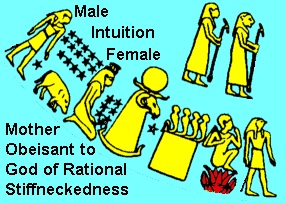
 of posterity.On the Denderah stone the Sextant is shown as the maiden Selket holding a bow in her hands under the front paws of the lion. Her arrow is pointed directly over the ruminating Hathor, through the double crown on the head of Horus, through the white crown on the Cocky Man, and directly into the center of the sun disk on the horns of the stiff necked Ram.

It seems that the heavens and the ancients have conspired to hit a "bull's eye" over a period of two thousand cycles of the earth around the sun. Extend the scepter in the hand of Venus to realize that it passes through the boundary between Cancer and Leo to the hand on the bow of the maiden. Try to imagine the improbability of these events. The one acceptable answer is that Love itself defrocked the Mother of us All. 


She guided the progress of civilization during two thousand years of denial of our cosmic umbilical cord, so that she could prove her wisdom to be far superior to any Great Man with assertive intuition. On the stone, Venus guided the hand of the maiden as her arrow was let loose to find its mark in the enlightenment of the stiff necked ram. Two thousand years later, the heavens wrote the same message as Venus (love) returned to steer the stars.


=========


                                       Denderah Zodiac (19th-century engraving)


Its representation of the zodiac in circular form is unique in ancient Egyptian art. More typical are the rectangular zodiacs which decorate the same temple's pronaos.

The celestial arch is represented by a disc held up by four pillars of the sky in the form of women, between which are inserted falcon-headed spirits. On the first ring, 36 spirits symbolize the 360 days of the Egyptian year. 


At the center of the Hathor vignette and the Denderah zodiac is the image of Tauret. She is a pregnant hippopotamus who wears cow horns and a crocodile skin cloak. In the heavens, she is the Sun Dragon, Draco, which marks the north axis of the ecliptic plane. 

The cloak around Draco is the Milky Way. The crocodile can be seen in the Milky She protects 
her children within her mouth.Way with an open mouth through which the swan Cygnus, the fox Vulpecula, and the Eagle Aquila are moving. Coming out of the mouth of the crocodile is the end of the tail  of Serpens. Also, within the mouth is the child Antinous, or Horus the son of Isis and Osiris. Like a river crocodile, Tauret protects in the Kingdom of Heaven.


The purpose of Hathor as Mother Nature is to provide the budding life with an opportunity for receiving abundance.

That is the message written in the Denderah monument, the vignette to Hathor, and the Tauroctony of Mithras. Finding the truth in that message is the method of the sacred sciences. 

We can search throughout the whole universe for truth. But, when it comes, it will come from the same places where it had come before. When we listen to the Fables of the Ancients, the future will unfold as a resurrection of the past. That is the mystery of teleology.


Stretching 
the cord with Seshat.These versus put into words what the Denderah architects put into stone. The axis of the Denderah stone is coincident with the axis of the temple. The clear implication is that the temple was designed to be aligned with human knowledge. The one with greater wisdom than the Queen of Sheba is the wife of Thoth, Seshat. Seshat is the Egyptian Fairy Godmother. Her powers of cause and effect for any affectation were legendary before the founding of Egypt. In a temple constructed during Hatshepsut's reign, queen Hatshepsut is shown directing Thoth to go speak to Seshat to find the answers to his questions. Seshat was the origin of all the wisdom of Thoth. 


Seshat is the feminine consort/counterpart/wife of Thoth the Scribe, he who wrote the story/program of humanity's journey through time. She is a Magician, as is Isis, Thoth, Hermes, etc. Seshat bore the title 'Egyptian Fairy Godmother'. Her magic wand, with its seven pointed star, was the symbol which represented the source of all creative ideas, consciousness. Her powers of cause and effect for any affectation were legendary before the founding of Egypt


- The Tree Of Life -

Seshat was the essence of cosmic intuition, creating the geometry of the heavens alongside Thoth. In Egyptian mythology, Seshat was originally the deification of the concept of wisdom, and so became a goddess of writing, astronomy, astrology, architecture, and mathematics.

She was known as 'Mistress of the House of Books', indicating that she also took care of Thoth's library of spells and scrolls. She is the patron of libraries and all forms of writing, including census and accounting work. Seshat was the only female that has been found (so far) actually writing.


Seshat was the mistress of measure. Whenever a new project was undertaken, the Egyptian priests enacted the interplay of Seshat at the creation of the cosmos by the ceremony of the stretching of the cord. Her magic wand with its seven pointed star was the symbol which represented the source of all creative ideas. Being wise before Thoth, she was also wise before Solomon. Notice that the Great Man, User-Maat-Re, wears the atef crown in the stretching of cord scene in the adjacent vignette. He is shown on the temple axis as a man with Thoth's atef crown. 


This is the meaning of the Queen of Sheba and her visit with Solomon. Solomon had stretched the cord with Seshat. Solomon's wisdom could only be tested by Seshat, the Queen of Sheba, for she was the first to become inspired and she gave her treasures to Solomon, i.e. User-Maat-Re. It is interesting to note that the name She-ba means feminine spirit in English. Without question, Seshat was the queen of feminine spirits.


The seven messages of Seshat are echoed in the story of the conquest of Jericho by Joshua's seven trips around the wall of the city, and by the seven soundings of trumpets. When any initiate can make the victory sound for understanding each of the seven sacred spirits, the complete Wall of the Ruler will come tumbling down. The four elements and the three ingredients for communication are the seven points on Seshat's wand. 

These seven are demonstrated at the boundaries of Aries and Pisces and Capricorn and Sagittarius on the Denderah.
============
Here we recognize in the modern Judeo-Christian scriptures a principle reflected in the Denderah stone. When the Queen of Sheba visited Solomon (sun-man, Great Ruler) she brought the power of intuition. After Solomon, the flower of woman's intuition was no longer admired. This is recorded in the words of I Kings, and on the whole east side of the disk of the Denderah stone.

===========
I Kings 10:1-5 
1  And when the queen of Sheba heard of the fame of Solomon concerning the name of the LORD, she   came to prove him with hard questions.
2  And she came to Jerusalem with a very great train, with camels that bare spices, and very much gold, and precious stones: and when she was come to Solomon, she communed with him of all that was in her heart.
3  And Solomon told her all her questions: there was not any thing hid from the king, which he told her not.
4  And when the queen of Sheba had seen all Solomon's wisdom, and the house that he had built,
5  And the meat of his table, and the sitting of his servants, and the attendance of his ministers, and their apparel, and his cup bearers, and his ascent by which he went up unto the house of the LORD; there was no more spirit in her.
================

When it had come to pass that "there was no more spirit in her," Western Civilization crossed that boundary which is the deflowering of motherhood, and the loss of belief in fairy godmothers. The altar of four serpents became an altar of four rams. The Denderah stone tells us why.

The scriptures keep the reason a secret, and imply that the use of intuition had no more value. All that was worthy of being known had already been learned, and the time for controlling action was at hand. Western Civilization had matured to the point where it had to attempt to make it on the record at hand; the Book of Life. This is the stage of adolescence. The consciousness of Western Civilization marched to a different drum beat as it began to be about its Father's Business.

The Great Man's umbilical cord to Seshat, which is Western Culture, has now broken away, and it is time to get back to truthful cosmic consciousness once more. Capricorn has the spirit name "I Use." During the application of man made material laws and the implementation of his "order of law," the goddess of intuition makes her meaning clearly understood. When our laws fail us, we must resort to creative solutions. These always come to us by gut feel, or intuition, which are in the wand of Seshat, and the hands of Osiris-Seker, Sculptor.


Source:
Denderah Zodiac and the Solar Eclipse on August 11, 1999

============
Serpent Holder
============

The serpent holder ( as it was known as) bearing the thirteenth position, could have been feared taboo along with the man holding the serpent.


Ophiuchus holding the serpent, Serpens, as depicted in Urania's Mirror, a set of constellation cards published in London c.1825. Above the tail of the serpent is the now-obsolete constellation Taurus Poniatovii while below it is Scutum.

 
On the Denderah stone, the planet Saturn stands between Libra and Virgo. When the monument was designed the existence of the planet Pluto was not known. Saturn was recognized by the ancients as the "Ancient of Days." Thus, Saturn's position defines a Last Judgment. During the eclipse of August 11, 1999, the planet Pluto was located under the hand of Ophiuchus nearest Libra. This is the location of the hand of Ra holding the scepter on the Denderah stone between Scorpio and Libra. 

The position of Mars at the apex of the balance in Libra on August 11, 1999 tells us that it is the rational aspects of the cosmos that are on trial in the hall of the last judgment. The decision to be made is whether the rational being will be born to a new truth, or will it descend to the valley of shadows with a chance to dream a new dream in the dungeon of the Cosmic King. 
 
The decision has two possible outcomes, as shown at Libra. One leads to the jackal at the hand of Tauret. This is a return to the material source scenario, for she represents the material aspects of motherhood in the solar system and the galaxy. It is the path of starting from the beginning, again. 

The second outcome is through Virgo who shows the way with the light of wisdom (Mercury) held toward the Kingdom of Heaven. This route will result in no more judgments, for it passes through the "ancient of days." Being born of the Virgin will lead the child on the balance to become a Prince of Peace in the Kingdom of Heaven. 

In front of Leo and on top of the Cow of Hathor, which symbolizes Mother Earth, stands the icon of Jupiter. The implication is that the Prince of Peace will become the Ruler of an abundant World, for Taurus on the other side of Jupiter is looking toward the Lion with a beckoning glance.
===============


The sculptured Dendera zodiac (or Denderah zodiac) is a widely known Egyptian bas-relief from the ceiling of the pronaos (or portico) of a chapel dedicated to Osiris in the Hathor temple at Dendera, containing images of Taurus (the bull) and the Libra (the scales).


The zodiac is a planisphere or map of the stars on a plane projection, showing the 12 constellations of the zodiacal band forming 36 decans of ten days each, and the planets. These decans are groups of first-magnitude stars. These were used in the ancient Egyptian calendar, which was based on lunar cycles of around 30 days and on the heliacal rising of the star Sothis (Sirius).